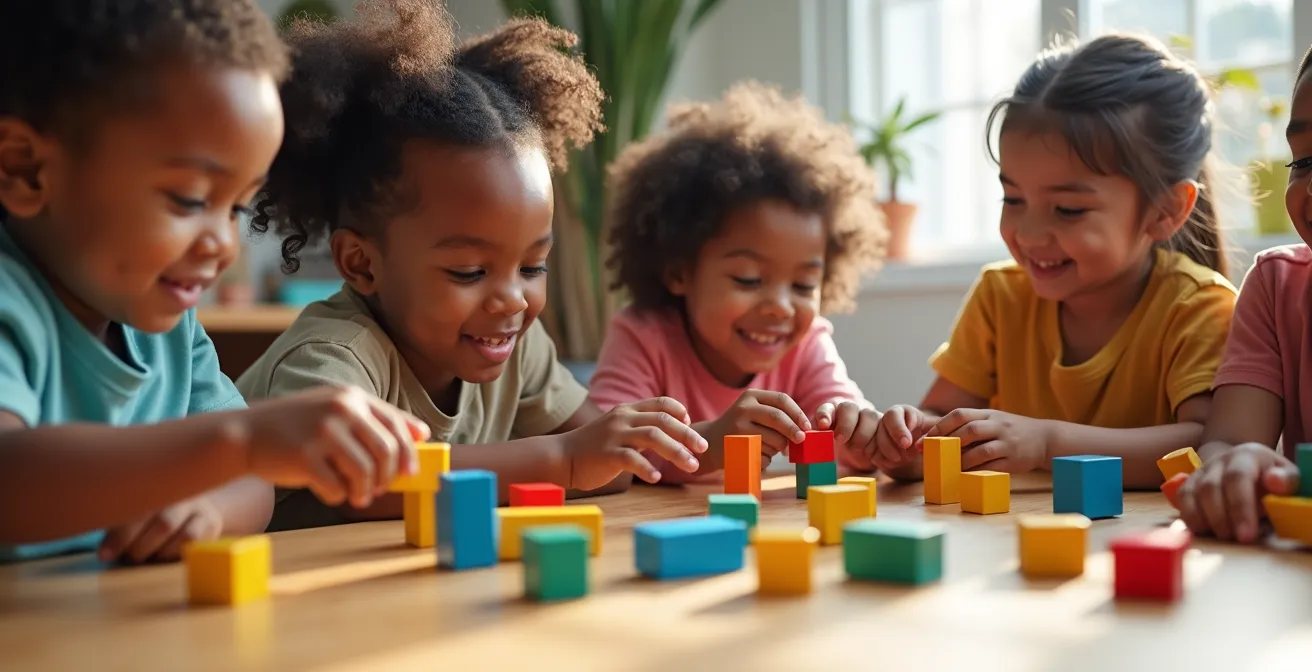
Pushing worksheets to boost a child’s STEM readiness is a fundamental misunderstanding of how their brain actually builds long-term knowledge.
- Child-led play builds flexible, problem-solving neural pathways, while worksheets often encourage rigid, short-term memorization.
- Emotionally rich, experience-based learning creates durable, multi-sensory memories that are essential for applying concepts later on.
Recommendation: Prioritize creating “invitations to play” with open-ended materials over structured drills to foster the genuine curiosity and cognitive flexibility that underpin true, lifelong STEM capability.
The pressure on parents starts early. You see another parent’s post about their four-year-old completing math worksheets, and a quiet anxiety begins to bubble. In a world obsessed with academic achievement and getting ahead, the push for structured learning—even in preschool—feels relentless. The conventional wisdom suggests that rigor and formal exercises are the fast track to a STEM-ready mind. We are led to believe that a child sitting quietly with a worksheet is a child who is learning productively.
But what if this rush toward formalization, this “schoolification” of early childhood, is not only less effective but actively counterproductive? What if the messy, chaotic, and joyful process of play is not a break from learning, but the most powerful and efficient learning engine a child has? This isn’t a sentimental belief; it’s a conclusion increasingly supported by neuroscience. The key to unlocking a child’s potential in science, technology, engineering, and math doesn’t lie in memorizing answers, but in building a brain that knows how to ask questions and test theories.
This article will dismantle the myth that worksheets are superior for academic readiness. We will explore the neurological mechanisms that make imaginative play a superhighway for brain development, explain how to set up environments that spark deep, focused learning, and reveal why experience-based memories are fundamentally more durable than rote memorization. Finally, we will provide a clear path for transitioning from play to the classroom, empowering you to advocate for your child’s true, lasting cognitive development.
To understand why play is so critical for building a scientifically-minded brain, it is essential to delve into the very architecture of childhood learning. The following sections break down the neurological evidence, offer practical strategies for parents, and provide a framework for confidently choosing play over pressure.
Summary: Why Play-Based Learning Is a Neurological Necessity for STEM
- Why Neural Connections Multiply Faster During Imaginative Play?
- How to Set Up “Invitations to Play” That Spark Deep Focus?
- Memorization vs. Experience: Which Stick Longer in a Child’s Memory?
- The “Schoolification” Mistake That Kills Natural Curiosity by Age 6
- When to Introduce Structure: Transitioning from Play to Classrooms Smoothly
- Why the First 1,000 Days Are Critical for Your Child’s Future IQ?
- Why Immediate Praise Works Better Than Delayed Rewards for ADHD Brains?
- How to Secure Your First Choice State School in a Competitive Catchment Area?
Why Neural Connections Multiply Faster During Imaginative Play?
A young child’s brain is not an empty vessel waiting to be filled with facts; it’s a dynamic, rapidly growing network. In fact, neuroscience research reveals that during the first years of life, over 1 million new neural connections form every second. This period of explosive growth establishes the foundational neural architecture that will support all future learning. The question for parents isn’t just *what* the child is learning, but *how* efficiently their brain is building these critical pathways. This is where play demonstrates its profound neurological advantage.
Rote learning, typical of worksheets, engages a limited part of the brain. It’s a slow, repetitive process. Imaginative play, however, is a full-brain workout. When a child pretends a cardboard box is a spaceship, they are simultaneously engaging in spatial reasoning, narrative creation, problem-solving (“How do I fix the engine?”), and emotional regulation. This multi-modal engagement is neurologically potent. As Dr. Karyn Purvis, a renowned child development expert, explains, this efficiency is staggering. In her work on integrating neuroscience into early education, she highlights the difference:
Scientists have discovered that it takes approximately 400 repetitions to create a new synapse in the brain, unless it is done in play, in which case it only takes 10 to 20 repetitions.
– Dr. Karyn Purvis, The Importance of Integrating Neuroscience into Early Childhood Education
This isn’t magic; it’s brain chemistry. Play floods the brain with hormones like dopamine and oxytocin, which reduce stress and enhance neural plasticity, making the brain more receptive to forming and strengthening connections. A worksheet provides a single, correct answer. Play provides a thousand possibilities, forcing the brain to become more flexible, creative, and resilient—the very definition of a STEM-ready mind.
How to Set Up “Invitations to Play” That Spark Deep Focus?
Knowing play is powerful is one thing; facilitating it effectively is another. The goal isn’t to leave a child in a room full of toys and hope for the best. Instead, the most effective approach is to create “invitations to play” or “provocations.” These are thoughtfully arranged setups of materials that spark curiosity and encourage exploration without dictating the outcome. This method moves beyond simple observation and encourages children to test, revise, and use evidence to communicate their ideas—core STEM practices identified by research from the InterPLAY Framework.
An invitation to play is not about providing answers but about posing an open-ended question through materials. Think of it as setting a stage for discovery. Instead of a coloring sheet of a flower (one outcome), you might provide clay, petals, leaves, and small sticks (infinite outcomes). The child is now an engineer, a scientist, and an artist, all at once. This approach respects the child’s intelligence and fuels their intrinsic motivation, leading to periods of deep, sustained focus known as “flow state.”

The key is to use open-ended materials—items that can be used in multiple ways. This is where the “Loose Parts Theory” comes in, encouraging the use of everyday objects like screws, bolts, fabric scraps, and natural items. These materials invite manipulation and experimentation, building foundational engineering and analytical skills far more effectively than a pre-filled worksheet.
Your Action Plan: Setting Up a STEM Provocation
- Create an ‘unsolved problem’: Provide ramps, balls of different weights, and a measuring tape. Pose the question: “How can you make the ball roll the farthest?” Let them experiment with angles and force.
- Apply Loose Parts Theory: Collect a “tinkering tray” with screws, bolts, wood scraps, and fabric. Provide simple tools and let them explore construction and deconstruction without a specific goal.
- Set up Task Deconstruction: Offer an old keyboard, a broken toy, or a simple pulley system. The challenge is simply to figure out how it works by taking it apart, fostering reverse engineering skills.
- Design subject-specific invitations: For Science, a tray with oil, water, and food coloring. For Technology, a broken flashlight with new batteries nearby. For Engineering, straws and tape. For Math, natural items like shells and stones to sort and count.
Memorization vs. Experience: Which Stick Longer in a Child’s Memory?
The fundamental flaw of a worksheet-heavy approach lies in the type of memory it builds. Worksheets primarily develop semantic memory—the recall of context-free facts, like “2+2=4.” While useful, this type of memory is shallow and easily forgotten if not constantly reinforced. Play, on the other hand, builds deep, rich episodic memory, which is tied to personal experiences, emotions, and sensory input. It’s the difference between memorizing the definition of “gravity” and feeling the thud of an apple you dropped from a chair.
When a child learns through a multi-sensory, emotionally-tagged experience, the brain encodes that memory differently. It’s stored across multiple brain regions and is far more durable and accessible for future problem-solving. This is why play-based learning can boost information retention by up to 70%. The learning isn’t an abstract fact; it’s a lived story. This process also builds motor memory through physical manipulation, permanently encoding skills in a way that simply circling an answer on a page cannot.
The following table, based on our understanding of cognitive science, breaks down how these memory systems are engaged differently by worksheets versus hands-on, play-based experiences. It clearly illustrates why one leads to temporary knowledge and the other to lasting comprehension.
| Memory Type | Worksheet Learning | Play-Based Experience |
|---|---|---|
| Semantic Memory | Relies on recalling context-free facts (e.g., naming shapes). | Grasps concepts through multi-sensory interaction (e.g., feeling the corners of a block). |
| Episodic Memory | Offers limited emotional engagement, making memory less “sticky.” | Creates rich, emotionally-tagged memories that are highly durable (e.g., the joy of a tower not falling). |
| Motor Memory | Involves minimal physical action, mostly writing or circling. | Develops “embodied cognition” through physical manipulation, leading to permanent skill encoding. |
In essence, worksheets teach a child to find the right answer. Play teaches a child how to think, experiment, and derive the answer for themselves. For STEM subjects, where applying knowledge to new problems is paramount, the choice is clear. You want a child who doesn’t just know that triangles have three sides but who has intuitively discovered principles of structural integrity by trying to build a stable tower.
The “Schoolification” Mistake That Kills Natural Curiosity by Age 6
The trend of pushing formal academic structures onto younger and younger children—a phenomenon known as “schoolification”—stems from good intentions but is rooted in a deep misunderstanding of child development. It mistakes performance for learning and compliance for engagement. When the focus shifts to getting the right answer, avoiding mistakes, and pleasing the adult, the child’s natural drive to explore, question, and take risks is extinguished. This is especially damaging for fostering a STEM mindset, which thrives on experimentation and failure.
The long-term consequences are concerning. When learning is framed as a performance, children develop a “fixed mindset,” believing their intelligence is a static trait. They become afraid to try challenging things for fear of “looking dumb.” As Stanford psychologist Carol S. Dweck notes in her foundational research on mindsets:
Students in a fixed mindset were more concerned with feeling smart in the short run at the expense of learning and becoming smarter in the long run.
– Carol S. Dweck, Growth Mindset and the Future of Our Children
This pressure to perform early creates anxiety and disengagement. It teaches children that there is one right way to do things, a concept antithetical to scientific innovation. The result? By the time they reach high school, many students have lost their spark. Sobering data shows that the current approach is failing to build the pipeline of innovators we need, as research shows that only 20% of high school graduates are prepared for college-level coursework in STEM fields. The problem doesn’t start in high school; it begins when a child’s natural curiosity is replaced by a fear of red ink on a worksheet.
Play, in contrast, is the natural incubator of a “growth mindset.” In play, there are no mistakes, only unexpected outcomes. A collapsed block tower isn’t a failure; it’s a data point that informs the next attempt. This process builds resilience, perseverance, and a love for challenges—the true foundations of a successful scientist, engineer, or innovator.
When to Introduce Structure: Transitioning from Play to Classrooms Smoothly
The argument for play-based learning is not an argument against all structure. Rather, it’s about introducing structure in a developmentally appropriate way that builds upon, rather than replaces, a child’s natural curiosity. The transition from pure, unstructured play to more formal learning is a delicate dance, best guided by the concept of “scaffolded play.” This approach, rooted in Vygotsky’s theory of the “Zone of Proximal Development,” involves an adult gently guiding and extending a child’s play to introduce new concepts and skills.
Scaffolding isn’t about taking over; it’s about being a thoughtful co-explorer. If a child is building a tower, the adult doesn’t provide a blueprint. Instead, they might ask an open-ended question like, “Your tower is very tall! I wonder what would happen if we tried to make it stronger?” As research on adult-scaffolded play shows, these guided interactions help children develop proactive control and executive functions by pushing them to think just beyond their current capabilities.
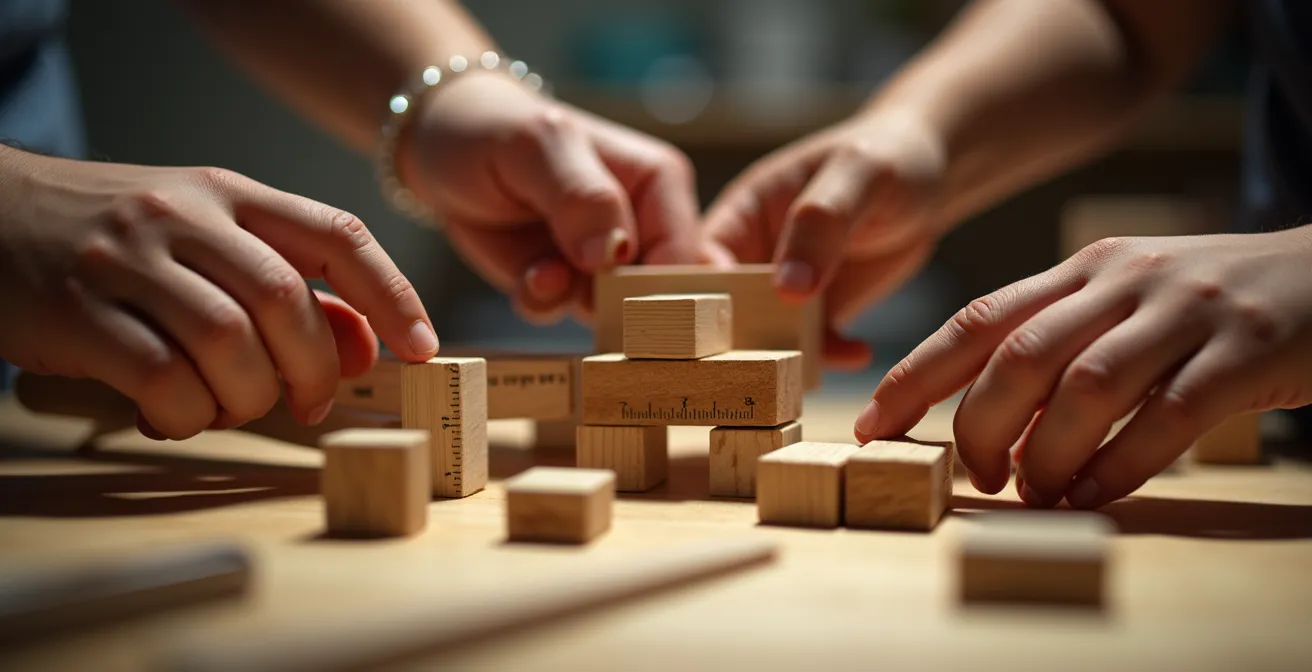
This gradual process helps bridge the gap between free exploration and the demands of a classroom. The adult can begin to introduce STEM vocabulary naturally (“Let’s *predict* which car will be faster”), add tools for measurement, and help the child articulate what they have learned (“I solved the wobbly bridge problem by creating a wider base”). This turns implicit discovery into explicit knowledge.
The progression should be fluid and follow the child’s lead, moving from unstructured play toward more structured games with embedded rules. For example, a child’s free play with sorting shells by color can be scaffolded into a game of creating patterns (a math skill) and then into a simple board game with rules about collecting different types of shells. This method honors the child’s autonomy while systematically building the cognitive skills—like following directions and understanding symbolic representation—needed for a smooth transition to school.
Why the First 1,000 Days Are Critical for Your Child’s Future IQ?
The time from pregnancy to a child’s second birthday—roughly the first 1,000 days—is the single most important period of brain development. During this window, the brain grows at a pace never to be repeated, laying the groundwork for all future cognitive, social, and emotional functioning. By age three, a child’s brain has around 1,000 trillion synapses, or connections—twice as many as an adult. The experiences a child has during this time determine which of these connections are strengthened and which are pruned away.
Simple, repetitive, physical play is the primary driver of this foundational brain-building. Activities that seem basic to an adult are, in fact, complex physics experiments for an infant and toddler. When a baby repeatedly drops a toy from their high chair, they are testing the laws of gravity. When they crawl, they are developing spatial awareness and an internal GPS. When they stack blocks, they are learning about balance, weight distribution, and cause-and-effect.
Research confirms that this early motor development is directly correlated with later STEM comprehension. The physical act of grasping, rotating, and manipulating objects builds a foundational, embodied understanding of how the physical world works. Furthermore, these activities stimulate myelination, the process of coating nerve fibers with a fatty sheath that allows nerve impulses to travel faster. Efficient neural pathways in motor and sensory areas of the brain provide a high-speed network that later supports more abstract thinking in subjects like geometry and physics. A child who has a rich physical understanding of space is better equipped to later understand that space on a graph.
Ignoring the importance of this early, play-based sensory and motor exploration in favor of premature academic drills is like trying to build a skyscraper without first laying a solid foundation. The first 1,000 days are when that concrete is poured and set, almost entirely through play.
Why Immediate Praise Works Better Than Delayed Rewards for ADHD Brains?
While this article focuses on all children, examining how a brain with ADHD learns provides a powerful lens for understanding a universal principle: the power of immediate, intrinsic feedback. Children with ADHD often struggle with executive functions and have a dopamine system that responds more strongly to immediate reinforcement than to delayed rewards. A sticker at the end of the week is far less motivating than the immediate satisfaction of a successful experiment. And what is play, if not a constant stream of immediate feedback?
When a child builds a block tower and it stands, the reward is intrinsic and instantaneous. The tower itself is the prize. When it falls, the feedback is also immediate, prompting a new strategy. This rapid-fire cycle of action, feedback, and adaptation is perfectly attuned to how the human brain, and especially the ADHD brain, learns best. It keeps the mind engaged and floods the dopamine pathways in a way that a worksheet with a delayed grade cannot replicate.
Worksheets often represent the opposite: a delayed, external, and often arbitrary reward system. The feedback is disconnected from the action. This can be particularly demotivating for a child who struggles with sustained attention. In contrast, play-based learning is a self-regulating, self-motivating system. It also helps build crucial emotional skills. Studies show that children who play regularly show a 60% improvement in emotional regulation. They learn to manage frustration when a structure collapses and to persevere toward a goal.
This ability to self-regulate is a core executive function, and its lack is a major hurdle not just for children with ADHD, but for any student facing a complex STEM problem. By understanding the ADHD brain’s need for immediacy, we gain a clearer appreciation for why play-based learning is a more neurologically aligned approach for *all* children. It builds the very skills of focus, persistence, and frustration tolerance that worksheets often fail to address.
Key Takeaways
- Play is a neurologically efficient process, creating new brain synapses with 20 times fewer repetitions than rote learning.
- Learning through experience creates “episodic memories” that are emotionally tagged and far more durable than the “semantic memory” built by worksheets.
- The role of the parent or educator is not to direct learning but to act as a “scaffolder,” creating rich environments and asking questions that extend a child’s natural exploration.
How to Secure Your First Choice State School in a Competitive Catchment Area?
The ultimate test for many parents comes when it’s time to transition to formal schooling. In a competitive environment, how do you convince a school that your child, who has spent their time building mud-pie empires instead of filling out phonics worksheets, is ready to learn? The key is to reframe their play experiences into the language of academic skills. You must become a translator, documenting and presenting their play-based achievements as evidence of their foundational STEM readiness.
This is where creating a “play-based learning portfolio” becomes an invaluable tool. Instead of a folder of completed worksheets, you will have a collection of photos, short videos, and anecdotes that showcase your child’s developing cognitive skills in action. This portfolio provides concrete evidence that your child has mastered the underlying competencies that predict school success far more accurately than memorized facts. As studies like the 2020 Bristol study have shown, schools that embrace these methods see improved engagement and a better recognition of children’s foundational skills.
Here is how you can document your child’s play to build a compelling portfolio:
- Document projects with photos: Take pictures that show the progression of a building project, from initial failure to final success, to demonstrate problem-solving and persistence.
- Translate play into academic language: ‘Making mud pies’ becomes ‘early chemistry and material properties experimentation.’ ‘Building a fort’ is ‘structural engineering and spatial reasoning.’
- Capture video evidence: A short clip of your child deeply focused on a building challenge is powerful proof of their ability to sustain attention (an executive function skill).
- Record social skills: Note down examples of peer collaboration, negotiation, and conflict resolution during play, as these are critical for classroom success.
- Showcase executive function: Highlight a complex, multi-step project they completed over several days, demonstrating planning and goal persistence.
When you meet with a school, you are not just saying, “My child played a lot.” You are presenting evidence: “Here is a video of my child demonstrating frustration management while solving a complex engineering problem they set for themselves.” This approach shows that you are an engaged and informed parent who understands the *process* of learning, not just the performance of it. It positions your child as a curious, resilient, and self-motivated learner—exactly the kind of student every great school wants.
By trusting the process of play and learning to articulate its profound benefits, you are not just preparing your child for school; you are equipping them with the cognitive flexibility, resilience, and innate curiosity to thrive in a complex, ever-changing world. Begin today by observing, documenting, and celebrating the incredible learning happening in your child’s every moment of play.