
The secret to a calm family isn’t a more rigid, color-coded schedule; it’s a flexible ‘Family Operating System’ designed to reduce friction.
- Effective routines manage the family’s energy and attention, not just their time.
- Predictability lowers stress hormones in children, making them more cooperative.
Recommendation: Instead of adding more rules, start by auditing one week to identify and eliminate a single activity that drains your family’s joy.
For most working parents, the daily grind feels less like a smooth operation and more like a series of chaotic sprints. From the frantic morning rush to the exhausting bedtime battle, the feeling of being overwhelmed is constant. The common advice is to “be more organized” or “stick to a schedule,” which often translates into creating rigid, complex timetables that crumble at the first sign of a lost shoe or a toddler’s tantrum. This approach treats the family like a machine that needs stricter programming, when in reality, it’s a dynamic, living organism.
The pressure to manage school schedules, work deadlines, extracurriculars, and household chores can feel immense. We try to implement charts and apps, but these tools often become another source of stress—one more thing to manage. What if the problem isn’t a lack of tools, but a flawed strategy? What if the key to a calmer home isn’t about enforcing a rigid routine, but about designing a flexible, responsive Family Operating System (FOS)?
This guide reframes the challenge. Instead of just giving you a list of tasks, we will adopt the mindset of a project manager. We’ll analyze the ‘why’ behind children’s need for structure, learn how to build a system that even a toddler can understand, and discover how to audit your schedule to reclaim time and joy. This approach moves beyond simple time management to focus on what truly matters: managing energy, eliminating friction, and creating a family life that feels less like a stressful project and more like a connected team.
Summary: A Project Manager’s Framework for Family Harmony
- Why Kids Behave Better When They Know What Happens Next?
- How to Create a Visual Calendar That Toddlers Can Actually Understand?
- Routine vs. Rhythm: Which One Works Best for Creative Families?
- The Overscheduling Error That Kills Spontaneity and Joy
- When to Prep for the Week: The 1-Hour Sunday Ritual That Saves Mornings
- When to Start Positive Parenting: The 3 Signs Your Family Needs a Reset
- Why Hunger and Fatigue Destroy Self-Control in Even the Best Kids?
- How to Reclaim 5 Hours a Week from Your Hectic Family Schedule?
Why Kids Behave Better When They Know What Happens Next?
A child’s brain is not wired for abstract time management. For them, the world is a series of events, and when the sequence of those events is unpredictable, it creates underlying anxiety. This isn’t a sign of defiance; it’s a biological response to uncertainty. A predictable routine acts as a cognitive map, helping a child navigate their day with confidence. When they know that bath time always follows dinner, their brain isn’t wasting energy wondering, “What’s next?” This frees up their mental resources, reducing the likelihood of meltdowns caused by overwhelm or surprise transitions.
This isn’t just a parenting theory; it’s backed by science. Predictability helps regulate a child’s internal stress systems. A 2024 study on childcare environments found a direct link between routine and stress hormones. The effect is significant: in Norway, a study found that for 87% of toddlers in disorganized childcare groups, cortisol levels were considerably higher throughout the day. In contrast, children in structured settings with stable routines had lower stress levels, not just in care but also at home. The researchers noted that these routines are a form of temporal and spatial orientation for children.
From a project manager’s perspective, this means the first step in designing your Family Operating System is establishing clear, consistent anchor points. These are the non-negotiable pillars of the day (like waking up, meals, and bedtime) that provide the scaffolding for everything else. By stabilizing these key moments, you reduce the cognitive load on your child, which directly translates to better mood, increased cooperation, and fewer stress-induced behavioral issues.
How to Create a Visual Calendar That Toddlers Can Actually Understand?
For a pre-literate child, a standard calendar or a to-do list is meaningless. To them, “We have swimming lessons at 4 PM” is an abstract concept. The key is to create a user interface (UI) that they can read and interact with. This means moving beyond words and numbers and embracing tangible, visual cues. The goal is to represent the flow of the day in a way that allows them to “see” what is coming next, giving them a sense of control and ownership.
Instead of a written chart, consider a “sequence board.” This can be a simple strip of velcro on the wall or a magnetic board. The magic is in the items you attach to it: a picture of a toothbrush for “brush teeth,” a photo of their school for “school day,” or a small rubber duck for “bath time.” For an even more powerful, tactile experience, you can use real objects. A small box for each part of the day containing a miniature representation of the activity. This approach engages multiple senses and is far more memorable for a young child.
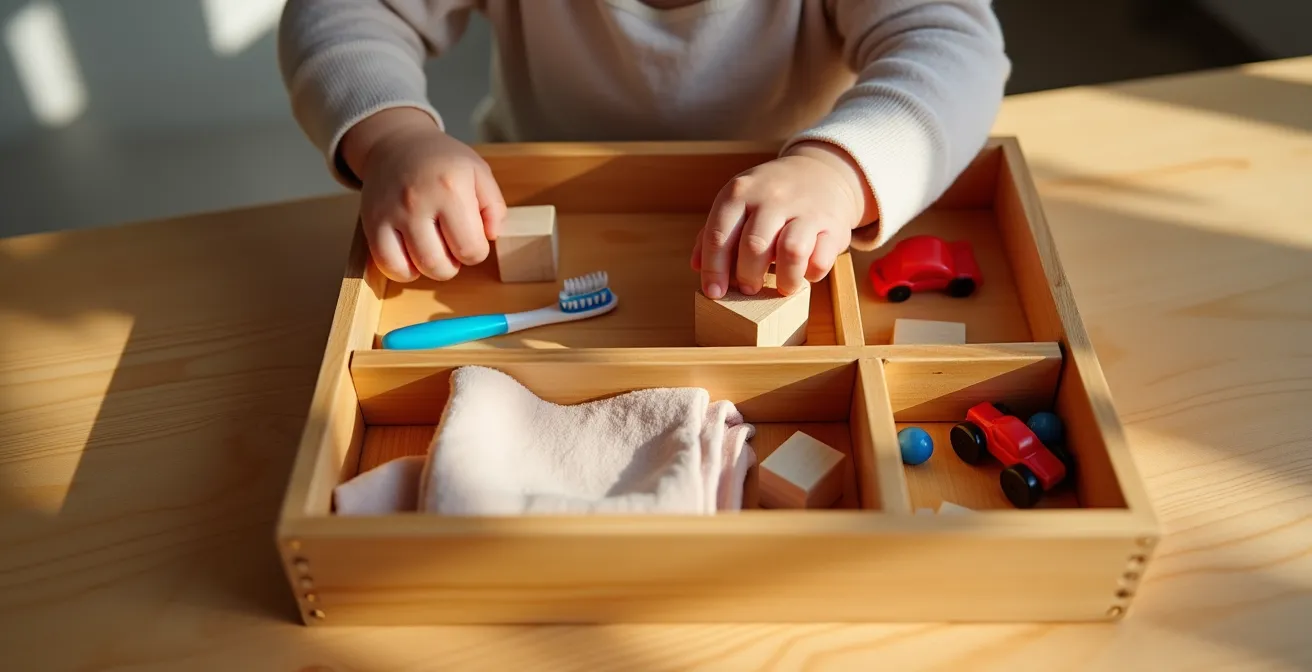
As the illustration shows, using tangible objects transforms the routine from a parental directive into an interactive game. The child isn’t just being told what to do; they are actively participating in organizing their day. They can move the object for the completed task into a “done” basket, providing a clear sense of accomplishment. This visual and physical feedback loop is incredibly powerful for reinforcing the sequence of events and making your family’s routine something they are excited to follow, rather than something they resist.
Routine vs. Rhythm: Which One Works Best for Creative Families?
Children cannot tell time, therefore they rely on daily cues – routines – to understand their day
– Family Development Specialists, Just a Basic Mama Family Blog
The words “routine” and “rhythm” are often used interchangeably, but for a family project manager, the distinction is critical. A routine is often time-based and rigid: breakfast is at 7:00 AM sharp, followed by getting dressed at 7:30 AM. A rhythm, on the other hand, is sequence-based and flexible: we have a “morning block” that includes breakfast, getting dressed, and brushing teeth, but the exact timing and order can flow more organically. Understanding this difference is key to designing a system that serves your family instead of constraining it.
For some families, especially those with children who thrive on high predictability, a strict routine can be a lifesaver. It eliminates all decision-making and provides a very clear structure. However, for many others, particularly creative families or those with fluctuating work schedules, a rigid routine can feel like a straitjacket. It creates stress when life inevitably gets in the way. This is where a rhythm shines. A rhythm focuses on key “anchor points” throughout the day (e.g., meal times, quiet time, bedtime) but allows for flexibility and spontaneity in the spaces between.
Choosing the right model depends entirely on your family’s personality and needs. There is no one-size-fits-all solution. Analyzing the core differences can help you architect the right system for your home, as this breakdown shows.
| Aspect | Routine | Rhythm |
|---|---|---|
| Time Structure | Fixed time slots (7:00 AM breakfast) | Time blocks (morning breakfast window) |
| Flexibility | Low – specific order of activities | High – fluid transitions between anchors |
| Best For | Families needing high predictability | Creative families valuing spontaneity |
| Anchor Points | Every activity scheduled | 3-4 non-negotiable anchors only |
| Stress Level | Lower for structure-seekers | Lower for flexibility-seekers |
Ultimately, the goal is to find a balance. You might have a stricter routine for school mornings and a more fluid rhythm for weekends. The key is to be intentional about your choice, designing a system that reduces friction rather than creating it.
The Overscheduling Error That Kills Spontaneity and Joy
In our quest to provide the best for our children, we often fall into the “overscheduling trap.” We fill their days with structured activities—sports, music lessons, tutoring—believing that a busy child is a successful child. However, this approach often backfires. A schedule packed to the minute leaves no room for boredom, which is the fertile ground for creativity and imagination. It also eliminates the downtime the nervous system needs to rest and recharge, leading to children (and parents) who are perpetually exhausted, irritable, and disconnected.
The overscheduling error stems from viewing the family schedule as a list of assets to accumulate (more activities = better). A project manager sees it differently: the schedule is a system with limited capacity. Overloading any system leads to breakdown. The most critical, yet often un-scheduled, item is unstructured free time. This isn’t just “doing nothing”; it’s a vital component for mental health, problem-solving, and strengthening family bonds. It’s the time when spontaneous games happen, deep conversations emerge, and kids learn to entertain themselves.
But how do you know if you’re overscheduled? The answer isn’t in a productivity app; it’s in your family’s emotional state. The key is to regularly audit your system for its impact on joy and energy. By systematically reviewing your commitments, you can make data-driven decisions about what to keep and what to let go of, ensuring your schedule serves your family’s well-being.
Your Weekly Joy Audit: A 5-Step Checklist
- Rate the Week: As a family, rate the past week’s joy level on a scale of 1-10. This creates a simple, shared metric.
- Analyze Energy Flow: List all scheduled activities. Next to each, mark whether it brought energy (+) or drained energy (-).
- Identify Highlights: Pinpoint 3 specific things everyone loved about the week. Were they scheduled activities or spontaneous moments?
- Eliminate a Drain: Identify one activity that consistently drained energy. Discuss as a family if it can be eliminated or reduced for the upcoming week.
- Schedule Freedom: Block out a chunk of unstructured free time on next week’s calendar and treat it as a non-negotiable appointment.
This simple audit shifts the focus from “what can we add?” to “what is truly serving us?” It’s a powerful tool for intentionally curating a life that prioritizes connection and joy over the appearance of productivity.
When to Prep for the Week: The 1-Hour Sunday Ritual That Saves Mornings
The most chaotic moments in family life are rarely a surprise. The frantic search for a missing shoe, the last-minute realization that a permission slip wasn’t signed, the “I have nothing for lunch” panic—these are predictable friction points. A project manager knows that the best way to handle recurring problems is to solve them upstream. This is the power of the “1-Hour Sunday Ritual”: a concentrated burst of preparation that smooths out the entire week ahead.
This isn’t about deep cleaning the house or meal prepping for seven days. It’s a targeted, strategic session focused on eliminating the most common sources of morning chaos. The goal is to front-load decisions and tasks to a time when you are calm and have mental bandwidth, rather than dealing with them in the high-stress environment of a weekday morning. By creating a “launch pad” area, you centralize everything needed for the next day, turning the morning departure from a frantic scavenger hunt into a simple grab-and-go operation.

This organized entryway is the physical manifestation of a successful Sunday ritual. Backpacks are packed, shoes are ready, and the next day’s requirements are visually accounted for. This simple system eliminates dozens of potential morning conflicts and decision points before they can even arise.
Case Study: The “Chris Loves Julia” Morning Transformation
Family blogger Julia of Chris Loves Julia documented how their chaotic mornings were plagued by predictable friction points. Their solution was a Sunday ritual and a series of “prepare the night before” habits. This included prepping pre-workout drinks, making a large weekly frittata for quick breakfast reheats, and using smart home devices for wake-up alarms. Their most impactful innovation was redesigning their entryway. By creating a dedicated “hall tree” mudroom station with a spot for every shoe and keeping socks in a basket by the door, they completely eliminated the daily, time-wasting shoe hunt that was a primary source of stress.
The Sunday Ritual is the ultimate project management tool for the family. It’s an investment of one hour that pays dividends all week long in the form of calmer mornings, reduced parental stress, and a greater sense of being in control of your schedule, not controlled by it.
When to Start Positive Parenting: The 3 Signs Your Family Needs a Reset
When demands on our time, energy, and resources challenge us, we experience stress. Short-term hassles can be harmless, but prolonged stress can put your health at risk.
– Anthem Health Services, Stress Warning Signs and Management Guide
Sometimes, a system doesn’t just need a minor tweak; it needs a full reboot. A “Family Reset” is a conscious decision to pause, re-evaluate, and change course when you recognize that the current way of operating is no longer sustainable. It’s not about admitting failure, but about being responsive to your family’s needs. Recognizing the warning signs early can prevent prolonged periods of stress and disconnection. Three key indicators signal that it’s time for a reset.
The first sign is constant reactivity. You feel like you’re always putting out fires. Your days are spent reacting to crises, mediating arguments, and managing meltdowns instead of proactively moving through your day. The second sign is a rise in negative communication. Sarcasm, yelling, and constant nagging become the default. Joyful interactions feel rare, and the overall emotional tone of the house is tense. The third sign is physical and emotional exhaustion. Everyone, including the kids, seems perpetually tired, irritable, and on edge. Small problems trigger disproportionately large reactions.
These signs are the system’s “error messages,” indicating that the demands on the family are exceeding its resources. For many, this looks like a morning routine that has completely broken down.
Before our routine, rousing my oldest was like waking the dead. My other two would take a bite or two of breakfast while whining for frosted cereal. Many mornings, when I asked them to get dressed and meet me by the front door after brushing their teeth, only one would show up, with no shoes or pants on. We were late for school – again.
– Parent, ADDitude Magazine
This powerful testimony isn’t just about a bad morning; it’s a perfect description of a system at its breaking point. Acknowledging these signs without blame is the first step. A reset means hitting pause to implement a new strategy, like a visual calendar or a Sunday ritual, to change the fundamental dynamics that are causing the stress.
Why Hunger and Fatigue Destroy Self-Control in Even the Best Kids?
Self-control is not a matter of willpower, especially for children. It is a finite cognitive resource that is profoundly affected by physiological states. As a project manager of the family, you must think of hunger and fatigue as the two biggest resource drains on your team’s ability to function. A hungry or tired child literally does not have the brain capacity to regulate their emotions, follow directions, or handle frustration. Their prefrontal cortex, the center for executive functions like self-control, effectively goes offline.
Fatigue is a primary culprit. Sleep is when the brain consolidates learning and replenishes its resources. When a child is sleep-deprived, their body is in a state of stress. A 2024 Family Relations study found that bedtime consistency directly impacted children’s stress hormones. Inconsistent sleep patterns led to altered morning cortisol levels, priming them for a day of emotional volatility. A consistent bedtime isn’t just a nice idea; it’s a critical component of managing your child’s physiological and emotional resources.
Similarly, hunger and dehydration have a direct, immediate impact on behavior. Low blood sugar tanks a child’s mood and ability to cope. Dehydration can increase blood pressure and put the body in a state of physical stress. Addressing these basic biological needs isn’t coddling; it’s the most fundamental level of proactive problem-solving. A well-stocked “snack station” and regular “water breaks” are not indulgences—they are essential tools for maintaining system stability.
Case Study: The Imperial Center’s Cortisol-Lowering Morning Routine
Imperial Center Family Medicine highlighted how easily overlooked physiological needs can derail a morning. They documented that dehydration, even mild, constricts blood vessels and spikes blood pressure in children, contributing to feelings of stress and irritability. Their simple intervention focused on proactive resource management: families were instructed to have everyone drink a tall glass of water immediately upon waking. This was combined with gentle morning movement, like light stretching, instead of high-intensity activities or screen time. The result was measurably lower cortisol levels and a calmer, more focused start to the day for the families in their program.
By treating hunger and fatigue as critical system variables to be managed, you move from reacting to meltdowns to preventing them from happening in the first place.
Key takeaways
- A family routine’s primary goal is to reduce cognitive load for everyone, freeing up mental energy for connection.
- Visual and tactile systems are not just for toddlers; they are effective “user interfaces” that promote independence at any age.
- The most effective schedules are built around preserving joy and energy, not just maximizing productivity.
How to Reclaim 5 Hours a Week from Your Hectic Family Schedule?
The feeling of having “no time” is a common symptom of a poorly optimized system. The truth is, significant amounts of time are often lost to decision fatigue, task switching, and repetitive, inefficient processes. By applying two core project management principles—task batching and strategic delegation—families can reclaim several hours each week. This isn’t about moving faster; it’s about moving smarter.
Task batching is the practice of grouping similar tasks together to be completed in one dedicated time block. Every time you switch from one type of task to another (e.g., from paying bills to signing a permission slip to booking a dentist appointment), your brain loses time and energy as it re-calibrates. By creating a “paperwork night” to handle all forms and mail, or consolidating all errands into a single weekly trip, you minimize this switching cost. You can also batch meal prep by chopping all vegetables for the next three days at once, or create a weekly “communication hour” to sync schedules and discuss upcoming events, avoiding a constant stream of questions throughout the week.
The second pillar is strategic delegation. As children grow, their capacity to contribute increases. Empowering them with age-appropriate ownership of their routines is not just about teaching responsibility; it’s a powerful tool for time recovery. A toddler choosing their own outfit (from two pre-approved options) saves you five minutes of negotiation. An elementary schooler packing their own lunch saves you fifteen. By building their skills incrementally, you are not only freeing up your own time but also building their competence and self-esteem.
| Age Group | Tasks They Can Own | Time Saved |
|---|---|---|
| Toddlers (2-3) | Put toys away, choose from 2 outfits | 5-10 min |
| Preschool (4-5) | Get dressed, clear dishes | 10-15 min |
| Elementary (6-10) | Pack lunch, make bed, full morning routine | 20-30 min |
| Tweens (11+) | Complete independence with checklist | 30-45 min |
As the table shows, the cumulative time saved by empowering children is substantial. Reclaiming this time creates space for the things that truly matter: reading an extra bedtime story, having a leisurely family dinner, or simply having a moment of quiet for yourself.
By shifting your mindset from a stressed-out parent to a strategic family project manager, you can move from constantly reacting to chaos to proactively designing a life that is calmer, more connected, and more joyful. The next logical step is to begin your own “Weekly Joy Audit” to identify the biggest friction point in your current system and start there.