
The fear of raising a “reward junkie” stems from a misunderstanding of reinforcement; its true power lies not in the reward, but in the communication that shapes a child’s inner voice.
- Effective praise focuses on the process and effort (“You worked so hard”) rather than the person (“You’re so smart”), which builds resilience.
- A “reward” is a proactive tool to teach a new skill, whereas a “bribe” is a reactive, desperate attempt to stop misbehavior.
Recommendation: Shift your goal from managing short-term behavior with treats to strategically building your child’s long-term internal motivation and sense of competence.
Every parent has stood at this crossroads: you want to encourage good behavior, but the very idea of sticker charts and post-chore treats feels unsettling. The fear is palpable—are we teaching our children to be helpful and kind, or are we training them to expect a payout for every decent act? This concern that we might be creating a “reward junkie,” a child whose motivation is purely transactional, is valid. Many common approaches, like generic praise or inconsistent rewards, can inadvertently feed this cycle.
We often hear about the importance of being consistent or focusing on the positive, but these tips rarely address the core anxiety. The conversation frequently stalls at the surface level, leaving parents to navigate the murky waters between encouragement and bribery alone. This leads to a hesitant, often ineffective application of what could be a powerful and ethical parenting tool.
But what if the true purpose of positive reinforcement isn’t to dispense rewards, but to act as a precise communication strategy? The key isn’t the sticker, but the words you use when you give it. The secret lies in shifting our focus from the child’s performance to their process, from their fixed traits to their growing abilities. This approach moves beyond simple behavior management and becomes a method for intentionally shaping your child’s internal monologue—the very voice they will use to talk to themselves for the rest of their lives.
This article will guide you through this more nuanced perspective. We will deconstruct the science behind effective praise, clarify the crucial line between a reward and a bribe, and provide a clear roadmap for using these strategies to build genuine, lasting confidence and intrinsic motivation. You will learn not just what to do, but *why* it works, empowering you to raise a resilient child, not an arrogant one.
To navigate this essential parenting skill, we’ll explore the key principles that transform reinforcement from a simple transaction into a profound tool for development. The following sections break down exactly how to implement these strategies effectively and ethically.
Summary: How to Use Positive Reinforcement Without Creating a Reward Junkie?
- Why Immediate Praise Works Better Than Delayed Rewards for ADHD Brains?
- How to Praise the Process Instead of the Person for Better Resilience?
- Bribes vs. Rewards: What Is the Crucial Difference?
- The “Don’t” Mistake: Why Focusing on Negatives Reinforces Them
- When to Fade Out Rewards: Moving From Stickers to Internal Pride
- The Phrase You Say That Accidentally Kills Your Child’s Initiative
- Growth Mindset vs. Fixed Mindset Praise: Which One Fuels Persistence?
- How to Raise a Confident Child Without Creating an Arrogant Ego?
Why Immediate Praise Works Better Than Delayed Rewards for ADHD Brains?
For any child, timely feedback is important, but for a child with ADHD, it’s a neurological necessity. The ADHD brain functions differently when it comes to motivation and reward processing. This is not a matter of willpower, but of brain chemistry. Specifically, the brain’s dopamine pathways—responsible for pleasure, motivation, and focus—are regulated differently. A promise of a reward next week, or even in a few hours, may not register with the same motivational force as it would for a neurotypical peer.
This phenomenon is known as “delay aversion.” As research on ADHD and reward timing shows, children with the condition respond significantly better to smaller, immediate rewards than to larger rewards they have to wait for. An immediate, high-energy “Wow, you got your shoes on all by yourself!” provides a small but crucial hit of dopamine right in the moment of action. This neurological feedback helps the brain form a stronger connection between the action (putting on shoes) and a positive outcome, making the behavior more likely to be repeated. A delayed reward lacks this reinforcing power, as the connection between the action and the eventual prize is too tenuous.
As the team at ADHD Naturally explains, this connection is direct and powerful. When you praise your child, you are creating a biological event. As they note, praise creates the very neurotransmitter the brain may lack, and the resulting “dopamine helps to better control behavior.” This isn’t just a feel-good moment; it’s a functional intervention that helps a child’s brain regulate itself. The more immediate the praise, the more effective the intervention.
Therefore, for a child with ADHD, waiting until the end of the day to praise morning behavior is a missed opportunity. The reinforcement must be delivered as close to the desired behavior as possible to be effective, wiring their brain for future success.
How to Praise the Process Instead of the Person for Better Resilience?
One of the most significant shifts in modern parenting is the move away from “person praise” to “process praise.” Person praise focuses on fixed traits: “You’re so smart,” or “You’re a natural artist.” While well-intentioned, this type of compliment can inadvertently create anxiety. It teaches a child that their value is tied to an innate, unchangeable quality. The moment they struggle or fail, their “smart” identity is threatened, leading to a fear of challenges and a reluctance to risk making mistakes.
Process praise, conversely, focuses on effort, strategy, and perseverance. It highlights the actions within the child’s control. Instead of “You’re so good at math,” you might say, “I saw you double-check your work—that’s what great problem-solvers do.” This feedback reinforces the idea that success comes from hard work and clever strategies, not just innate talent. It builds resilience because when the child faces a setback, their self-worth isn’t on the line. They can simply try a different strategy or apply more effort.
This approach helps a child build what psychologists call a “growth mindset”—the belief that abilities can be developed through dedication and hard work. A child with a growth mindset sees challenges as opportunities to learn and grow, rather than as tests of their fixed intelligence.

As you can see in the image above, the child’s focus is on the task itself—the process of fitting the pieces together. Process praise honors this engagement. It validates the concentration, the careful finger movements, and the trial-and-error that are all part of solving the puzzle. The following table, based on guidance from mindset experts, offers clear examples of this crucial distinction. The goal is to narrate the child’s effort back to them, helping them build an internal monologue that values persistence over perfection.
| Fixed Mindset (Person Praise) | Growth Mindset (Process Praise) |
|---|---|
| You’re so smart! | You worked really hard on that problem! |
| You’re a natural artist | I love the colors you chose for that sky |
| You’re so good at math | I saw you double-check your work – that’s what great problem-solvers do |
| You’re talented | Your strategy for solving that was really effective |
By consistently praising the process, you are not just complimenting your child; you are giving them the psychological tools to face future challenges with courage and persistence, knowing that their effort is what truly matters.
Bribes vs. Rewards: What Is the Crucial Difference?
The terms “bribe” and “reward” are often used interchangeably, but in the world of behavioral science, they are polar opposites. Understanding this difference is the single most important step to using positive reinforcement without creating a sense of entitlement. A reward is a proactive tool for teaching; a bribe is a reactive tool of desperation.
A reward is planned in advance and presented as a consequence of positive behavior. It follows an “If… then…” structure where the parent is in control: “If you finish cleaning your room, then we can go to the park.” The expectation is set beforehand, and the reward celebrates a goal that has been met. It communicates that effort and cooperation have value.
A bribe, on the other hand, is offered in the middle of a negative behavior to make it stop. It’s an unplanned, emotional reaction to a crisis: “Stop screaming in the store and I’ll buy you that candy.” In this scenario, the child is in control. They learn that misbehavior is a powerful tool to get what they want. It sends the message that acting out is profitable.
As the experts at Seattle Children’s Hospital clearly state, this distinction is not just semantic; it has long-term behavioral consequences. They offer this powerful clarification:
It’s important to understand that rewards are not bribes. Bribes happen when a child is not doing what’s desired, and a parent attempts to entice them to change their bad behavior, such as buying a child candy in the supermarket line so they will stop screaming. Bribes do not work well and can actually make behavior problems worse.
– Seattle Children’s Hospital, Good Growing Newsletter
To make this even clearer, a comparative analysis of financial education for kids provides a useful framework. The following table breaks down the key differences across several aspects, from timing to the underlying message being sent to the child.
| Aspect | Bribe | Reward |
|---|---|---|
| Timing | Reactive – offered during misbehavior | Proactive – planned in advance |
| Emotion Driving It | Frustration, desperation | Intentional teaching |
| Control | Child is in control | Parent sets expectations |
| Message | Misbehave to get something | Good behavior has value |
| Example | ‘Stop crying and I’ll buy you candy’ | ‘If you finish homework, we’ll go to the park’ |
By committing to a system of proactive, planned rewards, you maintain your role as the guide and teacher, reinforcing desired behaviors rather than inadvertently rewarding negative ones.
The “Don’t” Mistake: Why Focusing on Negatives Reinforces Them
The human brain, and especially a child’s developing brain, has a difficult time processing negatives. When you say, “Don’t run!” the primary image that forms in the child’s mind is *running*. In moments of high energy or distraction, the “don’t” is often lost, and the brain simply latches onto the action word. This is why you might see a child start running the exact moment you tell them not to. You have inadvertently primed their brain for the very action you want to prevent.
This isn’t a sign of defiance; it’s a feature of cognitive processing. Constantly using “don’t,” “stop,” and “no” can create a negative and stressful environment. It puts the focus on what is going wrong, rather than providing a clear picture of what to do right. Over-reliance on this approach, as positive psychology experts note, means we miss countless opportunities to notice and reinforce what our children are already doing well. The goal of positive reinforcement is to build a library of successful behaviors, not just to extinguish unwanted ones.
The effective alternative is to provide a positive, actionable instruction. Instead of telling a child what *not* to do, tell them what *to* do. This requires a small but powerful mental shift from being a “corrector” to being a “guide.” This approach gives the child a clear, positive action to focus on and execute. It removes ambiguity and sets them up for success, which you can then reinforce.
Here are some common “don’t” commands and their more effective, positive alternatives:
- Instead of “Don’t run!” → Say “Use your walking feet.“
- Instead of “Don’t yell!” → Say “Use your inside voice.“
- Instead of “Don’t hit!” → Say “Keep your hands to yourself.“
- Instead of “Don’t spill!” → Say “Carry that with two hands.“
- Instead of “Don’t forget your backpack!” → Say “Remember to grab your backpack.“
- Instead of “Don’t be mean!” → Say “Use kind words.“
Each positive reframe is an opportunity to teach a skill. “Use your walking feet” is a specific instruction that can be learned and praised, whereas “Don’t run” is simply a prohibition that offers no alternative path to success.
When to Fade Out Rewards: Moving From Stickers to Internal Pride
The ultimate goal of positive reinforcement is not to create a child who works for rewards, but one who is motivated from within. External rewards like stickers, screen time, or treats are not the destination; they are temporary scaffolding used to build a new behavior. Once the behavior is established, the scaffolding must be carefully and intentionally dismantled. This process is called “fading,” and it’s the most critical step in avoiding the “reward junkie” trap.
So, when do you start fading? Behavioral research suggests a simple guideline: the 80% success rule. When a child is successfully and independently performing the desired behavior about 80% of the time without needing reminders, it’s a strong signal that the behavior has become a habit. At this point, the external reward system has done its job of building the initial neural pathway, and it’s time to transition toward internal motivation.
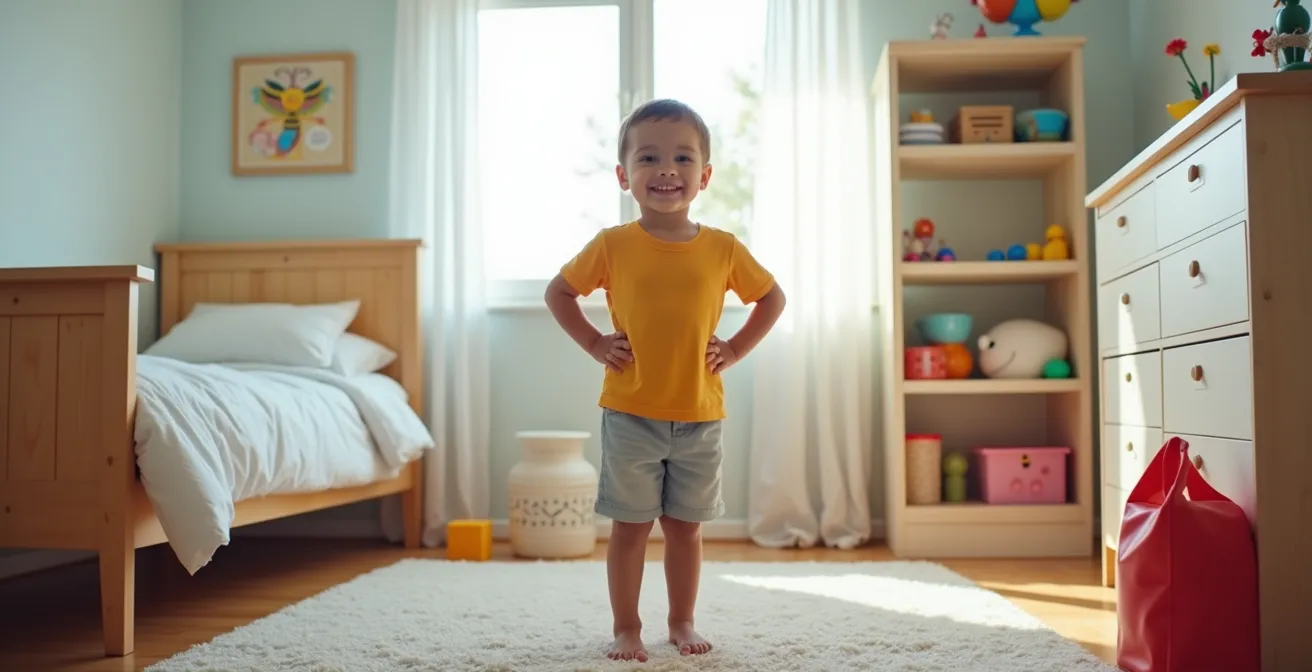
Fading isn’t about abruptly stopping all rewards. It’s a gradual process of shifting from tangible rewards to social and internal ones. You start by making the rewards less predictable, moving from a fixed schedule (a reward every time) to a variable one (a reward sometimes). Simultaneously, you increase the verbal praise that connects their action to their feelings of competence and pride. You are teaching them to recognize and enjoy the good feeling of accomplishment itself. The satisfaction of standing in a clean room, as depicted above, becomes its own reward.
Your Action Plan: Transitioning from External to Internal Motivation
- Phase 1: Fixed Ratio Rewards. Start by giving a small, immediate reward every single time the target behavior occurs to build the initial habit.
- Phase 2: Variable Ratio Rewards. Once the behavior is consistent (around 80% success), start rewarding it unpredictably—sometimes yes, sometimes no. This makes the behavior more durable.
- Phase 3: Pair Rewards with Internal Feelings. When you do give a reward, pair it with verbal recognition of their internal state. “You finished your homework, and you earned screen time! You must feel so proud of yourself.”
- Phase 4: Prompt for Self-Reflection. Start asking reflective questions that turn their focus inward. “How does it feel to have your room all clean? Doesn’t it feel nice and calm in here?”
- Phase 5: Replace Tangible with Social Rewards. Gradually replace the sticker or treat with high-fives, special one-on-one time, or simply telling another family member about their accomplishment in front of them.
By following this fading process, you guide your child from “I do this to get a sticker” to “I do this because I am the kind of person who is helpful and capable,” which is the foundation of true self-esteem.
The Phrase You Say That Accidentally Kills Your Child’s Initiative
It’s a parental reflex, born from love and a desire to protect: “Be careful!” We shout it as they scale the playground structure, as they carry a glass of water, as they teeter on a curb. While our intention is to prevent harm, the unintended message is often “You are not capable,” or “The world is a dangerous place, and you need me to navigate it.” This phrase, repeated over time, can subtly chip away at a child’s budding sense of competence and initiative.
The problem with “Be careful!” is that it’s a vague command that doesn’t provide any useful information. It signals danger without teaching the child how to assess or manage risk. It can cause a child to freeze up with anxiety or, conversely, to tune out the phrase entirely due to its overuse. To build true confidence and problem-solving skills, we need to replace this reflexive warning with language that promotes situational awareness and encourages self-assessment.
Instead of a blanket warning, we can act as a guide, prompting them to notice their environment and their own bodies. This empowers them to make their own informed decisions. It shifts the dynamic from you being the “director of safety” to them being the “active, aware participant” in their own activities. This doesn’t mean letting them engage in truly dangerous behavior; it means giving them the tools to manage reasonable, age-appropriate risks.
Here are some powerful alternatives to “Be careful!” that build initiative instead of fear:
- Instead of a warning, ask: “Do you feel steady on that rock?” (Promotes body awareness)
- Instead of a command, question their plan: “What’s your plan for getting down from there?” (Promotes problem-solving)
- Instead of an alarm, make an observation: “Notice how the ground is wet and slippery there.” (Promotes environmental awareness)
- Instead of assuming incompetence, ask for their assessment: “What parts of that climb look tricky to you?” (Promotes risk assessment)
- Instead of a general warning, give a specific prompt: “Remember to find good handholds.” (Provides an actionable strategy)
By using these prompts, you are communicating trust in your child’s ability to think and act. You are teaching them the invaluable life skill of how to be careful, rather than just telling them to be.
Growth Mindset vs. Fixed Mindset Praise: Which One Fuels Persistence?
Why does praising effort (“You worked so hard!”) build more persistence than praising innate ability (“You’re so smart!”)? The answer lies in how each type of praise frames the cause of success and failure. This is the core of the growth mindset theory, and it directly impacts a child’s willingness to persist through challenges.
When we praise a child for being “smart” (a fixed trait), we are telling them that their success is due to something they *are*. This feels good when they succeed easily. However, when they inevitably encounter a problem that is difficult and requires struggle, the logic flips. If success means they are smart, then struggle must mean they are not. This can be devastating to their motivation. To protect their “smart” label, they may give up easily or avoid challenging tasks altogether, robbing them of the chance to learn and grow. Fixed mindset praise makes persistence feel risky.
Conversely, when we praise a child for their effort, strategy, or focus (the process), we are telling them that their success is due to something they *did*. This is incredibly empowering. When they face a difficult problem, the narrative is not “I’m not smart enough.” Instead, it becomes “I need to try a different strategy,” or “I need to focus more,” or “I need to work harder.” The cause of failure is seen as temporary and changeable, not as a permanent reflection of their identity. Growth mindset praise makes persistence feel logical and productive.
The power of this distinction was demonstrated in a landmark study by researchers Claudia Mueller and Carol Dweck. In their experiments, children praised for their intelligence were more likely to give up on difficult tasks and were less likely to enjoy the process compared to children praised for their effort. The effort-praised group showed significantly more persistence and resilience in the face of failure.
Therefore, if the goal is to raise a child who doesn’t crumble at the first sign of difficulty, the choice is clear. Praising the process is the fuel for persistence, turning challenges from a threat into an essential part of the learning journey.
Key Takeaways
- Praise the Process, Not the Person: Focus on effort, strategy, and resilience (“You worked so hard”) to build a growth mindset, rather than fixed traits (“You’re so smart”).
- Rewards Are Proactive, Bribes Are Reactive: A reward is a planned tool to teach a new behavior, while a bribe is a desperate, in-the-moment reaction to stop misbehavior.
- The Goal Is Internal Pride: External rewards are temporary scaffolding. The true objective is to gradually fade them out as the child develops their own intrinsic motivation and sense of accomplishment.
How to Raise a Confident Child Without Creating an Arrogant Ego?
The fine line between confidence and arrogance is a source of anxiety for many parents. We want our children to have healthy self-esteem and believe in their abilities, but we don’t want them to become entitled or dismissive of others. The strategies of positive reinforcement, when applied thoughtfully, are perfectly designed to build the former without creating the latter. The key is to ground a child’s self-worth in competence and contribution, not in a sense of superiority.
Arrogance often stems from a fragile ego built on a foundation of “person praise” and a fixed mindset. A child who is constantly told they are “the best” or “the smartest” develops a need to perpetually prove that status. They may become poor losers, avoid tasks where they might not excel, and look down on those who they perceive as less talented. Their “confidence” is brittle because it depends on external validation and outperforming others.
True, resilient confidence, however, is built on a growth mindset. It is the quiet self-assurance that comes from knowing you can tackle challenges, learn from mistakes, and improve with effort. It is not about being the best; it’s about being better than you were yesterday. This type of confidence is cultivated through process praise, celebrating persistence, and focusing on the intrinsic satisfaction of accomplishment.
A crucial element in nurturing this healthy confidence is teaching a child how to receive both praise and constructive feedback gracefully. A confident child doesn’t need to broadcast their successes, and they don’t crumble when faced with criticism. They can accept a compliment with a simple “thank you” and view feedback as helpful information for growth, not a personal attack. This skill is not innate; it must be taught and modeled.
- Model saying “Thank you, I worked hard on it” when you receive a compliment.
- Teach them to see criticism as helpful information, not a personal attack.
- Practice calm responses to feedback, such as, “Thanks for pointing that out, I’ll think about it.”
- Demonstrate vulnerability by talking about your own efforts: “I was nervous about that presentation, but I prepared a lot.”
- Help them connect their achievements to a larger purpose: “You’re getting so good at reading. How could you use that to help your little brother?”
Ultimately, raising a confident child isn’t about shielding them from failure or inflating their ego. It’s about giving them the tools to navigate success and setbacks with equal grace, building a deep, unshakable belief in their own ability to learn, adapt, and grow.