In summary:
- Morning chaos is often a system failure, not a parenting failure. The key is understanding the ‘why’ behind your child’s behavior, like transition anxiety.
- Create a “Launch Station” by the door to streamline exits and give children a sense of control over their belongings.
- Establish predictable routines to “outsource” your child’s executive functions, freeing up their mental energy for emotional regulation.
- Use the commute, especially walking, as a dedicated time for connection, setting a positive tone for the day.
The scene is familiar in millions of homes: the clock is ticking, one child can’t find their shoes, another is refusing to put on their coat, and the volume of your voice starts to rise. The morning school run can feel like a daily battle, leaving both parents and children frazzled before the day has even truly begun. You’ve likely heard the standard advice: wake up earlier, pack bags the night before, be more organized. While these tips have some merit, they often fail to address the core of the problem.
The relentless stress isn’t just a matter of logistics; it’s a matter of emotional physics. What if the key to a peaceful morning wasn’t about enforcing stricter rules or just trying harder, but about fundamentally redesigning the morning system itself? The constant friction points—the battles over shoes, coats, and breakfast—are not acts of defiance. They are signals. They are symptoms of underlying needs: a need for predictability, a struggle with sensory input, or anxiety about a transition. Yelling is the final, desperate response to a system that is no longer working.
This guide offers a different perspective. We will deconstruct the most common morning friction points and look at them not as behavioral problems, but as design flaws in your family’s morning system. By understanding the psychology and logistics at play, you can stop managing chaos and start engineering calm. We will provide a blueprint to transform your morning from a source of conflict into an opportunity for connection, setting everyone up for a better day.
To navigate this transformation, this article is structured to tackle each morning challenge methodically. The summary below outlines the key systems and strategies we will explore to help you build a calmer, more connected start to your day.
Summary: The Blueprint for a Stress-Free School Morning
- Why the “Shoe Battle” Is Actually About Transition Anxiety?
- How to Create a “Launch Station” by the Door for Stress-Free Exits?
- Walking vs. Driving: Which Commute Sets Your Child Up for a Better Day?
- The “Snooze Button” Habit That Guarantees a Chaotic Morning
- When to Talk About the Day: Using the Commute for Connection
- Why Kids Behave Better When They Know What Happens Next?
- In What Order to Layer for Quick Morning Exits?
- How to Secure Your First Choice State School in a Competitive Catchment Area?
Why the “Shoe Battle” Is Actually About Transition Anxiety?
The daily struggle over putting on shoes is rarely about the shoes themselves. For many children, this moment represents the final, concrete step before leaving the safety and comfort of home for the more structured and demanding environment of school. This is a classic example of transition anxiety, a common challenge for children whose brains are wired for predictability. Leaving the house is a major shift, and the “shoe battle” is where that internal resistance manifests externally.
This resistance can be amplified for children with sensory processing challenges. As explained by experts, the world can feel overwhelming to them, so any change can be difficult. The very act of transitioning from a known activity (like playing) to an unknown one (the school day) can trigger a stress response. The child isn’t being willfully defiant; their nervous system is genuinely struggling to cope with the shift. This is particularly true for children on the autism spectrum, for whom routine and predictability are essential for feeling secure.
To solve the shoe battle, you must first diagnose the root cause. Is it a fear of separation, a need for control, or a sensory issue? A child who becomes clingy and asks repeated questions about the school day may be showing true transition anxiety. A child who insists on putting on shoes in a very specific order is likely seeking a sense of autonomy. And a child who complains that the socks “feel wrong” is giving you clear data about their sensory sensitivity. Recognizing these signals allows you to address the underlying need instead of just battling the behavior.
By reframing the “shoe battle” from a power struggle to a communication problem, you can shift from a mode of conflict to one of support, looking for ways to make the transition feel safer and more predictable for your child.
How to Create a “Launch Station” by the Door for Stress-Free Exits?
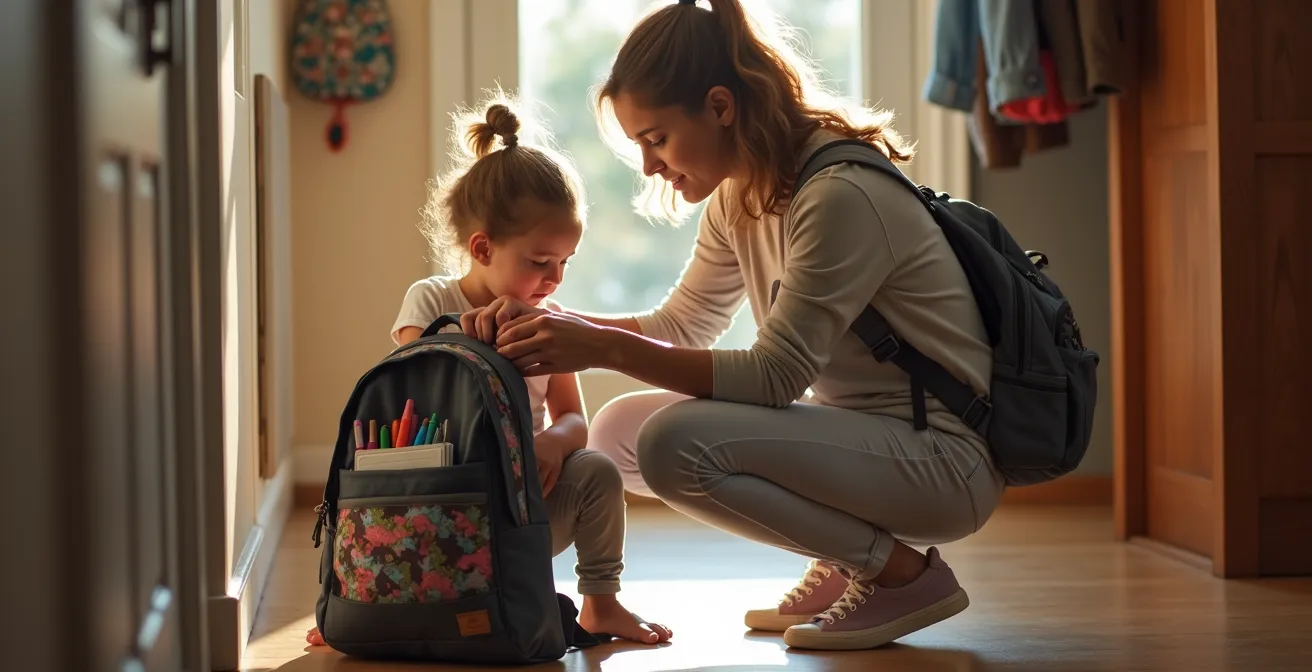
One of the most effective ways to combat morning chaos is to create a physical system that does the organizational work for you. This is the concept of a “launch station”—a designated, organized area near the exit of your home where everything needed for the day is ready to go. It’s a simple, powerful tool of environmental design that reduces decision-making, minimizes frantic searching, and gives children a tangible sense of ownership and predictability.
The goal is to eliminate the dreaded “we’re late, where is your…?” scramble. A well-designed launch station means backpacks, shoes, coats, homework, and sports kits have a permanent, logical home. As one family logistics guide points out, setting up a backpack station ensures everything is easy to grab on the way out, preventing last-minute dashes upstairs for forgotten items. The system itself becomes the reminder, reducing the mental load on both parent and child.

The key to a successful launch station is making it accessible and intuitive for the youngest members of the family. This means child-height hooks, open cubbies they can reach, and clear, simple labels (or color-coding). Involving your child in the design and setup process can further increase their buy-in. When they know exactly where their shoes go and where their backpack hangs, they are not just following rules; they are participating in a system they helped create, which fosters a crucial sense of autonomy.
Your Morning System Audit Checklist
- Identify Friction Points: List every channel where morning arguments occur (e.g., getting dressed, breakfast, teeth brushing, leaving the house).
- Collect Data: For one week, inventory what causes the delay or conflict at each friction point (e.g., “couldn’t find left shoe,” “complained about sock seam,” “wanted a different breakfast”).
- Check for Coherence: Compare the friction points to your family’s values. If you value autonomy, are you allowing for choices? If you value calm, is the environment overstimulating?
- Assess Emotional Tone: For each friction point, identify if the interaction is generic and command-based (“Put your shoes on!”) or unique and connection-based (“Let’s get your adventure boots on!”).
- Create an Action Plan: Prioritize the single biggest friction point. Brainstorm and implement one small system change (like a launch station) to address it.
Ultimately, the launch station is more than just storage; it’s a physical manifestation of being prepared, transforming the abstract concept of “getting ready” into a simple, repeatable set of actions.
Walking vs. Driving: Which Commute Sets Your Child Up for a Better Day?
The transition from home to school doesn’t end when you close the front door. The commute itself is a critical, and often overlooked, part of the morning routine that significantly impacts a child’s readiness for the day. As Dr. David Anderson of the Child Mind Institute notes, mornings are “definitely tough for most families,” and the stress doesn’t magically disappear in the car. The choice between walking and driving, when possible, presents a clear trade-off between speed and sensory-emotional regulation.
Driving is often the default for its perceived efficiency, but it can create its own set of stressors. Confined in a car, with limited eye contact and the parent’s attention focused on traffic, opportunities for genuine connection are scarce. Walking, in contrast, offers a powerful antidote. The bilateral, rhythmic motion of walking is naturally calming to the nervous system. It provides a shared, side-by-side experience at a natural pace, creating the perfect environment for low-pressure conversation and observation. This physical activity also gently increases alertness, preparing the brain and body for learning in a way that staying in a static, resting state in a car simply cannot.
Of course, the choice is not always simple and depends heavily on factors like distance, weather, and time. The following table breaks down the key differences to help you make a more informed decision based on your family’s specific needs.
| Aspect | Walking | Driving |
|---|---|---|
| Sensory Impact | Bilateral stimulation calms nervous system | Static position, limited movement |
| Connection Opportunity | Side-by-side conversation, natural pace | Limited eye contact, focus on traffic |
| Physical Readiness | Increases alertness and focus | Maintains rest state |
| Weather Dependency | High – requires appropriate clothing | Low – climate controlled |
| Time Required | 15-30 minutes typically | 5-15 minutes typically |
Even if you must drive, you can incorporate principles from the “walking” model. Consider parking a few blocks away from school to build in a short walk, or intentionally use the drive time for a specific connection ritual instead of just listening to the radio.
The “Snooze Button” Habit That Guarantees a Chaotic Morning
The tone for the morning is often set before your feet even hit the floor. The snooze button, seemingly a small act of self-kindness, is in reality a trap. It initiates a cycle of fragmented, low-quality sleep and, more importantly, it starts the day with an act of procrastination. Each time you hit snooze, you are sending a subconscious message that the day is something to be avoided. This mindset is the exact opposite of the calm, proactive energy needed to lead a family through a smooth morning.
This self-inflicted stress is layered on top of an already high baseline for parents. A U.S. Surgeon General’s report on parental stress is revealing: 33% of parents reported high levels of stress in 2023, compared to just 20% of other adults. When you are already operating from a place of heightened stress, every minute counts. The “extra” nine minutes from the snooze button aren’t restful; they are borrowed from the time you need to prepare, regulate your own emotions, and be fully present for your children. This is how a small time deficit quickly snowballs into a chaotic rush.
The solution is not just to “stop hitting snooze,” but to replace the habit with something that serves you better. Instead of seeking more sleep, seek a better start. A “Morning Anchor” is a brief, intentional one-to-five-minute activity you do immediately upon waking. Its purpose is to ground you, calm your nervous system, and set a positive intention for the day before the demands of others begin. This small investment in your own emotional state is the foundation of a yell-free morning.
5-Minute Morning Anchors (Snooze Button Alternatives)
- Deep breathing exercise: Use the 4-7-8 pattern (inhale for 4, hold for 7, exhale for 8) to activate your calming parasympathetic nervous system.
- Gratitude practice: Mentally or on paper, list three specific things you are looking forward to in the day ahead.
- Gentle stretching: Perform simple stretches in or beside your bed to wake up your body gradually and mindfully.
- Mindful coffee/tea ritual: Prepare and sip your first drink of the day slowly, without any other distractions, focusing on the warmth and aroma.
- Morning affirmations: Repeat a few calming phrases to yourself, such as “I can handle the morning peacefully,” or “I will choose connection over conflict.”
By replacing the snooze button with a positive anchor, you are not just gaining time; you are fundamentally shifting your approach from reactive and rushed to intentional and calm.
When to Talk About the Day: Using the Commute for Connection
Once you’re out the door, the commute offers a golden, yet often squandered, opportunity for connection. Too often, this time is filled with tense silence, last-minute reminders, or the residual stress from a rushed exit. However, reframing the commute as “protected time” for connection can transform its entire emotional texture and set a positive trajectory for your child’s day at school and your own workday.
The stakes are higher than we think. The stress of the morning routine has a measurable impact. Research shows that morning arguments lead to significant negative feelings; 35% of parents report their child has gone to school upset as a direct result of a bad school run. An additional 29% of parents admit to being reduced to tears themselves. When a child arrives at school already in a state of emotional distress, their capacity for learning, socializing, and managing classroom challenges is severely diminished.
The key is to avoid “interrogation-style” questions like “What do you have today?” or “Did you remember your homework?” These questions put the child on the defensive and frame the conversation around logistics and performance. Instead, use the time for low-stakes emotional logistics. This means focusing on gentle, open-ended conversations that aren’t about tasks. Talk about the squirrel you just saw, wonder about the color of a car, or share a simple, positive hope for the day. The goal is not to extract information but to share a space and co-regulate, letting your child’s nervous system settle into a state of safety and connection before the school bell rings.
By intentionally shielding the commute from logistical talk and dedicating it to connection, you are giving your child—and yourself—the invaluable gift of starting the day from a place of emotional equilibrium.
Why Kids Behave Better When They Know What Happens Next?
A child’s brain is a prediction machine. When it knows what’s coming next, it can relax. When the future is uncertain, it goes on high alert. This is the fundamental principle behind the power of routine. A predictable morning routine isn’t about creating robotic children; it’s a profoundly effective strategy for outsourcing executive function. Tasks like getting dressed, eating breakfast, and brushing teeth require planning, sequencing, and focus—skills that are still developing in a child’s prefrontal cortex. A set routine removes the decision-making burden, freeing up those limited mental resources for more important jobs, like managing emotions.
A predictable routine outsources executive function. This frees up the child’s (and parent’s) limited prefrontal cortex resources for emotional regulation and connection.
– Dr. Michael Rosenthal, PhD, Child Mind Institute, Clinical Neuropsychologist
This need for predictability is especially critical in today’s high-stress environment. For many children, school is not a carefree place; in fact, research from the American Psychological Association shows that a staggering 70% of youth identify academic pressure as their most significant source of stress. When a child is already carrying this mental load, adding uncertainty and chaos at home in the morning can be the tipping point that leads to meltdowns. A calm, predictable home base becomes a non-negotiable anchor.
The most effective routines are visual and co-created. A simple chart with pictures or words that outlines the morning sequence (e.g., 1. Wake Up, 2. Get Dressed, 3. Eat Breakfast, 4. Brush Teeth, 5. Shoes & Coat On) allows a child to see their progress and know exactly what is expected. This doesn’t just reduce verbal reminders and nagging; it empowers the child by making them an active participant in the family’s system. They are no longer being passively moved through a series of commands but are actively following a map they understand.
By providing this structure, you’re not just managing behavior; you’re providing a deep sense of security that allows your child to face the rest of their day with confidence.
In What Order to Layer for Quick Morning Exits?
For a child with sensory sensitivities, getting dressed can feel like navigating a minefield. A seam that scratches, a tag that irritates, or a fabric that feels “wrong” can derail the entire morning. The order in which clothes are put on, and the way it’s framed, matters immensely. The goal is to move from a potential source of conflict to a sequence that builds comfort and a sense of protection. The process must be both physically and emotionally logical for the child.
The foundation of this process starts with the materials closest to the skin. As sensory experts at Kozie Clothes explain, even things that happen before dressing, like restless sleep caused by incorrect textures, can set a negative tone. Therefore, the first step in a sensory-smart dressing routine is ensuring the initial layers are non-irritating. This establishes a baseline of comfort from which you can build. Before any other clothes go on, a “sensory checkpoint” is a crucial step to validate your child’s experience and make adjustments before frustration sets in.
A successful layering sequence is one that provides both physical comfort and a sense of control. By allowing choices within the routine—such as picking between two pre-approved sweatshirts—you satisfy your child’s need for autonomy while still keeping the process moving forward. Framing the final, outer layer as “armor” or a “superhero cape” can also transform it from a cumbersome task into an exciting step toward the day’s adventure. It’s a small but powerful shift in narrative. Here is a practical sequence to follow:
- Start with the softest layer: Begin with seamless underwear and socks. This first point of contact is critical to minimize sensory irritation.
- Base layer check: Before putting on shirts or pants, run your hands over the fabric to check for any tags or rough spots that might cause discomfort later.
- Mid-layer flexibility: Offer a choice for the mid-layer (e.g., “Do you want the blue hoodie or the green zip-up?”). This provides a crucial sense of control.
- Outer layer as ‘armor’: Frame the coat or jacket as a protective shield for the day’s adventure, turning it into a positive step.
- Final sensory checkpoint: Before leaving, do a quick body scan with your child. Ask, “Does anything feel scratchy or too tight?” This shows you value their comfort and helps prevent meltdowns later.
By approaching dressing with a sensory-aware mindset, you are not just putting clothes on a body; you are helping your child feel safe and comfortable in their own skin, ready to face the world.
Key Takeaways
- Predictability is a tool for calm. A visual routine outsources a child’s executive function, reducing their mental load and the likelihood of meltdowns.
- Your home’s physical layout matters. A well-designed “Launch Station” by the door automates organization and minimizes last-minute scrambling.
- The parent’s emotional state is the foundation. Replacing the snooze button with a 5-minute calming “Morning Anchor” sets a proactive, not reactive, tone for the day.
How to Secure Your First Choice State School in a Competitive Catchment Area?
While optimizing the daily routine is crucial, sometimes the underlying source of stress is bigger, more systemic, and located outside the home. It’s the persistent, low-grade anxiety about the destination itself: the school. For many parents, the stress of the morning is compounded by worries about school safety, quality, and competition. This macro-stressor consumes significant emotional energy that could otherwise be used to navigate the morning’s micro-challenges.
The data on this is stark and sobering. Beyond academic pressures, school safety is a primary source of parental anxiety. The U.S. Surgeon General’s Advisory on the youth mental health crisis reveals that an overwhelming 74% of parents report school shootings or the possibility of one as a significant source of stress. This level of background anxiety is not sustainable. When parents are this stressed, their capacity to function calmly is compromised, which directly impacts the family’s morning dynamic.
Therefore, the process of securing a spot in a desired school, especially in a competitive area, is not just a long-term logistical task—it’s an act of stress reduction. Feeling confident in your child’s school environment removes a massive variable of worry from the daily equation. This doesn’t mean every family must move or enter a hyper-competitive race. Rather, it means that actively engaging with your school options—visiting, talking to staff, understanding its culture and safety protocols—and making a conscious, informed choice can be one of the most powerful things you do for your family’s daily well-being. It’s about trading a vague, powerful anxiety for a concrete, manageable plan.
By proactively addressing this major source of stress, you free up the emotional bandwidth necessary to handle the inevitable small hurdles of a family morning, transforming your ability to remain a calm and connected leader.