In summary:
- Feeling awkward talking to your baby is normal, especially for introverted parents. The key isn’t a constant monologue.
- Focus on “narration micro-habits”—small, specific techniques like “Sportscasting” playtime or using “Parentese”—to make talking feel natural.
- Quality of interaction (conversational turns) is more important for brain development than the raw number of words.
- Shift from “quizzing” your child to asking open-ended questions that build connection and encourage them to talk.
- The goal is to create a language-rich environment through connection, not performance.
If the thought of keeping up a running commentary for a baby who can’t talk back makes you feel a little silly, you are not alone. Many parents, especially those who are more introverted, hear the advice to “talk to your baby constantly” and feel a wave of pressure. It can feel unnatural, like a performance for an audience of one. You might find yourself wondering, “What am I even supposed to be talking about?” or feel your own voice trail off mid-sentence, convinced you’re doing it wrong.
The common advice often misses a crucial point: it’s not about the sheer volume of words or becoming a chatterbox overnight. It’s about the quality and context of those words. The pressure to narrate every single moment can be paralyzing, leading to a cycle of trying, feeling awkward, and giving up. This is a common frustration, but the good news is that building your baby’s brain and vocabulary doesn’t require a personality transplant.
But what if the key wasn’t to talk *more*, but to talk with more *intention*? This guide is built on a different premise. Instead of pushing you to maintain a constant, exhausting monologue, we will reframe narration as a series of simple, low-pressure “narration micro-habits.” These are science-backed techniques you can weave into the routines you already have, like diaper changes, playtime, and reading. They are designed to feel less like a performance and more like a natural, connected conversation.
We’ll explore why early language exposure is so critical, but we’ll focus on practical, actionable strategies that work for quieter personalities. You’ll learn how to use “sportscasting” to make playtime a language lesson, why a specific tone of voice (Parentese) is like a superpower for learning, and how to ask questions that genuinely invite conversation instead of creating test anxiety. It’s about building a language-rich world for your child, one comfortable and authentic moment at a time.
This article breaks down these practical methods into manageable steps. The following sections offer a roadmap to transform everyday moments into powerful opportunities for language growth, all without feeling the need to put on a show.
Summary: Narrating Your Day to Boost Baby’s Vocabulary
- Why The Number of Words a Child Hears by Age 3 Predicts School Success?
- How to Use “Sportscasting” to Teach Verbs During Playtime?
- Parentese vs. Adult Speak: Which Tone Helps Babies Learn Faster?
- The “Quizzing” Mistake That Makes Kids Stop Talking
- When to Stop Reading and Start Talking: Interaction Strategies for Books
- Closed vs. Open Questions: Which One Builds Better Vocabulary?
- Why “Quality Time” Doesn’t Count If You Are Mentally Absent?
- How to Ask Questions That Get Your Child Talking About Their Day?
Why The Number of Words a Child Hears by Age 3 Predicts School Success?
The connection between a child’s early language environment and their later academic success is one of the most well-established findings in child development. For decades, we’ve known that the first few years of life are a critical window for brain development, where the architecture for all future learning is built. Language is the primary tool for this construction. Every word a baby hears helps form neural connections that support not just vocabulary, but also reading skills, problem-solving, and social-emotional intelligence down the line.
A foundational study in this area highlighted this connection dramatically. The original Hart and Risley study from 1995 was a landmark piece of research that tracked families over several years. While some of its specific figures like the “30 million word gap” have been updated and debated by newer research, its core finding remains undisputed: there is a powerful link between the quantity and quality of early language exposure and a child’s later academic achievement. Children who were immersed in language-rich environments simply had a stronger foundation when they entered school.
But for an introverted parent, the idea of producing thousands of words per hour can sound exhausting. The modern understanding of this research offers a reassuring perspective: it’s not just a numbers game. While exposure matters, the quality of interaction is a more powerful predictor of success. It’s about creating a “language-rich environment” where words are used in a meaningful, responsive, and connected way. This shifts the focus from a performance of endless talking to the more manageable goal of creating moments of genuine connection, which is a much more comfortable space for any parent to operate in.
How to Use “Sportscasting” to Teach Verbs During Playtime?
One of the most effective and low-pressure narration techniques is called “sportscasting.” Imagine you’re a sports announcer, calmly and factually describing the action as it unfolds. This method is perfect for introverted parents because it removes the pressure to be creative or entertaining. You’re not inventing a story; you’re simply observing and describing what your child is already doing. It’s a powerful way to provide a rich vocabulary of action words (verbs) in a highly relevant context.
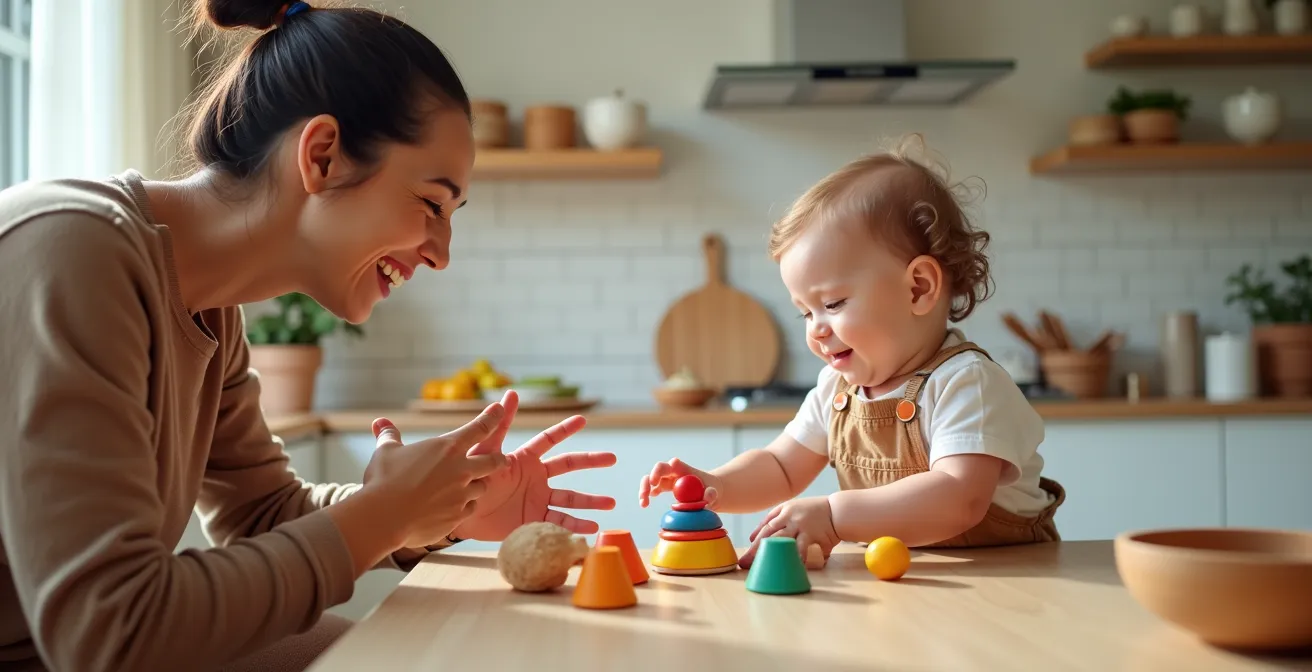
During playtime, instead of feeling like you need to direct the play, take a step back and become the sportscaster. Is your baby reaching for a block? “You are reaching for the red block.” Did they just knock over a tower? “You pushed the tower, and it all fell down! Crash!” This real-time narration connects words directly to actions, which is how a baby’s brain learns language most effectively. You are giving them the exact words for what their body is experiencing in that moment.
This technique turns play into a natural language lesson. It helps your child feel seen and understood, validating their efforts and focus without judgment. The goal is to provide a steady stream of relevant vocabulary, particularly verbs, which are the building blocks of sentences.

As you can see in the focused action of stacking, every small movement is an opportunity for a word. “You are stacking the block. You’re balancing it. Oh, careful… you placed it on top.” This simple, descriptive language provides a powerful learning experience. It’s not about interrupting their play, but about layering it with meaning, turning their physical exploration into a cognitive leap forward. By focusing on observation rather than invention, sportscasting makes narration feel authentic and manageable.
Parentese vs. Adult Speak: Which Tone Helps Babies Learn Faster?
When it comes to the *way* you talk to your baby, not all tones are created equal. You might have heard of “baby talk,” often associated with nonsensical goo-goo-ga-ga sounds. However, what scientists and speech-language pathologists actually recommend is a specific way of speaking called “Parentese.” This isn’t about using silly words; it’s about changing the acoustic properties of your voice to capture a baby’s attention and make language easier to learn. And the evidence is clear: babies’ brains are wired to respond to it.
Parentese involves speaking in a higher-pitched, more melodic voice, slowing down your speech, and elongating vowel sounds. Think of the way you might say, “Hiiiii, sweetieeeee!” You’re naturally using Parentese. This musical quality is highly engaging for infants and helps them distinguish individual words within a stream of sound. It acts like a spotlight, highlighting the sounds and structure of language for their developing brain.
As pediatric speech development expert Dr. Robert Titzer explains, this method is scientifically sound:
Use parentese when talking with your young infants. Parentese means speaking in a higher-pitched voice, elongating the vowel sounds, and slightly over-enunciating words. Babies prefer higher-pitched voices.
– Dr. Robert Titzer, The Science of Early Learning
This isn’t just a preference; it has measurable results. In fact, research shows that infants who get more baby talk (meaning Parentese) know significantly more words by the time they are two years old. For a quiet parent, this is great news. You don’t have to talk constantly, but when you do talk, adopting this simple, instinctual shift in tone can make your words much more powerful and effective.
The “Quizzing” Mistake That Makes Kids Stop Talking
As our children begin to understand language, it’s a natural and exciting instinct to want to know what they know. This often leads parents down the path of “quizzing”—asking a series of test-like questions where we already know the answer. “What color is this?” “What does the cow say?” “What’s that called?” While well-intentioned, this pattern can inadvertently shut down the very communication we’re trying to encourage. It shifts the dynamic from connection to examination.
For a young child, this constant testing can create pressure and performance anxiety. Instead of a joyful, shared exploration of the world, conversation becomes a series of verbal hurdles they have to clear. If they don’t know the answer or aren’t in the mood to perform, they might respond with silence, a shrug, or by changing the subject. This isn’t defiance; it’s a natural reaction to feeling put on the spot. Quizzing teaches a child that the purpose of talking is to provide correct answers for adults, not to share thoughts, ideas, or feelings.
The alternative is to shift from “test questions” to “real questions” or, even better, to make collaborative statements. Instead of asking, “What color is the car?” try a more observational approach: “Wow, I see a blue car. It’s going so fast!” This provides the vocabulary without the pressure of a test. Or you can phrase it as a shared wonder: “I wonder what that animal is called…” This invites your child to be a partner in discovery rather than a student in an exam. The goal is to foster a love of communication, and that thrives in a low-pressure environment built on mutual curiosity.
When to Stop Reading and Start Talking: Interaction Strategies for Books
Reading to your child is one of the best things you can do for their development, but many parents picture a quiet, attentive child sitting through an entire story. The reality with a baby or toddler is often much more chaotic: they might want to turn the pages too fast, chew on the corner of the book, or fixate on a single picture for ten minutes. This is not a failure; it’s an opportunity. The real magic of early literacy isn’t in finishing the book, but in using it as a springboard for interactive conversation.
This approach is often called “dialogic reading,” and it means you follow the child’s lead. If they point to a picture of a dog, you pause. You don’t just say “dog.” You can sportscast what you see: “Look at that big, brown dog! He’s running!” You can connect it to their life: “That looks like Grandma’s dog, Sparky!” You can add sounds: “Woof woof!” This transforms a passive listening activity into an active, engaging conversation. It teaches your child that books are not just stories to be heard, but worlds to be explored and talked about together.
Zero to Three’s Interactive Reading Approach
The child development experts at Zero to Three champion this interactive method. Their research highlights that it’s perfectly normal for babies to have short attention spans for books. The goal is not to get through the text on each page. Instead, the key is to follow the baby’s interest. If they are captivated by a picture of a ball, you spend your time talking about the ball—its color, its shape, how it can bounce. This strategy uses books as powerful conversation starters, making them a tool for connection and language building, rather than just a script to be read verbatim.

This shared experience, with pointing, talking, and turn-taking, is far more valuable than silently listening to a story. It models the back-and-forth rhythm of conversation and shows your child that their interests matter. So, the next time your toddler wants to skip to the last page or just point at the moon on every page, embrace it. You’ve been given the perfect opening for a great conversation.
Closed vs. Open Questions: Which One Builds Better Vocabulary?
As your child’s language skills grow, the types of questions you ask can either open the door to rich conversation or close it with a one-word answer. Understanding the difference between closed and open questions is fundamental to encouraging your child to talk more. A closed question is one that can be answered with a “yes,” “no,” or a single piece of information (“Did you have fun?”). An open question invites a longer, more descriptive response and often starts with words like “what,” “how,” or “why” (“What was the most fun part of your day?”).
While closed questions have their place, especially with very young talkers, relying on them too heavily can stifle conversation. Open questions are the engine of vocabulary growth because they require your child to access their own thoughts and find the words to express them. They encourage elaboration, storytelling, and the use of more complex sentences. However, jumping straight to broad open questions can sometimes be overwhelming for a toddler.
A helpful strategy is to think of question types as a scaffold, building up in complexity as your child’s language develops. You can start with simple closed questions, move to choice questions (“Did you like the slide or the swings?”), and then gradually introduce more open-ended prompts. This progressive approach builds their confidence and gives them the structure they need to succeed.
This approach can be adapted based on your child’s age and language abilities, as shown in a helpful framework from the American Speech-Language-Hearing Association (ASHA).
| Question Type | Example | Language Benefit | Best Age Range |
|---|---|---|---|
| Closed Question | Did you play with blocks? | Low-pressure entry point, yes/no response | 12-18 months |
| Choice Question | Did you like the slide or swings better? | Bridge between closed and open, reduces overwhelm | 18-24 months |
| Open Question | What did you build with the blocks? | Encourages elaboration and vocabulary use | 2-3 years |
| Predictive Question | What do you think will happen next? | Fosters abstract thinking and hypothesis forming | 3+ years |
Using this table as a guide, you can intentionally choose questions that match your child’s developmental stage, gently stretching their abilities without causing frustration. This makes conversation a successful and rewarding experience for them.
Why “Quality Time” Doesn’t Count If You Are Mentally Absent?
In our busy, digitally-saturated lives, the concept of “quality time” is often praised. But what does it truly mean for a baby’s developing brain? It’s easy to be physically present—in the same room, sitting on the floor—but mentally absent, scrolling through your phone or running through a mental to-do list. Research is making it increasingly clear that for language development, this physically-present-but-mentally-absent time doesn’t deliver the benefits we think it does. The secret ingredient is attuned, responsive interaction.
This is where the concept of “conversational turns” comes in. A conversational turn is the back-and-forth exchange that happens between a parent and child. It can be verbal (you say something, your baby babbles back) or non-verbal (your baby points, you look and name the object). This serve-and-return interaction is the single most important factor in building a baby’s brain. It’s more predictive of language and cognitive skills than simply the number of words a child hears. In fact, one influential study showed that the number of adult-child conversational turns was a key factor in brain development.
This is incredibly liberating news for the introverted parent. You don’t need to be “on” all day. As developmental specialists at Pathways.org guide, “Three minutes of fully present, focused narration while changing a diaper is more potent for bonding and language-building than 30 minutes of distracted playtime.” This highlights that a few moments of genuine, focused connection are far more powerful than long stretches of distracted co-existence. When you put your phone away and truly tune in—noticing what your baby is looking at, responding to their babbles, and sportscasting their actions—you are providing the highest quality fuel for their brain. It’s about presence over performance.
Key takeaways
- The goal is connection, not performance. Focus on small, manageable “narration micro-habits” rather than a constant monologue.
- Quality over quantity is key. A few minutes of fully present, responsive interaction (“conversational turns”) are more powerful than hours of distracted time.
- Follow your child’s lead. Use tools like “sportscasting” and “dialogic reading” to build on what they are already interested in, making conversation natural and relevant.
How to Ask Questions That Get Your Child Talking About Their Day?
The classic after-school question, “How was your day?” is famously ineffective, usually earning little more than a “fine” or a shrug. This is because the question is too broad and abstract for a young child’s mind. To truly open up a conversation and encourage your child to share their experiences, you need to be more specific and creative. The goal is to provide a concrete starting point that helps them access their memories and find the words to describe them.
Instead of one big question, try asking a series of small, specific, and often sensory-based questions. Prompts like, “What was the loudest thing you heard today?” or “What did you eat for snack that was yummy?” are much easier for a child to answer. They anchor the question in a tangible experience. Another popular technique is to create a daily ritual, like “High, Low, Buffalo,” where each person shares the best part of their day (high), a challenging or sad part (low), and something funny or weird (buffalo). This provides structure and makes sharing a predictable, fun part of the routine.
Modeling is also incredibly powerful. Before you ask them about their day, share a specific, short story about your own day first. “At the grocery store today, I saw a man with a giant stack of pizza boxes! It almost fell over.” This not only models how to tell a story but also signals that this is a time for shared experience, not an interrogation. By making it a safe and engaging exchange, you invite them to participate and build the narrative skills that are so crucial for communication and literacy.
Your Action Plan: Conversation Starters That Work
- Use sensory-specific questions: Don’t ask “what did you do?” Ask “What was the loudest thing you heard today?” or “Did you play with anything squishy?”
- Try a sharing ritual: Implement a daily routine like “High, Low, Buffalo” where everyone shares their best moment, a challenging one, and a funny one.
- Model first: Before asking, share your own specific, brief story from the day to show them how it’s done.
- Use supportive interjections: When they start talking, keep them going with encouraging sounds and phrases like “Oh, wow!”, “Really?”, and “And then what happened?” to stretch their story.
- Ask about specific moments: Instead of the whole day, zoom in. “What happened right after snack time?” or “Tell me about the song you sang this morning.”
Start small. You don’t have to implement every strategy at once. Pick one “narration micro-habit” that feels most comfortable—perhaps trying “sportscasting” during one playtime or using “Parentese” while you get your baby dressed. The goal is to find your own authentic rhythm. By focusing on connection over performance and quality over quantity, you can build a rich world of words for your child in a way that feels good for both of you.
Frequently Asked Questions on Talking to Your Baby
What’s the difference between a ‘test question’ and a ‘real question’?
A test question is one where the adult already knows the answer (‘What color is this?’). It puts the child on the spot. A real question shows genuine interest and invites exploration (‘What do you think the dog is trying to do?’). Real questions foster curiosity and connection.
How can I rephrase quiz-style questions?
Instead of asking a direct test question like ‘What’s that?’, try turning it into a collaborative statement. For example, say ‘I wonder what that animal is called…’ or simply observe, ‘Look at that big, fluffy cat!’ This provides the vocabulary without the pressure of an exam.
Why do children shut down when quizzed?
Quizzing can feel like an examination, which triggers performance anxiety in young children. When the focus shifts from a warm connection to getting the “right answer,” it can inhibit their natural desire to communicate and explore language. They may become hesitant to speak for fear of being wrong.