In summary:
- A child’s foot is mostly soft cartilage, making it extremely vulnerable to deformity from poorly-fitting shoes.
- The common “thumb test” is flawed; use a clinical three-point check (toe space, width, and heel grip) for an accurate fit.
- Never use second-hand shoes, as they carry the harmful “gait imprint” of the previous owner, forcing your child’s foot into an unnatural position.
- Flexible soles are not just a preference; they are essential for the proprioceptive feedback a new walker needs to develop balance and coordination.
The online shopping cart is full, but a familiar fear holds you back: choosing the right shoe size for your child. Parents are often told to simply trace the foot on paper or use the “thumb test,” but these methods are fraught with inaccuracies. As a pediatric podiatrist, I see the long-term consequences of these well-intentioned mistakes daily—issues that go far beyond simple discomfort, affecting a child’s gait, posture, and overall musculoskeletal development. The fundamental error is viewing a child’s foot as a miniature version of an adult’s. It is not.
A toddler’s foot is a delicate, developing structure, composed more of cartilage than bone. This malleability means it can easily be misshaped by improper footwear, setting the stage for future problems. The advice you find online often misses this critical context, focusing on length while ignoring the equally important factors of width, volume, and biomechanical support. This is where a clinical approach becomes essential, even when measuring from your own living room.
This guide moves beyond simplistic tips. We will deconstruct the process of shoe fitting from a podiatric perspective. You will learn not just *how* to measure, but *why* each step is crucial for protecting your child’s developing anatomy. We will examine the science of foot ossification, correct the common errors in fit testing, and provide clear, evidence-based criteria for selecting footwear that supports, rather than hinders, healthy growth. It’s time to transform your fear of getting it wrong into the confidence of getting it right.
To navigate this clinical approach effectively, this article is structured to build your expertise step-by-step. The following summary outlines the key areas we will cover, from understanding the unique nature of a toddler’s foot to identifying red flags that warrant a professional consultation.
Summary: A Podiatric Guide to Children’s Footwear
- Why Toddler Feet Are Cartilage and Easily Deformed by Wrong Shoes?
- How to Perform the “Thumb Test” Correctly at the Toe and Heel?
- Flexible vs. Rigid Soles: Which Is Best for a New Walker?
- The Second-Hand Shoe Mistake That Alters Your Child’s Gait
- When to Measure: Why Feet Grow Faster in Spring and Summer?
- Why Your Child’s Height Potential Is 80% Determined Before Birth?
- Why the “Shoe Battle” Is Actually About Transition Anxiety?
- How to Tell If Your Child Needs Orthopedic Support or Just Time?
Why Toddler Feet Are Cartilage and Easily Deformed by Wrong Shoes?
The primary reason for clinical vigilance in fitting children’s shoes is the very nature of their foot structure. Until around the age of five, a child’s foot is not a solid, bony framework. It is a soft, pliable collection of cartilage that is gradually undergoing a process called ossification, where it hardens into bone. This process is surprisingly slow. In fact, the navicular is the last foot bone to ossify, occurring between 2 and 5 years of age. This means the very core of your child’s arch structure remains soft and susceptible to external pressures during their most active developmental years.
Think of it this way: forcing a cartilaginous foot into a shoe that is too narrow, too short, or too rigid is like putting a growing plant into a pot that is too small. The growth doesn’t just stop; it deforms. The pressure can alter the natural alignment of the foot, leading to issues like bunions, hammertoes, or flattened arches later in life. The nerves and blood vessels are also still developing, and constant compression can impede both circulation and sensory development. This is why a “close enough” fit is never acceptable. The shoe must accommodate the foot’s natural shape and allow for unrestricted growth. Understanding this vulnerability is the first step toward appreciating that a shoe is not just a covering, but a critical developmental environment.
How to Perform the “Thumb Test” Correctly at the Toe and Heel?
The “thumb test”—pressing on the front of the shoe to feel for the big toe—is perhaps the most common but most misunderstood fitting technique. Its failure rate is alarming; a comprehensive study on children’s footwear reveals that 67% of all children are wearing shoes that are too small, with a shocking 48% being a full size too small. The primary reason for this discrepancy is a child’s natural defense mechanism: the toe-curl reflex. When you press down, a child will often instinctively pull their toes up, creating a false sense of space.
To perform a clinically accurate assessment, you must evolve from the simple thumb test to a three-point check. This method counteracts the toe-curl reflex and assesses the entire foot.
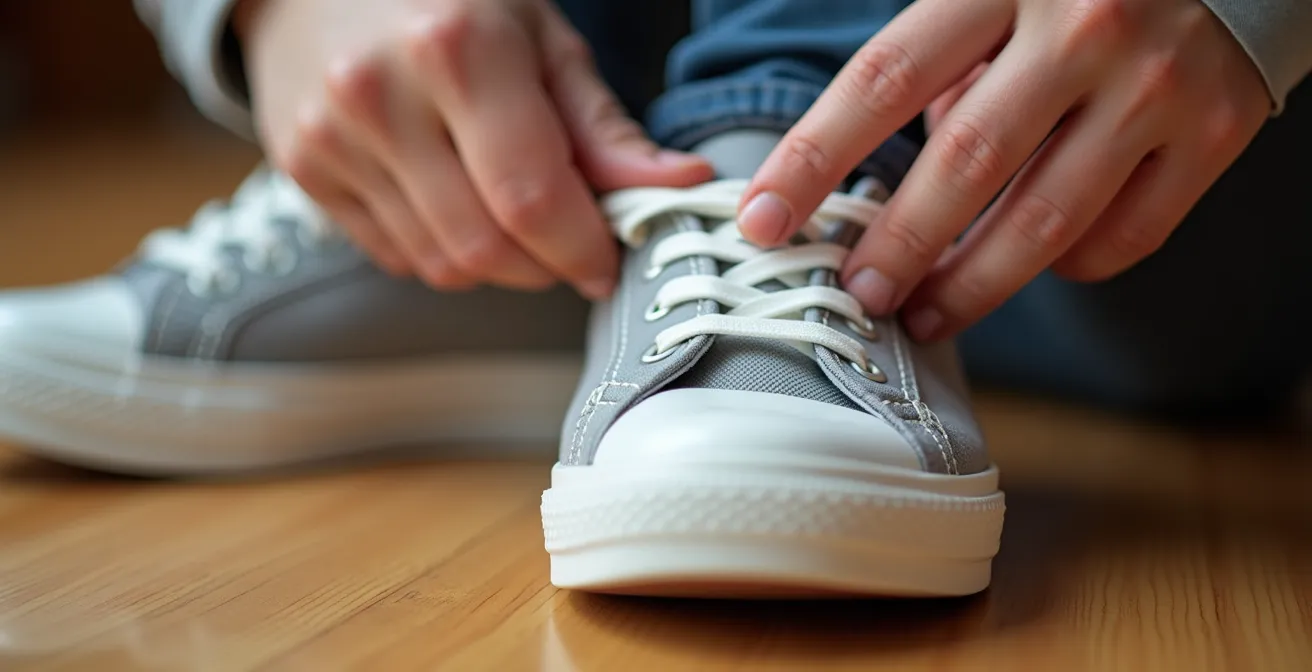
First, have your child stand up, ensuring their weight is distributed evenly on both feet. Gently place one hand over the front of the shoe to stabilize the foot and prevent the toes from curling. With your other hand, use your thumb to check for a space of about half an inch (a thumb’s width) between the end of the longest toe and the front of the shoe. Second, feel along the sides of the shoe to ensure it is not pinching the widest part of the foot. You should not feel a significant bulge. Finally, check the heel. You should be able to slip your pinky finger snugly between your child’s heel and the back of the shoe. If it’s too loose, the foot will slide forward; if it’s too tight, it will cause blisters. This methodical approach provides a far more reliable measure of a true fit.
Flexible vs. Rigid Soles: Which Is Best for a New Walker?
For a new walker, the foot is not just a lever for propulsion; it’s a sensory organ. The nerves on the sole of the foot provide crucial proprioceptive feedback to the brain, informing it about the texture, angle, and stability of the ground. This information is fundamental for developing balance, coordination, and a natural gait. A rigid, thick sole effectively “blinds” the foot, depriving the brain of this vital data. This is why, for early and confident walkers, flexibility is paramount. A shoe should mimic the freedom of being barefoot as much as possible while still offering protection from the elements.
The ideal shoe should bend easily at the ball of the foot, where the foot naturally flexes. It should not be stiff or require force to bend. You can perform a few simple in-hand tests before even putting the shoe on your child. The “Bend Test” involves holding the shoe and ensuring it flexes at the forefoot, not in the middle of the arch. The “Taco Test” involves trying to fold the shoe in half lengthwise; it should offer some resistance but still be pliable. Finally, the “Twist Test” requires you to gently twist the shoe, which should show a degree of torsional flexibility. However, while the sole should be flexible, the heel counter (the back of the shoe) should be firm to provide stability and prevent the foot from rolling inward or outward.
The following table provides a clear guide to choosing the right sole based on your child’s developmental stage and activity level, as highlighted in a recent analysis on toddler footwear.
| Activity Level | Recommended Sole Type | Key Features | When to Use |
|---|---|---|---|
| Indoor exploration | Barefoot or soft soles | Maximum sensory feedback | Pre-walking to early walking |
| Outdoor pavement | Flexible-soled shoes | Protection with natural movement | Confident walkers |
| Rough terrain | Slightly firmer flexible sole | Enhanced protection, still bendable | Active toddlers 2+ years |
The Second-Hand Shoe Mistake That Alters Your Child’s Gait
While passing down clothes is a sensible and sustainable practice, this logic must never be applied to shoes. From a podiatric standpoint, a used shoe is not a blank slate; it is a mold of another child’s foot and, more importantly, a record of their gait pattern. This phenomenon is known as gait imprinting. The foam midsole and insole of a shoe compress and wear down according to the unique pressure points, arch height, and walking style of its original owner. When a second child wears that shoe, their soft, developing foot is forced to conform to this pre-existing, asymmetrical mold.
This can have significant consequences. If the original wearer had a tendency to pronate (roll their foot inward), the shoe will be worn down on the inner edge. The new wearer’s foot will be forced into that same pronated position, potentially stressing their ankle, knee, and hip alignment. It disrupts the natural development of their own unique gait, creating instability and inefficient movement patterns that can persist long after the shoe is discarded. The supposed cost savings are not worth the risk of altering your child’s fundamental biomechanics during their most critical growth period.
Fortunately, there are several ways to acquire proper footwear on a budget without resorting to hand-me-downs:
- Shop end-of-season sales for high-quality brands at a significant discount.
- Visit outlet stores of reputable children’s shoe manufacturers.
- Prioritize buying one excellent, durable pair over multiple cheap, poorly constructed pairs.
- Take advantage of store loyalty programs that may offer discounts on future purchases.
- Maximize barefoot time at home to extend the life of outdoor shoes.
When to Measure: Why Feet Grow Faster in Spring and Summer?
A common question parents ask is how often they should measure their child’s feet. The standard advice is every one to three months for toddlers and every four to six months for older children. However, a more nuanced, clinical approach recognizes that growth is not linear; it is seasonal. Children, like many other living things, experience growth spurts that are tied to the seasons, with growth velocity peaking during the warmer, sunnier months of spring and summer.
This phenomenon is linked to two key factors: increased physical activity and Vitamin D production. Longer, warmer days encourage more outdoor play, which stimulates bone and muscle growth. More importantly, increased sun exposure boosts the body’s synthesis of Vitamin D. As clinical research shows, Vitamin D plays a critical role in calcium absorption, which is the primary building block for bone development. Studies have demonstrated that children’s growth rates are significantly higher in summer compared to winter, a pattern that affects not just height but also foot size. Therefore, it is essential to be extra vigilant with shoe checks during spring and summer, as a perfect fit in April may become painfully tight by July. Making measurement a regular, positive family routine is a great way to stay on top of these seasonal spurts.
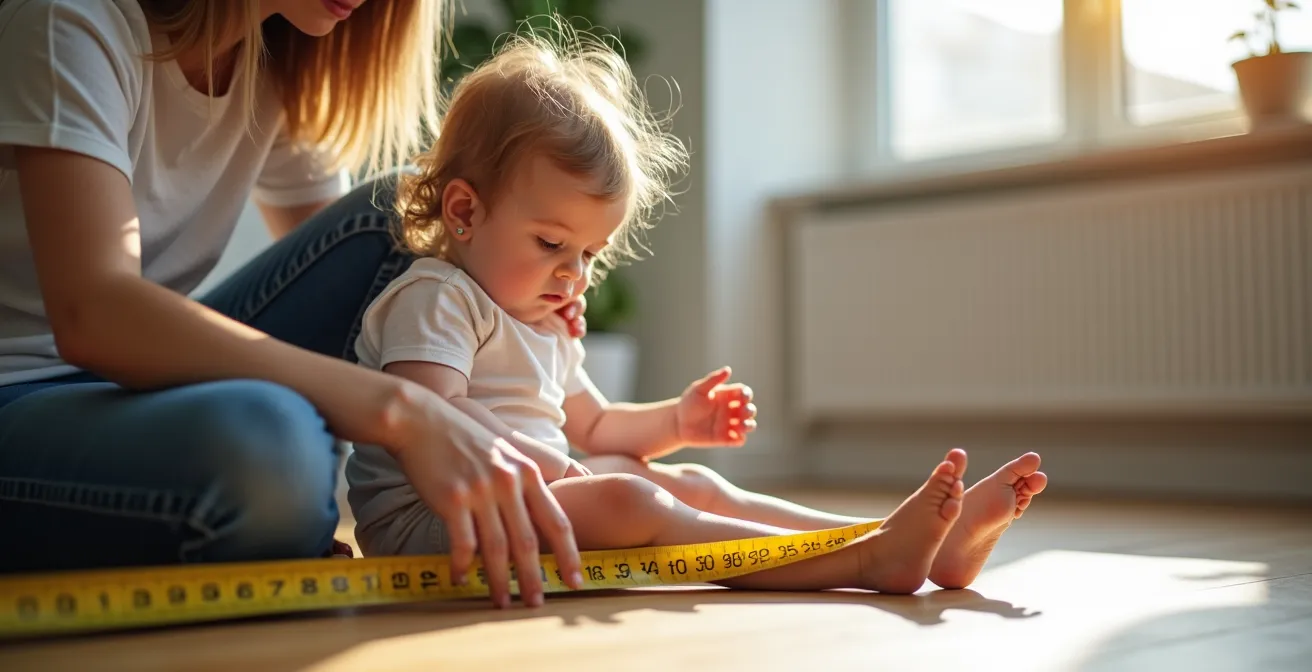
By keeping a simple growth chart, you can monitor these changes and anticipate the need for new shoes before they become a problem. This proactive approach prevents the discomfort and potential damage caused by a sudden growth spurt rendering a pair of shoes too small overnight. Remember to measure at the end of the day, when feet are naturally at their largest due to swelling from activity.
Why Your Child’s Height Potential Is 80% Determined Before Birth?
While we focus heavily on the environmental factors of shoe fitting, it is crucial to acknowledge the powerful role of genetics. Just as a child’s height potential is largely predetermined by their parents’ genetics, so too are the fundamental characteristics of their feet. In fact, podiatric research confirms that foot size and structure are largely determined by genetics, with hereditary traits like arch shape, foot width, and toe length often becoming apparent in early childhood. This genetic blueprint is not something that can be changed, but it is valuable information that can and should be used to guide your footwear choices.
If you or your partner have particularly wide feet, high arches, or flat feet, there is a strong likelihood your child will inherit these traits. Ignoring this genetic predisposition is a common mistake. For example, a parent with narrow feet might not think to seek out wider shoe options for their child, inadvertently squeezing a naturally wide foot into a standard-width shoe. By proactively examining your own feet and those of close family members, you can anticipate your child’s needs and shop more intelligently. This genetic awareness allows you to move from a reactive approach (addressing a problem once it appears) to a proactive one (selecting appropriate footwear from the very beginning).
Action Plan: Using Family Genetics to Predict Foot Needs
- Examine Your Own Feet: Take a critical look at your own foot structure. Do you have wide or narrow feet? Do you have visibly high arches, or are your feet flat?
- Note Family Patterns: Discuss foot-related traits with your family. Do flat feet, bunions, or wide-width needs run in the family? These patterns are strong indicators.
- Shop Proactively: If your family has a history of wide feet, start by looking exclusively at brands known for offering multiple width options. Don’t wait for a problem to arise.
- Monitor for Early Signs: As your toddler begins to walk, watch for the emergence of these inherited traits. A foot that looks wide from the start will likely stay wide.
- Plan for Support: If flexible flat feet are a strong family trait, be prepared to prioritize footwear with good arch support once they are past the early walker stage.
Why the “Shoe Battle” Is Actually About Transition Anxiety?
Many parents describe a daily “shoe battle,” a frustrating power struggle with a toddler who resists wearing shoes. This resistance is often misinterpreted as simple defiance, but from a developmental perspective, it is frequently rooted in sensory processing and transition anxiety. For a child accustomed to the rich sensory experience of being barefoot—feeling the texture of the carpet, the coolness of the tile, the softness of the grass—a shoe represents sensory deprivation. It muffles the world beneath their feet, and this sudden change can be jarring and overwhelming.
The foot has one of the highest concentrations of nerve endings in the body, and for a toddler, this input is crucial for learning about their environment. Acknowledging this sensory perspective allows parents to reframe the problem. The issue isn’t a “bad” child; it’s a child struggling with a significant sensory transition. The solution, therefore, is not to force compliance but to ease this transition with empathy and strategy. This involves making the experience of wearing shoes less abrupt and more positive, acknowledging their preference for being barefoot while gently introducing the need for protection.
Here are several strategies to reduce shoe-related anxiety and transform the battle into a cooperative routine:
- Start with very short wearing periods indoors, perhaps during a favorite activity, to build a positive association.
- Offer a choice between two parent-approved, appropriate shoe options. This gives the child a sense of control.
- Create a positive narrative around the shoes, calling them “adventure shoes,” “fast shoes,” or “park shoes.”
- Gently massage your child’s feet before putting shoes on to provide positive sensory input and prepare them for the change.
- Validate their feelings: “I know you love being barefoot, it feels so nice! Right now, we need our ‘outside shoes’ to keep our feet safe.”
- Choose shoes with soft, seamless interiors to minimize any potential sensory irritation.
Key Takeaways
- A toddler’s foot is mostly soft cartilage and can be permanently deformed by shoes that are even slightly too small or narrow.
- The standard “thumb test” is unreliable due to a child’s toe-curl reflex; use a three-point check of toe length, foot width, and heel grip for an accurate fit.
- Never use second-hand shoes. They contain the “gait imprint” of the original owner, which can force your child’s developing foot into an unnatural and harmful position.
How to Tell If Your Child Needs Orthopedic Support or Just Time?
One of the greatest sources of parental anxiety is noticing an “abnormality” in their child’s feet or walk, such as flat feet, in-toeing, or toe walking. The immediate fear is that this signals a serious problem requiring orthopedic intervention. However, many of these conditions are normal, transient phases of development that resolve on their own with time. The key is to be able to distinguish between a normal developmental variation (a “green flag”) and a genuine sign of a structural issue that warrants professional evaluation (a “red flag”).
For example, most toddlers have flexible flat feet. Their arch appears to be non-existent when they stand, but this is often due to a combination of baby fat pads and ligamentous laxity. A simple diagnostic you can perform at home is the “Tiptoe Test.” Ask your child to stand on their tiptoes. If a normal-looking arch appears, it indicates the foot has the proper underlying structure and the flatness is likely to resolve as their muscles strengthen. However, if the foot remains flat or if the child experiences pain, it could signal a more rigid condition. Knowing these distinctions can save a great deal of worry and prevent unnecessary interventions.
This checklist, based on guidance from pediatric specialists, helps differentiate between normal developmental stages and potential red flags that should prompt a consultation with a podiatrist or orthopedic specialist. Remember that asymmetrical patterns are always a key indicator for professional review.
| Green Flags (Normal) | Red Flags (Consult Professional) |
|---|---|
| Flexible flat feet in toddlers | Rigid flat feet at any age |
| Mild in-toeing before age 2 | Persistent pain in feet or legs |
| Some clumsiness while learning | Asymmetrical shoe wear patterns |
| Toe walking until age 3 | Walking on toes past age 3 |
| Both feet look similar | Significant limp or altered gait |
Ultimately, a parent’s informed observation is the most powerful tool in ensuring a child’s healthy foot development. If you observe any of the red flags mentioned, or if your parental intuition tells you something is not right, do not hesitate. The next logical step is to seek a professional opinion for peace of mind and, if necessary, early intervention.