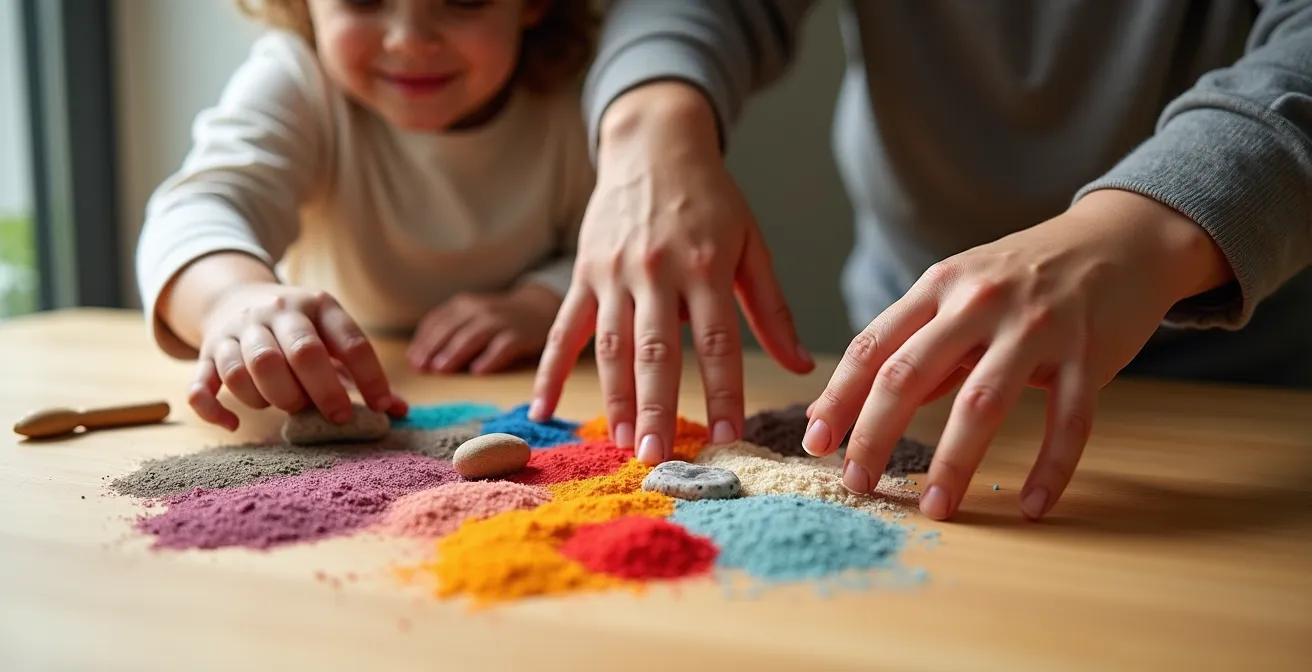
Messy play isn’t the enemy of a clean home; it’s your child’s first, most important science lab.
- Sensory sensitivities are neurological, explaining why some kids crave slime while others recoil.
- Exposure to natural soil isn’t just messy; it’s a crucial process that builds a resilient immune system and can even improve mood.
Recommendation: Instead of banning the mess, reframe your role from ‘cleaner’ to ‘lab supervisor’ by creating controlled experiments that contain the chaos and maximize the learning.
The sight of it can make a tidy parent’s heart race: a tub of slime, a pile of mud, or fingers covered in brightly colored goo. You want your child to learn and explore, but your mind immediately calculates the cleanup time, the potential for stained carpets, and the general household entropy. The common advice to “just embrace the mess” or “put down a tarp” often feels dismissive, ignoring the very real stress that chaos can induce.
These tips treat the symptom—the mess—but not the underlying conflict. You value learning and scientific curiosity, but you also value order and a calm environment. The constant battle between these two desires can feel exhausting, leading many well-intentioned parents to limit or avoid these critical developmental activities altogether.
But what if we reframed the entire problem? What if the mess isn’t chaos, but data collection? What if your child isn’t just making a mess, but conducting their very first controlled experiments in physics, chemistry, and biology? When you shift your perspective from being the “Head of Cleanup” to the “Lab Supervisor,” everything changes. You can strategically manage the experimental parameters to facilitate profound learning while keeping the ‘lab’—your home—from descending into disaster.
This guide will give you a new framework for tactile play. We will explore the science behind your child’s sensory needs, provide blueprints for safe and contained “experiments” (including edible ones for the youngest scientists), and establish effective “cleanup protocols” that teach responsibility. It’s time to put on your lab coat and empower your child’s inner scientist, without sacrificing your sanity.
To help you navigate this new approach, this article is structured to build your confidence as a lab supervisor. We’ll start with the ‘why’ behind sensory needs and move systematically toward the ‘how’ of managing experiments and cleanup.
Summary: The Neat Parent’s Guide to Messy Play
- Why Some Kids Crave Slime While Others Gag at the Sight of It?
- How to Make Edible “Mud” for Toddlers Who Put Everything in Their Mouths?
- Sand vs. Water: Which Medium Teaches Volume and Physics Better?
- The Hygiene Mistake That Blocks Your Child’s Immune System Development
- When to Clean Up: Teaching Responsibility After the Messy Fun
- Why Sensory Play Calms High-Energy Kids Before Bedtime?
- Why Playing in the Mud Is Actually Good for Your Child’s Immune System?
- How to Create Mess-Free Sensory Bins for Small Urban Apartments?
Why Some Kids Crave Slime While Others Gag at the Sight of It?
Ever wonder why one child will gleefully plunge their hands into a bowl of oobleck while their sibling recoils in disgust? This isn’t a matter of personality or pickiness; it’s a matter of neurology. Every brain is wired to process sensory information—touch, sight, sound, smell, and taste—but not every brain is wired the same way. This variation is key to understanding your little scientist’s unique needs.
For some children, known as “sensory seekers,” their nervous systems require intense input to feel regulated and aware of their bodies. They crave strong textures, pressures, and movements. For them, squishing slime or smearing paint isn’t just fun; it’s a way to feed their brains the input they need to feel calm and organized. For others, who are “sensory avoiders” or have heightened sensitivity, the same sensations can be overwhelming, triggering a fight-or-flight response. Their brains struggle with “sensory gating,” the ability to filter out irrelevant information.
Children with SPD demonstrate less sensory gating and more within-group variability than typically developing control children.
– Davies & Gavin, STAR Institute Research
This neurological difference is more common than many parents realize. In fact, studies show that atypical sensory processing affects nearly 40% of children with neurodevelopmental disorders, and it’s also present in many typically developing children. Understanding whether your child is a seeker or an avoider is the first step in designing “experiments” they will actually enjoy. A seeker might need a giant bin of “mud,” while an avoider might prefer starting with a small, sealed bag containing hair gel and beads—offering the visual input without the direct tactile challenge.
How to Make Edible “Mud” for Toddlers Who Put Everything in Their Mouths?
For the youngest scientists, typically under the age of three, the primary tool for data collection is their mouth. This oral exploration phase is a normal and crucial part of development, but it poses a significant challenge for sensory experiments involving non-food items. The solution? Design experiments with edible materials. This eliminates the safety concern and allows even the tiniest toddlers to fully engage their senses.
Creating a taste-safe sensory lab is surprisingly simple and often involves common kitchen ingredients. The goal is to provide a variety of textures for exploration—smooth, gritty, fluffy, or gooey—that are completely harmless if ingested. You can think of these as your lab’s ‘starter chemicals’. Some of the most effective and popular options include:
- Edible Slime: Mix pudding powder with water for a smooth, creamy slime that is perfect for scooping and tasting.
- Taste-Safe Paint: Use plain yogurt mixed with natural food coloring for a vibrant finger-painting experience.
- Cloud Dough: Combine flour and a small amount of vegetable oil (an approximate 8:1 ratio works well) for a soft, moldable dough.
- Aquafaba Foam: Whip the liquid from a can of chickpeas with a little cream of tartar to create a stable, fluffy foam for scooping and hiding toys.
This illustration shows just how engaging these simple materials can be for little hands. The focus is on the tactile experience—the squishing, patting, and trailing of fingers through the material.
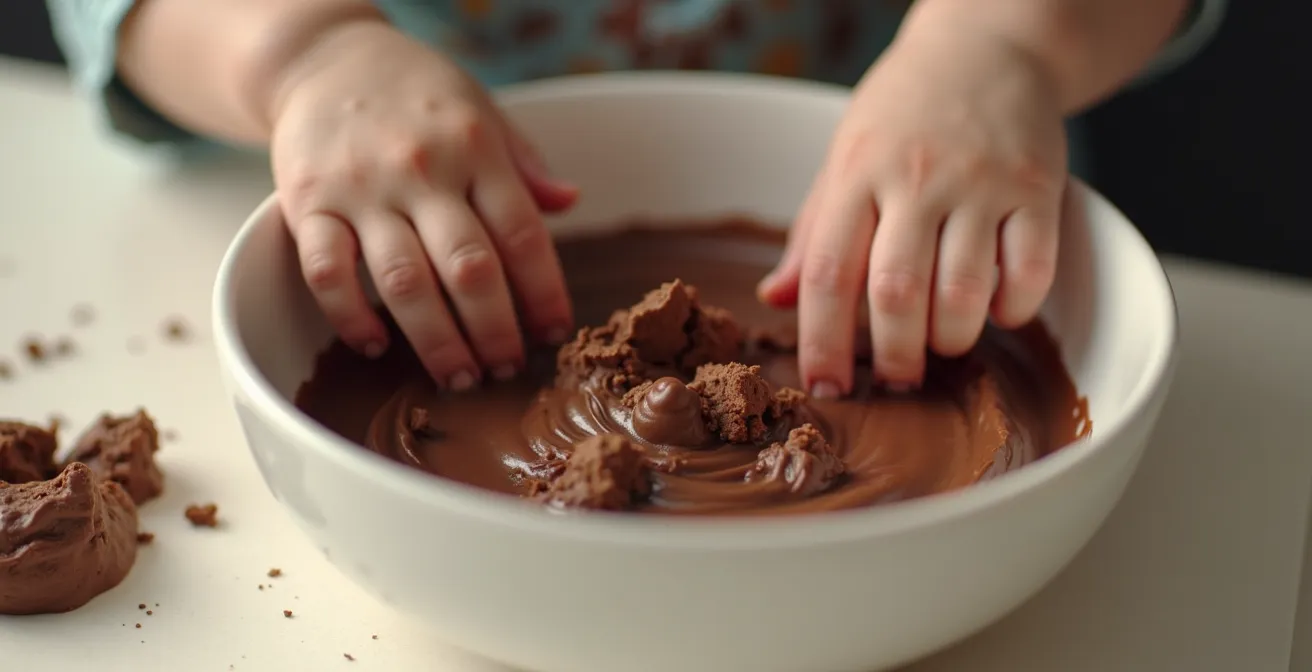
When selecting your edible medium, consider both texture and cleanup. This guide can help you choose the right “experiment” for your lab’s conditions.
| Recipe Type | Texture | Allergen-Free Options | Clean-Up Score (1-5) |
|---|---|---|---|
| Chocolate Pudding Mud | Smooth, creamy | Dairy-free available | 3 |
| Coconut Cloud Dough | Soft, moldable | Gluten-free | 2 |
| Chickpea Aquafaba Foam | Fluffy, light | All allergen-free | 1 |
| Oatmeal Sensory Mix | Gritty, chunky | Can be gluten-free | 4 |
Sand vs. Water: Which Medium Teaches Volume and Physics Better?
Once your child graduates from the “everything-in-the-mouth” phase, you can introduce classic, non-edible materials to your sensory lab. Sand and water are two of the most fundamental and powerful mediums for teaching core principles of physics. While they both offer immense value, they excel at demonstrating different scientific concepts. Choosing the right one depends on your learning objective for the day’s “experiment.”
Water is the ultimate teacher of buoyancy, displacement, and surface tension. A simple tub of water becomes a laboratory for understanding why a heavy rock sinks while a wide, flat boat made of the same material might float. By adding measuring cups and containers of different shapes, children intuitively grasp the concept of volume. They are conducting real-time experiments in fluid dynamics every time they pour water from a tall, thin container into a short, wide one and see the water level change.
Sand, on the other hand, is a masterclass in structural engineering and friction. A child pouring dry sand learns about angles of repose as they watch their pile grow and collapse. They are testing the properties of a granular solid. When you add a little water, the experiment changes entirely. Wet sand introduces the concept of cohesion—the force that holds the particles together, allowing for the construction of elaborate castles and tunnels. This is a direct, hands-on lesson in how materials science works.
Case Study: The Aluminum Foil Boat Challenge
A classic experiment that highlights the power of tactile learning is the aluminum foil boat challenge. Neuroscience research shows that hands-on exploration activates diverse brain receptors. In this challenge, a child is given a piece of foil and asked to build a boat that can hold the most pennies before sinking. This simple activity is a profound lesson in buoyancy and weight distribution, as children physically test their predictions about shape, surface area, and structural integrity. It turns an abstract physics concept into a tangible problem to be solved.
Instead of viewing them as competitors, think of sand and water as complementary tools in your lab. As this comparative analysis from Action for Healthy Kids shows, each material offers a unique window into the laws of physics.
| Physics Concept | Water Excellence | Sand Excellence | Wet Sand Bonus |
|---|---|---|---|
| Buoyancy | ✓ Floating/sinking experiments | – | – |
| Displacement | ✓ Volume measurement | Limited | Moderate |
| Surface Tension | ✓ Bubble formation | – | – |
| Friction | – | ✓ Pouring angles | ✓ Enhanced |
| Structural Engineering | – | ✓ Pile formation | ✓ Castle building |
| Cohesion | Limited | – | ✓ Binding properties |
The Hygiene Mistake That Blocks Your Child’s Immune System Development
For a parent who values cleanliness, the instinct to sanitize everything after a messy play session is strong. We associate dirt with germs and germs with illness. However, a growing body of scientific evidence suggests that our modern obsession with hygiene might be a significant mistake, depriving our children’s developing immune systems of the exact input they need to become strong and resilient. This concept is known as the “hygiene hypothesis.”
The hypothesis proposes that a lack of early childhood exposure to diverse microorganisms, like those found in soil and on farms, can lead to a miscalibrated immune system. Instead of learning to distinguish between real threats and harmless substances, an under-stimulated immune system can overreact to benign triggers like pollen or dust, leading to allergies, asthma, and other autoimmune conditions. The data is compelling: research confirms that children on traditional farms are 30-50% less likely to develop these conditions.
It’s not about being unhygienic in a dangerous way (handwashing after using the bathroom or before eating remains critical). It’s about rethinking our relationship with “good dirt.” Dr. Christopher Lowry, a behavioral neuroscientist, discovered a specific soil bacterium, Mycobacterium vaccae, with remarkable properties. His work revealed a direct link between exposure to this microorganism and a stronger, more well-regulated immune response.
It appeared that this microorganism living in the soil had powerful immune-regulating properties that were somehow making the vaccines work better.
– Dr. Christopher Lowry, University of Colorado Boulder
So, the hygiene mistake isn’t letting your child get dirty; it’s the over-sanitization that prevents them from interacting with the beneficial microbes that are essential for their biological development. Allowing some exposure to natural soil or resisting the urge to immediately use antibacterial wipes on every surface is a form of “immune system training.” You are, in effect, providing the data your child’s body needs to build a robust and intelligent defense system.
When to Clean Up: Teaching Responsibility After the Messy Fun
In any well-run laboratory, the final step of an experiment is the cleanup. This isn’t just a chore; it’s an integral part of the scientific process that teaches respect for the tools, the space, and the work itself. For the neat-loving parent, this “cleanup protocol” is a non-negotiable part of messy play. It’s the moment where order is restored, but more importantly, it’s a golden opportunity to teach responsibility, sequencing, and teamwork.
The key to a successful cleanup is to frame it not as a punishment for making a mess, but as a natural and even fun conclusion to the experiment. The process should be introduced before the play even begins. Setting the expectation—”After we finish our volcano experiment, we’ll do the ‘Bubble Dynamics’ test to clean our tools”—makes the transition smooth and predictable. Using a timer and giving a five-minute warning also helps children mentally prepare to switch tasks.
Most importantly, the cleanup tasks must be age-appropriate. Expecting a two-year-old to wipe down a whole table is a recipe for frustration. However, they are perfectly capable of putting one toy in a bucket or carrying their cup to the sink. As children grow, their responsibilities can increase, turning cleanup into a skill they master over time. This collaborative effort, as shown below, reinforces that everyone in the “lab” plays a part in maintaining the space.
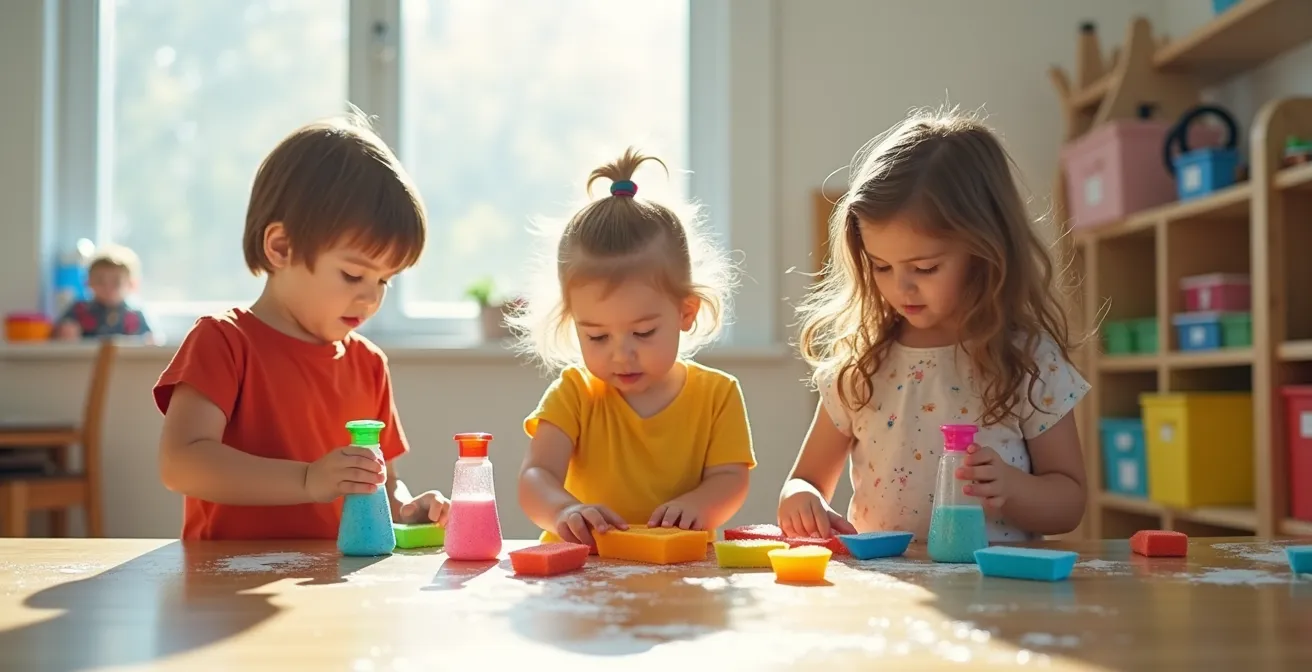
A structured approach ensures that cleanup is seen as part of the fun, not the end of it. By breaking down the process into manageable steps, you empower your child and transform a potential power struggle into a moment of shared accomplishment. This checklist provides a clear guide for assigning roles in your lab.
Your Lab’s Cleanup Protocol: Age-Appropriate Responsibilities
- Toddlers (2-3 years): Focus on simple, single-step tasks. Their job might be to put one tool in the wash bucket or help carry a light item to the sink. The goal is participation, not perfection.
- Preschoolers (4-5 years): Introduce multi-step processes. They can be responsible for wiping down their own tray, helping to sort materials (e.g., “all the blue rocks go in this bin”), and rinsing tools under supervision.
- School-Aged (6+ years): Assign ownership of the entire station. They can be responsible for the full clean-up process, from sorting and washing materials to wiping surfaces and even sweeping the floor area.
- Introduce a 5-Minute Warning: Always signal the transition. A simple “Five more minutes of play, and then it’s time for our clean-up game!” prevents abrupt endings and gives them time to finish their thought.
- Frame Cleanup as Science: Turn washing into its own experiment. “Let’s do a ‘Sponge Absorption Test’!” or “Watch the ‘Bubble Dynamics’ as we wash the tools!” This keeps the playful, curious mindset going.
Why Sensory Play Calms High-Energy Kids Before Bedtime?
It might seem counterintuitive to introduce a “messy” activity before bed, a time usually reserved for winding down. However, the right kind of sensory play can be one of the most powerful tools for calming a high-energy or anxious child and preparing their body for sleep. The secret lies in understanding the difference between activating and regulating sensory input.
Activating play, like tickling, chasing, or bright, flashing toys, revs up the nervous system. Regulating play, in contrast, provides predictable, rhythmic, and repetitive input that soothes it. Activities like slowly pouring sand, kneading dough, or watching glitter settle in a jar engage the parasympathetic nervous system. This is the body’s “rest and digest” system, responsible for lowering heart rate, decreasing stress hormones like cortisol, and promoting a state of calm. For a child who has been running on high alert all day, this type of play is like a reset button for their brain.
The connection between sensory processing and sleep quality is scientifically validated. Research has shown that a child’s sensory behaviors are a powerful predictor of their sleep patterns. A study on the topic found that behavioral and physiological measures predicted good versus poor sleepers with 85.7% accuracy when sensory factors were considered. A child who doesn’t get the right sensory input during the day may seek it out at night by tossing, turning, or resisting bedtime.
Therefore, incorporating a 10-15 minute “calm-down” sensory experiment into the bedtime routine can be transformative. The key is to choose activities that are contained and soothing. Think of a “sensory bag” made with a sealed Ziploc filled with hair gel and glitter, a small tray of scented salt for drawing, or a classic “calm-down jar.” These contained experiments provide the regulating input the child’s nervous system craves without creating a large-scale cleanup right before bed. It’s a targeted dose of sensory medicine.
Why Playing in the Mud Is Actually Good for Your Child’s Immune System?
We’ve already touched on the “hygiene hypothesis” and the mistake of being too clean. Now, let’s zoom in on the star of that story: mud. Far from being just “dirt,” soil is a complex, living ecosystem teeming with microorganisms that have co-evolved with humans for millennia. One particular bacterium found in soil, Mycobacterium vaccae, has been the subject of fascinating research that links it not only to immune health but also to mental well-being.
The initial discoveries were remarkable. As we discussed, exposure to this bacterium helps “train” the immune system to be more balanced. But the benefits don’t stop there. Researchers at Bristol University made a groundbreaking connection between M. vaccae and brain chemistry. They found that this humble soil bacterium had a surprising effect on mood.
The study, later expanded upon by other researchers, found that when mice were exposed to M. vaccae, it activated a specific group of neurons in their brains. As Dr. Chris Lowry explained in a report on his Bristol University study, these were the neurons responsible for producing serotonin. Serotonin is a critical neurotransmitter often called the “happiness chemical” because of its role in regulating mood, anxiety, and feelings of well-being. The effect was so profound that it was comparable to that of antidepressant medication.
This research gives a whole new meaning to the joy children experience while making mud pies. It’s not just in their heads; it might actually be *in their brains*, triggered by the microbes in the soil. This suggests that exposure to natural environments and “good dirt” acts as a kind of natural antidepressant. When cancer patients were treated with a heat-killed version of M. vaccae, they not only showed improved immune function but also reported a higher quality of life and better mood. So, letting your child play in the mud isn’t just a nostalgic pastime; it’s a science-backed activity that supports both their physical and mental health.
Key Takeaways
- Shift Your Role: You are not a cleaner, but a ‘Lab Supervisor’ facilitating critical scientific learning.
- Reframe the Mess: The mess is not chaos; it is ‘data’ your child is collecting about the physical world.
- Embrace “Good Dirt”: Exposure to natural soil is a science-backed method for building a resilient immune system and improving mood.
How to Create Mess-Free Sensory Bins for Small Urban Apartments?
The “Sensory Lab” concept is powerful, but what if your laboratory is a small urban apartment with no backyard and pristine floors? The fear of rice getting everywhere or slime ending up on the sofa is a legitimate barrier. The solution lies in one word: containment. With a few strategic choices, you can create engaging sensory experiences that are virtually mess-free, making them perfect for limited spaces.
The first principle of containment is the “double-bin” method. Place your primary sensory bin (the one with the sand, water, or pasta) inside a much larger, shallow container. An under-bed storage box, a large baking sheet with a high rim, or even a small inflatable kiddie pool can serve as this outer barrier, catching 99% of the spills and stray materials. This simple step dramatically reduces the ‘blast radius’ of the experiment.
Second, choose your materials wisely. There is a whole world of sensory play beyond loose sand and wet goo. Consider these contained categories for small-space success:
- Dry & Contained: Opt for larger items that are easy to pick up, like pom-poms, large buttons, or dry pasta shapes, instead of fine-grained rice or sand.
- Wet & Sealed: Create “sensory bags” by filling sturdy Ziploc bags with hair gel, shaving cream, or even paint. Seal them with strong tape. This provides all the squishy, gooey fun with zero direct contact and zero mess.
- Controlled & Evaporative: One of the cleanest sensory activities is “water painting.” Give your child a small bowl of water and a paintbrush, and let them “paint” on construction paper or a small chalkboard. The marks darken and then disappear as they dry, offering endless, mess-free creativity.
For many parents in tight spaces, finding this balance is the key to making sensory play sustainable. As one parent wisely noted, the magic lies in managing expectations and preparation.
I’ve learned that if the activity takes longer to set up than it does to entertain my kiddo—not worth it. My secret formula? Low cost, low prep, & low expectations. Big mess maybe, big magic probably.
– Houston Mom Blog
Now that you have the framework and the practical tools, the final step is to begin. Don’t feel you need to create a massive, Pinterest-worthy setup. Start small. Choose one contained experiment, present it to your child, and observe. Your role as a lab supervisor is to facilitate, observe, and guide. By embracing this mindset, you can provide rich, essential learning experiences for your child while keeping the chaos in a very manageable, scientifically-approved container.
Frequently Asked Questions About Sensory Play
What is the difference between activating and regulating sensory play?
Activating play like tickling or chasing raises energy levels, while regulating play like rhythmic pouring or kneading provides predictable input that lowers heart rate and cortisol.
How does sensory play affect the nervous system?
Repetitive sensory input activates the parasympathetic nervous system, which helps calm the body and prepare it for rest.
What are good bedtime sensory activities?
Calm-down jars with glitter, sensory bags with hair gel, and drawing in scented salt trays provide contained, soothing sensory input perfect for evening routines.