
In summary:
- Focus on heavyweight denim (12oz or more) as the primary indicator of durability.
- Inspect seams for triple-stitching, especially at high-stress points like the inseam and yoke.
- Choose 100% cotton over elastane blends for superior abrasion resistance and longevity.
- Ensure a fit that allows for a full range of motion to prevent tears and encourage active play.
- Look for hidden reinforcements like gusseted crotches and Cordura patches for ultimate toughness.
The sight is painfully familiar for any parent of an adventurous child: a brand-new pair of jeans, worn only a handful of times, now sporting a gaping hole in the knee. The endless cycle of buying, ripping, and replacing feels wasteful and frustrating. Many parents resort to flimsy tracksuits that offer no protection or simply look for jeans with a “reinforced knee” patch, often without understanding what that reinforcement truly means. This approach treats the symptom, not the cause, leaving you with a wardrobe full of failed experiments.
But what if the solution wasn’t just about patching weaknesses, but about choosing gear that was engineered for the mission of play? What if, instead of just buying clothes, you could learn to identify trousers with the structural integrity of outdoor equipment? The secret to indestructible kids’ jeans lies not in the brand name or the price tag, but in a tactical trio of material science: fabric weight, seam construction, and fiber composition. This isn’t about dressing dolls; it’s about outfitting explorers for their next great adventure.
This guide will deconstruct the anatomy of a truly tough pair of jeans. We’ll move beyond surface-level tips and dive into the specific, verifiable details that separate playground-proof denim from fast-fashion failures. You’ll learn how to assess fabric like a pro, identify superior construction at a glance, and ultimately select trousers that can withstand every slide, climb, and tumble.
Summary: How to Find Kids’ Jeans Tough Enough for Tree-Climbing?
- Why 12oz Denim Survives the Slide While 8oz Tears?
- How to Spot Triple-Stitched Seams on Kids’ Jeans?
- Elastane vs. 100% Cotton: Which Holds Up Better to Scuffs?
- The Tight Fit Mistake That Hinders Gross Motor Development
- When Will They Soften? Techniques to Make Rugged Jeans Comfortable Fast
- Why Cordura Patches Outlast Denim by 300%?
- Playground vs. Forest: Which Environment Develops Better Balance?
- How to Choose Trousers That Won’t Rip After Two Playground Trips?
Why 12oz Denim Survives the Slide While 8oz Tears?
The single most important factor in a jean’s durability is its weight, measured in ounces per square yard (oz). Think of it as the fabric’s armor. Lighter denim, typically 8-10oz, is common in fast-fashion kids’ wear because it’s cheaper and feels soft off the rack. However, it has a loose weave and thin threads that offer little resistance to the friction of a playground slide or the snag of a branch. This is why these jeans tear with alarming speed.
In contrast, heavyweight denim starts at 12oz. According to denim industry standards, 12-16 oz is considered mid-weight denim, offering the perfect balance between robust durability and wearable comfort for active kids. The threads are thicker and the weave is significantly tighter, creating a formidable barrier against abrasion. When a child slides, the dense 12oz fabric dissipates friction and heat across a wider surface area, while 8oz fabric concentrates the force on a few threads, causing them to snap.
Don’t just trust the label. You can become adept at identifying quality fabric weight in the store. Hold the jeans up to a light source; a dense 12oz weave will block most of the light, whereas a flimsy 8oz will appear semi-transparent. Perform a “pinch test” between your thumb and forefinger. Substantial denim feels dense and resists compression, while lighter fabric feels thin and crushes easily. A quality pair of adventure-ready jeans should feel less like a shirt and more like a lightweight canvas shield.
How to Spot Triple-Stitched Seams on Kids’ Jeans?
If fabric is the armor, the seams are the skeleton holding it all together. A pair of jeans is only as strong as its weakest stitch. Most standard jeans are constructed with single or double-stitched seams, which are perfectly adequate for casual wear but become a critical point of failure under the stress of active play. When a child squats, lunges, or climbs, these seams are put under immense tension, particularly at the crotch, back yoke (the V-shape below the waistband), and inseam.
For true structural integrity, you must hunt for triple-stitched seams. As the name implies, this construction method uses three parallel rows of stitching to join fabric panels. This simple addition distributes tension across three lines instead of one or two, exponentially increasing the seam’s strength and resistance to bursting. It’s a hallmark of high-quality workwear and military gear, and it’s the non-negotiable standard for any trousers destined for the playground battlefield. You can typically find this reinforcement on the outer leg seams and, in the best-made pairs, along the back yoke and inseam.
This macro photograph highlights exactly what you should be looking for. The three distinct, parallel lines of heavy-duty thread are a clear visual cue of superior construction.
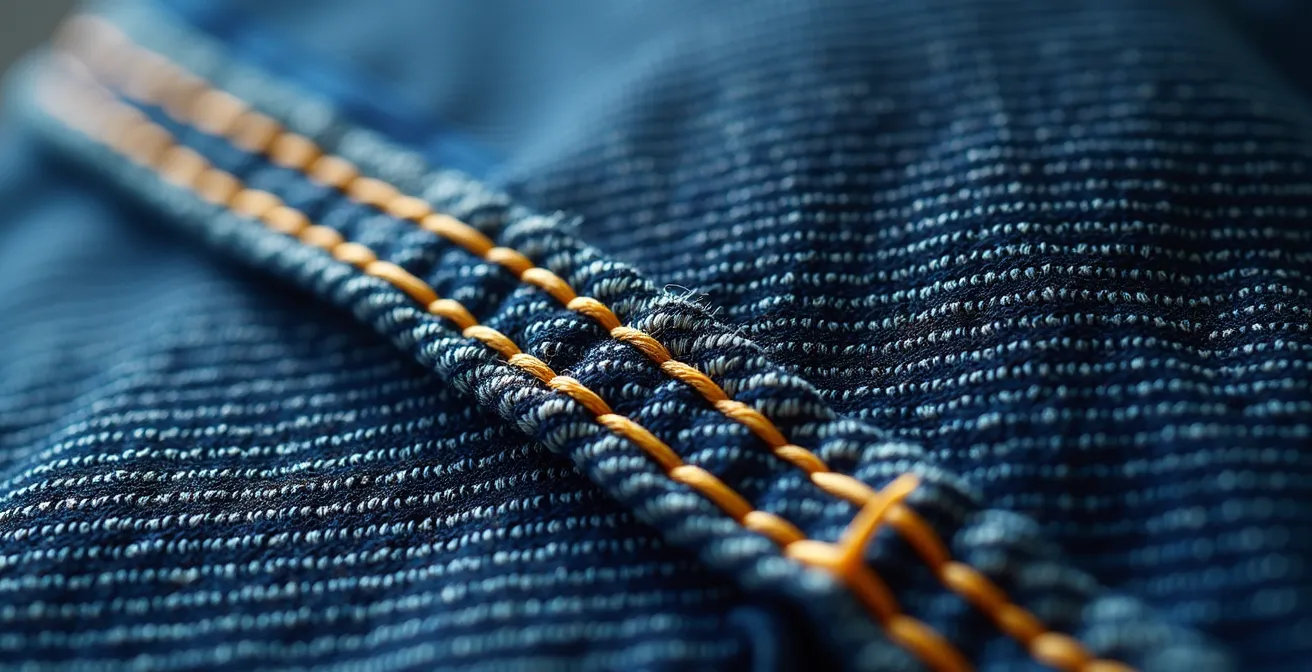
Beyond the triple stitch, look for bar tacks. These are small, tight zig-zag stitch patterns found at stress points like the corners of pockets and the base of belt loops. They act as reinforcements, preventing the fabric from tearing away from the seam during rough use. A combination of triple-stitching and bar tacks indicates that the manufacturer has prioritized durability in their design.
Elastane vs. 100% Cotton: Which Holds Up Better to Scuffs?
The rise of “stretch” denim, which blends cotton with synthetic fibers like elastane (also known as Spandex or Lycra), seems like a win for active kids. The added flexibility is undeniable. However, this comfort comes at a significant cost to durability. When it comes to resisting scrapes, slides, and scuffs, 100% cotton denim is the undisputed champion. The natural cotton fibers are robust and can withstand significant abrasion before breaking.
Elastane, by contrast, is the weak link in the fabric blend. It’s a delicate fiber that breaks down quickly when exposed to friction and heat—two elements that are ever-present during active play. When a child slides across a surface, the tiny elastane fibers are the first to snap. This leads to the fabric losing its shape, becoming baggy and saggy, particularly at the knees and seat. Worse, the broken elastane creates weak points in the fabric’s weave, making it far more susceptible to catastrophic rips.
This is a critical trade-off every parent must consider. While a 2-4% elastane blend offers immediate flexibility, it sacrifices long-term structural integrity. A 100% cotton jean might feel stiffer initially, but it will maintain its shape and resist abrasion for years, not months. The following comparison, based on technical analysis from denim specialists at ZEVA, breaks down the key differences:
| Feature | 100% Cotton Denim | Cotton-Elastane Blend (2-4%) |
|---|---|---|
| Initial Durability | Excellent – no weak synthetic fibers | Good – elastane is weakest link |
| Abrasion Resistance | Superior for slides/rough surfaces | Moderate – elastane breaks down first |
| Movement Freedom | Restricted when new | Excellent flexibility |
| Shape Retention | Maintains structure permanently | Bags and sags after 20-30 wears |
| Heat Sensitivity | Withstands hot dryers | Elastane degrades with heat |
| Longevity | 3-5 years with proper care | 1-2 years before stretch fails |
As denim durability experts have noted, the failure of stretch denim is often gradual before it is sudden. It doesn’t just rip; it loses its form first, signaling an impending breakdown.
Elastane-blend denim doesn’t just rip; it bags, sags, and loses its shape as the elastic fibers break down, leading to a poor fit long before the cotton gives out.
– Denim durability research findings, ZEVA Denim Technical Analysis
The Tight Fit Mistake That Hinders Gross Motor Development
While choosing durable materials is crucial, the wrong fit can render even the toughest jeans useless. A common mistake is selecting jeans that are too tight, particularly “skinny” or “slim-fit” styles, under the assumption that a snug fit is neater or more stylish. However, for an adventurous child, an overly restrictive fit is a triple threat: it causes premature fabric failure, restricts movement, and can even hinder the development of gross motor skills.
When a child attempts a high-knee climb or a deep squat in tight jeans, the fabric is pulled taut across their joints. This constant, focused tension creates extreme stress on the fibers and seams, leading to blowouts at the knees and crotch, regardless of the denim’s quality. More importantly, this resistance can discourage natural, exploratory play. If climbing a log feels difficult or uncomfortable, a child may simply choose not to, missing a valuable opportunity for physical development. The ideal fit for an active child is a “regular” or “relaxed” cut that provides ample room around the hips, thighs, and knees. This is their movement blueprint, enabling a full range of motion without restriction.
Don’t rely on waist size alone. Before you buy, put the jeans through a quick field test with your child to ensure they allow for true freedom of movement.
Your Action Plan: The Freedom of Movement Test
- The Squat Test: Have your child squat down as if picking up a stone – the fabric shouldn’t pull tight across the seat or restrict the downward motion.
- The Lunge Test: Ask them to take a large forward step – check for any fabric tension at the hips and thighs that pulls them back.
- The Tree Climb Simulation: Have them lift one knee to hip height, as if placing a foot on a branch. The jeans should allow this without any resistance.
- The Sitting Cross-Legged Test: The child should be able to sit comfortably on the floor cross-legged without the fabric digging into their thighs or hips.
- The Running Motion Check: Have them simulate running in place with high knees; their thighs shouldn’t feel constricted during the upward movement.
When Will They Soften? Techniques to Make Rugged Jeans Comfortable Fast
You’ve chosen a pair of unyielding, 100% cotton, 12oz+ denim jeans. They’re built like a fortress, but they also feel like one. The initial stiffness of raw, heavyweight denim can be a major deterrent for kids who are used to softer fabrics. The good news is that this rigidity is temporary. These jeans are designed to break in and mold to the wearer’s body, becoming uniquely comfortable over time. But who has weeks to wait? Fortunately, you can accelerate this process significantly.
While the best way to break in jeans is simply to wear them during vigorous play—crawling, climbing, and rolling all help soften the fibers—a few household tricks can give you a massive head start. The goal is to wash out the factory starch that gives new denim its crispness and to mechanically agitate the cotton fibers to make them more pliable. Forget expensive fabric softeners, which can coat fibers and ironically reduce breathability.
Field Method: The Vinegar & Tennis Ball Technique
A time-tested method reported by denim enthusiasts involves a simple wash and dry cycle. For the first wash, turn the jeans inside out and add one cup of standard white vinegar to the cold wash cycle; the vinegar acts as a natural fabric softener, helping to break down the starch in the cotton. Then, tumble dry the jeans on a low-heat setting with three clean tennis balls. As the dryer tumbles, the tennis balls will continuously beat against the fabric, physically breaking down the stiffness of the weave. This single process can reduce the break-in period from several weeks to just a few wears, transforming the jeans from rigid armor into a comfortable second skin.
It’s important to use low heat, as high heat can cause excessive shrinkage in 100% cotton. This technique prepares the jeans for adventure, ensuring they are comfortable enough for your child to want to wear them, allowing the real, play-driven breaking-in process to begin on day one.
Why Cordura Patches Outlast Denim by 300%?
Even the toughest denim has its limits. For the most demanding adventurers, the next level of durability comes from advanced materials borrowed from military and mountaineering gear. Chief among them is Cordura, a high-performance nylon fabric renowned for its exceptional resistance to abrasion, tears, and scuffs. When integrated into children’s jeans, it creates zones of near-indestructibility.
The numbers are staggering. Durability is measured in the lab using the Martindale test, where a machine rubs a piece of fabric with a standardized abrasive surface until threads start to break. While high-quality heavyweight denim can withstand a respectable 15,000 to 20,000 abrasion cycles, standardized Martindale abrasion testing shows that Cordura-reinforced areas can exceed 40,000 cycles, and in some cases, go far beyond. This means a Cordura knee patch is, at a minimum, two to three times more durable than the denim surrounding it.
Some innovative brands, like the Swiss company Dreifeder, even weave Cordura fibers directly into the denim fabric itself, creating trousers that are up to 10 times more durable than their all-cotton counterparts while maintaining flexibility. While buying jeans with pre-installed Cordura is ideal, you can also take a proactive approach to fortify any pair of high-quality denim.
Your Action Plan: DIY Proactive Knee Reinforcement Strategy
- Purchase Early: Buy iron-on Cordura patches before the new jeans show any signs of wear. Prevention is far more effective than repair.
- Apply Internally: For invisible armor, apply the patches to the INSIDE of the knee area. This reinforces the fabric without altering the classic look of the jeans.
- Use Proper Heat: Place a pressing cloth (like a piece of cotton fabric) over the patch area and press with an iron on a medium-high setting for at least 30 seconds to ensure a strong, permanent bond.
- Reinforce All High-Friction Zones: Don’t just stop at the knees. Consider adding small patch sections to the seat and the edges of front pockets, where keys or treasures can cause wear from the inside out.
- Add External Patches Last: Decorative patches can be added to the outside for style, but only after the crucial internal reinforcement is complete.
Playground vs. Forest: Which Environment Develops Better Balance?
While both the manicured playground and the untamed forest offer fantastic opportunities for play, they are fundamentally different environments that test clothing in unique ways. Understanding these differences allows you to choose the right “gear” for the day’s specific mission. The forest, with its uneven terrain, fallen logs, and gnarled roots, is an unparalleled environment for developing proprioception and balance. The playground, with its slides and metal structures, is a torture test for abrasion resistance.
A trip to the forest demands trousers that can resist snags from thorns and branches and offer some protection from moisture. A slightly lighter-weight denim (10-11oz) with a very tight weave can be beneficial here, as it’s less likely to catch on undergrowth. More importantly, stretch is essential for forest play, as climbing over logs or scrambling up muddy banks requires a greater range of motion than most playground equipment. This is one of the few scenarios where a high-quality cotton blend with 4-6% elastane might be preferable.
The playground, however, is a high-friction zone. The primary hazards are the repetitive scraping on slides, the sharp edges of metal equipment, and the constant scuffing on pavement. Here, abrasion resistance is paramount. This is the home turf of heavyweight, 12oz+ 100% cotton denim. Stretch is less critical, and its presence is a liability, as the friction will quickly degrade the synthetic fibers.
This table breaks down the specific gear requirements for each theater of play.
| Environment Factor | Playground Requirements | Forest Requirements |
|---|---|---|
| Primary Hazard | Slide friction, metal edges | Branches, thorns, moisture |
| Key Fabric Need | Abrasion resistance (12oz+ denim) | Snag resistance + water repellency |
| Reinforcement Priority | Knees and seat for slides | Full leg coverage, gusseted crotch |
| Ideal Fabric Weight | 12-14oz heavyweight denim | 10-11oz with DWR coating |
| Stretch Requirement | Minimal (2% max) | Essential (4-6% for climbing logs) |
| Cleaning Challenge | Rubber marks, paint | Mud, sap, organic stains |
Key Takeaways
- Prioritize Fabric Weight: 12oz+ denim is the foundation of a durable jean; anything less is a compromise.
- Demand Better Construction: Triple-stitched seams and bar tacks are non-negotiable signs of a well-made garment.
- Choose Cotton for Abrasion: For playground durability, 100% cotton will always outlast elastane blends in scuff tests.
How to Choose Trousers That Won’t Rip After Two Playground Trips?
You are now armed with the intelligence to distinguish truly robust trousers from disposable fashion. The final step is to put this knowledge into practice in the store, performing a final inspection before committing. Your mission is to move beyond the price tag and brand and assess the garment based on its tangible, structural merits. By methodically checking five key points, you can confidently determine whether a pair of jeans is built for adventure or destined for the rag pile.
This process shifts your perspective from consumer to gear inspector. You’re not just buying pants; you’re selecting a piece of equipment that needs to perform under pressure. This final audit is your guarantee against disappointment. It combines the principles of fabric armor, structural integrity, and thoughtful design into a simple, hands-on checklist. Over time, this inspection will become second nature, allowing you to spot quality from across the aisle.
Thinking this way also reframes the concept of cost. A cheap pair of jeans that lasts two months is far more expensive in the long run than a well-constructed pair that endures for years and can be handed down. As parent durability tracking studies have shown, a quality $50 pair of jeans lasting 18 months has a cost-per-wear of just 9 cents per day, while a $20 pair replaced every two months costs 33 cents per day. You’re investing in fewer, better things—a principle of both sustainability and sanity.
Your Action Plan: 5-Point Durability Checklist for Store Testing
- Fabric Weight Check: Ignore the label. Feel the fabric. It must feel substantial, closer to a canvas work jacket than a soft shirt. Aim for what feels like a minimum of 10-12oz.
- Seam Inspection: Scan the high-stress seams: the outer leg, the inseam, and the back yoke. Identify the three parallel lines of a triple-stitch. If they aren’t there, the jeans fail the test.
- Crotch Construction: Look at the point where the leg seams meet. The gold standard is a diamond-shaped “gusseted” panel, which distributes stress. At a minimum, there should be heavy reinforced stitching here.
- Stress Point Fortification: Locate the corners of the back pockets and the belt loops. You should find small, dense bar tack stitches reinforcing these areas. Their absence is a red flag.
- Knee Design: Feel the inside of the knee area. Is there a second layer of fabric? Is the material noticeably thicker? This indicates a truly reinforced knee, not just a decorative patch.
Armed with this tactical knowledge, your next mission is clear: head to the store not as a shopper, but as an inspector. Put these principles to the test, choose gear over garments, and equip your adventurer to conquer their world with confidence.