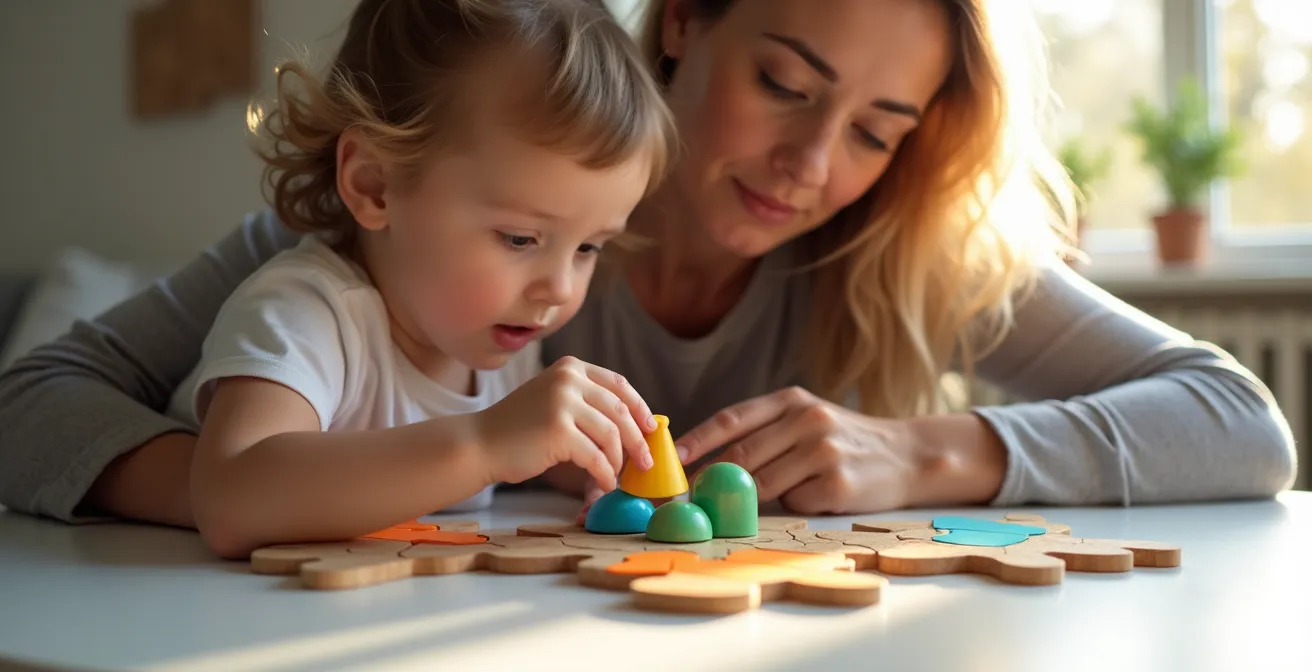
The secret to a successful STEM puzzle isn’t its age rating; it’s selecting a ‘calibrated struggle’ that perfectly matches your child’s cognitive edge.
- Early puzzle play directly predicts future mathematical ability by building foundational spatial literacy.
- Physical puzzles like wooden blocks are superior for teaching tangible physics concepts like gravity and balance compared to their digital counterparts.
Recommendation: Evaluate puzzles based on the specific skill they teach and their ability to foster independent discovery, rather than simply matching the age on the box.
You’ve likely seen it happen. The brand-new, expensive STEM puzzle, guaranteed to turn your toddler into a tiny engineer, is unwrapped with excitement. Ten minutes later, it’s either abandoned in frustration or “solved” with so much parental help that the child learned nothing. The toy, meant to build a brilliant mind, now just builds clutter in the corner of the room. This cycle is a common source of disappointment for parents wanting to give their child a head start in a world increasingly shaped by science, technology, engineering, and math.
The conventional wisdom is to simply match the puzzle to the age recommendation on the box or choose the one with the brightest colors. But this approach often fails because it overlooks the most critical factor: the quality of the challenge itself. It assumes all children of a certain age have the same abilities and learning styles, which is rarely the case. The result is a toy that is either boringly simple or infuriatingly difficult, both of which shut down the learning process.
But what if the key wasn’t avoiding frustration, but harnessing it? The true art of selecting an effective STEM puzzle lies in curating the right kind of struggle—a challenge calibrated to the precise edge of your child’s current abilities. This is about finding a puzzle that prompts them to think, experiment, and fail productively, ultimately leading to the profound confidence that comes from independent discovery. It’s about building genuine cognitive skills, not just assembling pieces.
This guide will equip you to become a curator of these powerful learning experiences. We will explore why early spatial skills are a critical predictor of future success, how to accurately gauge the right difficulty level, and why your role as a facilitator—not a solver—is paramount to the entire process. You’ll learn to distinguish between a gimmick and a genuine tool for cognitive growth, ensuring your next puzzle choice is one that truly challenges and inspires.
text
To help you navigate this curated approach, this article is structured to build your expertise step by step. Below is a summary of the key areas we will cover, from the foundational science to practical tips for your home.
Summary: A Curated Guide to a Smarter Puzzle Collection
- Why Spatial Skills at Age 3 Predict Math Success at Age 10?
- How to Pick the Right Puzzle Difficulty for Your Child’s Stage?
- App Puzzles vs. Wooden Blocks: Which Teaches Physics Better?
- The Helper Mistake That Ruins the STEM Learning Curve
- Where to Set Up a “Maker Space” That Encourages Daily Tinkering?
- When to Introduce Abstract Concepts: The 3 Stages of Cognitive Readiness
- Why Solving “Impossible” Puzzles Builds More Confidence Than Easy Wins?
- How to Manage Tactile Experimentation Without Ruining Your Home?
Why Spatial Skills at Age 3 Predict Math Success at Age 10?
The connection between a toddler fitting shapes into a wooden board and their ability to solve algebraic equations a decade later might seem tenuous, but it’s scientifically robust. The foundation of this link is a concept called spatial literacy—the ability to think about objects in three dimensions and draw conclusions from them. This isn’t just about navigating a map; it’s a fundamental cognitive tool for understanding relationships, patterns, and sequences, which are the building blocks of mathematics.
When a young child plays with puzzles, they are engaging in a powerful form of spatial training. They mentally rotate pieces, visualize how they fit together, and learn from trial and error. This hands-on experimentation builds neural pathways that support abstract thought later on. In fact, research has demonstrated that children aged 26-46 months who frequently played with puzzles showed significantly better spatial skills when they were re-assessed at 54 months old. This early advantage becomes a long-term asset.
Consider the classic Tower of Hanoi puzzle. At first glance, it’s a simple game of moving discs. But as a child works to solve it, they are physically interacting with a mathematical formula (m = 2^n – 1). They may not know the equation, but they are internalizing the logic of exponential growth through tactile experience. They are learning that the solution requires planning, sequencing, and pattern recognition—all key mathematical skills.
Therefore, when you choose a puzzle that challenges your child’s spatial reasoning, you aren’t just giving them a toy. You are providing them with a foundational tool for future academic success. You are building their capacity for abstract thought by grounding it in concrete, physical manipulation.
How to Pick the Right Puzzle Difficulty for Your Child’s Stage?
The most common mistake in selecting a puzzle is relying solely on the age printed on the box. This generic guide ignores the unique developmental pace of your child and is often the root cause of frustration or boredom. The expert approach is to curate a calibrated struggle—a challenge that is difficult enough to be engaging but not so hard that it leads to quitting. This requires you to be an observer of your child’s specific abilities.
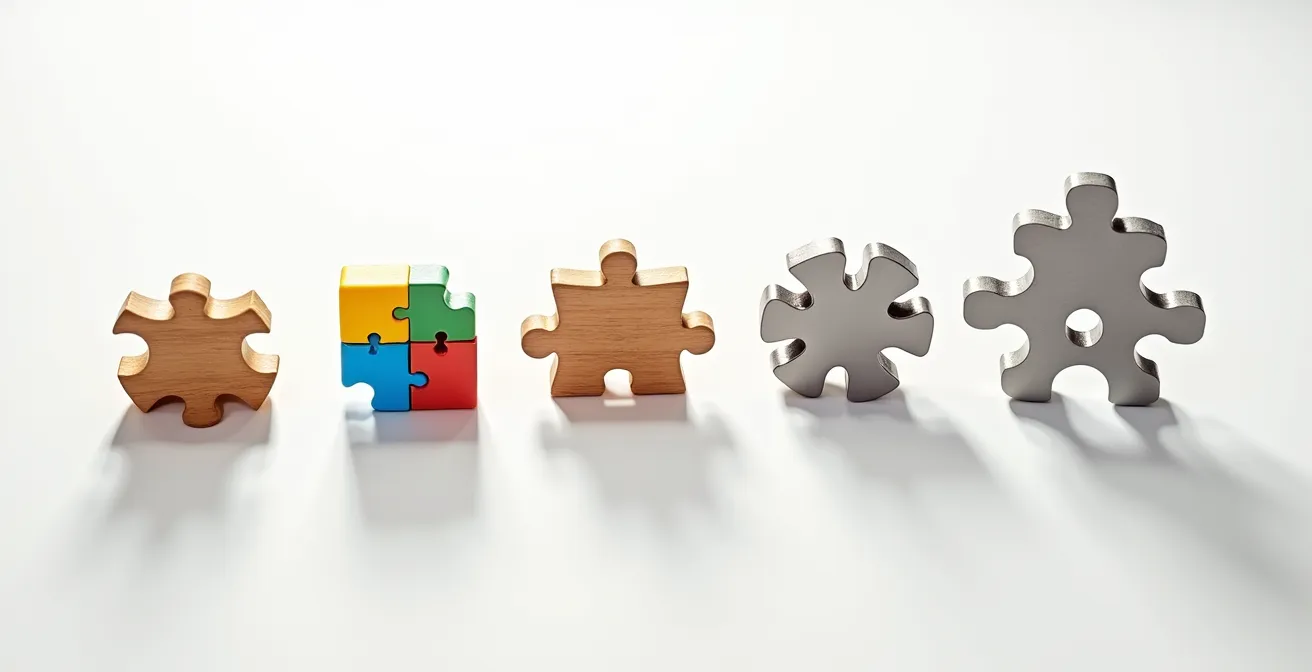
As a starting point, general guidelines can be useful for understanding the typical progression. Toddlers (2-3 years) often start with large-piece puzzles of 12 pieces or less, while preschoolers (4-5 years) can move to 30-piece puzzles that involve more complex color and shape matching. Early elementary children (6-8 years) are ready for logic puzzles and introductory STEM kits, with complexity growing from there. However, this is just a map; you must identify where your child is on that map.
This visual guide illustrates the journey from simple shapes to intricate mechanical components, a path your child will travel at their own pace.
To find the sweet spot, look for these signs. If a child solves a puzzle instantly with no effort, the cognitive benefit is minimal. It’s time to level up. Conversely, if they make no progress after several attempts and begin to show signs of genuine distress (not just mild frustration), the puzzle is likely too advanced. The perfect puzzle is one where they might get stuck, try a few wrong approaches, and then have that “aha!” moment of independent discovery. It is this very process that builds resilience and problem-solving skills.
App Puzzles vs. Wooden Blocks: Which Teaches Physics Better?
In the debate between digital and physical play, the answer isn’t that one is “good” and the other “bad.” Rather, it’s that they teach different things with vastly different levels of depth. When it comes to understanding the laws of physics, the tactile feedback of physical objects like wooden blocks or marble runs offers a learning experience that apps can only simulate. A child building a tower of blocks gets a direct, intuitive lesson in gravity, balance, friction, and stability.
When their tower collapses, they don’t just see a failure animation; they feel the vibration, hear the crash, and must physically rebuild, learning from the structural flaw. An app with an “undo” button, while convenient, robs the child of this critical feedback loop. This direct interaction with the physical world is what we call learning tangible physics. As one expert from the Children’s Urgent Care blog notes in their analysis of board games:
Hours and hours of open-ended marble run play can be had with these pieces… As kids tinker and build, they get hands-on experience with balance, stability and physics
– Children’s Urgent Care Blog, Board Games For Children By Age
This isn’t to say digital puzzles have no value. They can be excellent for teaching pure logic, 2D spatial reasoning, or concepts that are difficult to replicate physically. However, for foundational physics, the difference is clear. The following table, based on an analysis of different learning tools, breaks down the key distinctions.
| Learning Aspect | Wooden Blocks | App Puzzles |
|---|---|---|
| Physics Understanding | Direct experience with gravity, balance, friction | Simulated physics within programmed parameters |
| Sensory Feedback | Haptic feedback on mass, texture, stability | Visual and audio feedback only |
| Problem Recovery | Physical rebuilding after collapse | Instant reset button |
| Spatial Skills | 3D manipulation in real space | 2D representation of 3D concepts |
| Collaboration | Natural multi-player interaction | Structured turn-taking or solo play |
Ultimately, a balanced approach is wise. Use apps for their strengths in abstract logic, but never let them fully replace the irreplaceable lessons taught by the simple, profound act of building something real and watching it stand—or fall.
The Helper Mistake That Ruins the STEM Learning Curve
It comes from a good place: the desire to see your child succeed and to shield them from frustration. When you see them struggling with a puzzle piece, the instinct is to point to the right spot or even place it for them. This is the “helper mistake,” and it inadvertently sabotages the most important part of the STEM learning process: the struggle itself. By providing the solution, you deny your child the chance to build persistence and experience the confidence boost of solving the problem on their own.
This well-intentioned over-helping can have long-term consequences. When children are not allowed to grapple with challenges, they can develop a dependency or an aversion to difficult tasks. This may contribute to the worrying trend where, as statistics reveal, the percentage of children reporting positive attitudes about math and science drops from 71% in fourth grade to just 48% by eighth grade. They learn to associate STEM subjects with a need for external help rather than a capacity for internal problem-solving.
The correct approach is to provide cognitive scaffolding, not answers. This means structuring the environment for success without directing the play. The “Three Little Pigs” logic puzzle is a perfect case study. The puzzle book provides a clear goal (protect the pigs from the wolf) and minimal pieces. The parent’s role is simply to present the challenge. The child must then discover the solution independently. The game’s design provides the scaffolding, allowing the child to build brainpower through self-directed effort.
Your role as curator is to be a patient observer. You can offer encouragement (“That’s an interesting way to try it!”) or ask guiding questions (“What do you think might happen if you turn that piece?”). But you must resist the urge to become the solver. The goal of a STEM puzzle is not a completed picture; it’s a more capable and resilient mind.
Where to Set Up a “Maker Space” That Encourages Daily Tinkering?
A “maker space” sounds like something that requires a dedicated room and expensive equipment, but in reality, it’s more of a mindset than a location. The goal is to make STEM materials so accessible and inviting that tinkering becomes a natural part of your child’s daily routine, not a special, scheduled event. It’s about reducing the “friction” between your child and a moment of creative problem-solving. This means integrating opportunities for play throughout your home.
The key is visibility and ease of access. Storing complex STEM kits in opaque boxes on a high shelf in a closet sends the message that they are off-limits or require adult supervision. Instead, using clear containers stored on low, open shelving allows a child to see the materials and access them independently. This simple change empowers them to act on a flash of inspiration, turning a spare ten minutes into a valuable learning opportunity.
An organized, child-height corner with visible materials can transform a passive space into an active hub of creativity and learning.
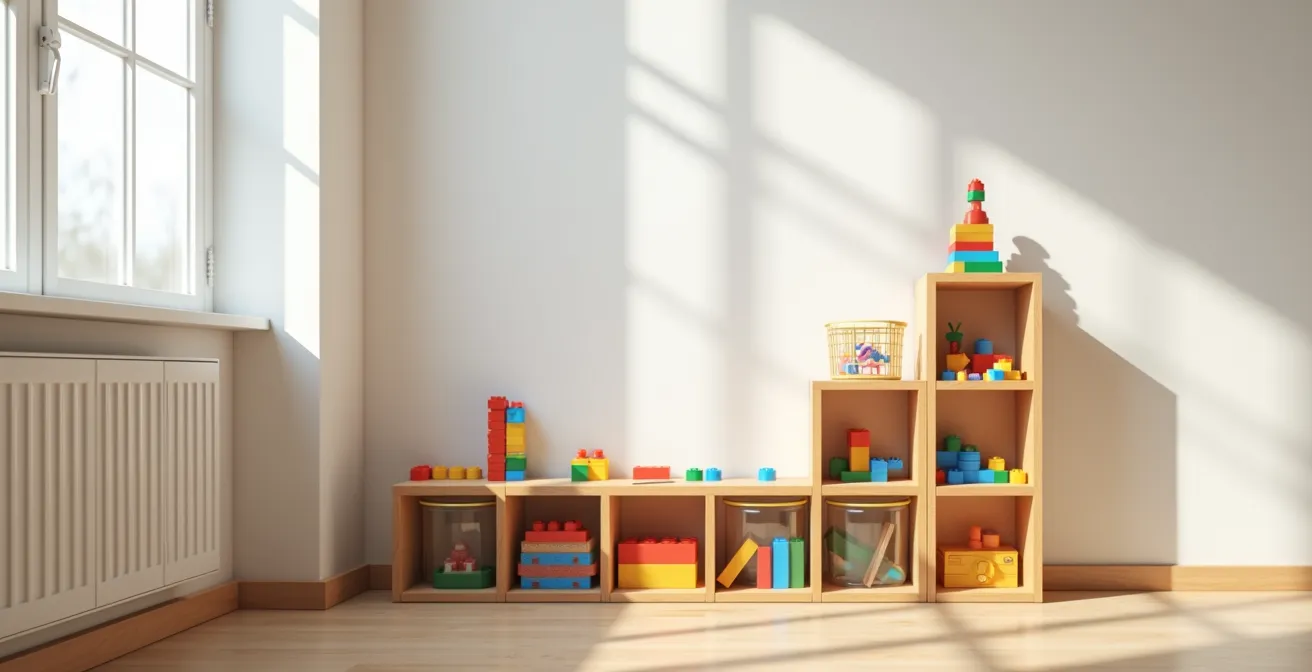
Creating this environment doesn’t require a major home renovation. It can be as simple as a designated “work-in-progress” shelf where a multi-day puzzle or building project can live undisturbed. It could be a small basket of puzzle pieces near the living room for spontaneous engagement or portable kits ready for a road trip. The focus is on making these brain-building tools a visible and integrated part of your family’s life.
Action Plan: Creating Your Home’s Maker Space
- Portability is Key: Keep some puzzles and STEM toys in portable containers that can easily travel to restaurants, waiting rooms, or on road trips.
- Enable Discovery: Store kits and puzzle boxes on low, child-height shelves. Use clear containers so children can see the contents and are inspired to play.
- Protect Projects: Designate a “work-in-progress” shelf or table where a multi-day project can be left out safely without needing to be cleaned up.
- Spontaneous Engagement: Place small, engaging puzzle sets or building blocks in baskets in main living areas to encourage impromptu tinkering.
- Encourage Collaboration: Ensure you have enough supplies or multiple small kits so that siblings or friends can work on projects simultaneously, fostering teamwork.
When to Introduce Abstract Concepts: The 3 Stages of Cognitive Readiness
Introducing a child to an abstract concept like geometry or a mathematical rule before they are cognitively ready is a recipe for frustration. True understanding is built progressively, moving from the concrete to the abstract. As a curator of learning experiences, your role is to recognize and provide for three key stages of cognitive readiness. Ignoring this progression is like asking a child to read a novel before they know the alphabet.
The Tangram, a deceptively simple puzzle of seven flat shapes, is a perfect tool for illustrating this journey. It naturally guides a child through the stages of understanding, making it a timeless educational toy. Its evolution in play mirrors a child’s cognitive development.
- Stage 1: Concrete Manipulation. In the beginning, the child’s interaction is purely physical. They might simply match the seven pieces to a template of a square, learning how the shapes fit together without any deeper understanding of the final form. They are learning the “what” of the pieces.
- Stage 2: Pictorial Representation. Next, they can move on to following diagrams to create more complex images, like animals or objects. They are now connecting the physical pieces to a 2D representation, bridging the gap between the concrete and the symbolic.
- Stage 3: Abstract Application. Finally, they reach a stage of abstract understanding. They internalize the rule that all seven pieces must be used without overlap and can apply this principle to create their own original designs. They are no longer just copying; they are creating based on an abstract rule.
This progression is vital because, as research consistently shows, early math skills are one of the strongest predictors of later school success. Activities that respect these cognitive stages—like Tangrams, pattern blocks, or counting games—build a solid foundation for STEM skills. Pushing for abstract understanding too early only builds anxiety.
Why Solving “Impossible” Puzzles Builds More Confidence Than Easy Wins?
In a culture that often celebrates instant gratification, the idea of giving a child a puzzle that seems “impossible” can feel counterintuitive. We worry it will crush their spirit. Yet, when managed correctly, tackling a monumental challenge builds a far deeper and more resilient form of confidence than a series of easy, forgettable victories. The key lies in reframing the goal from “finishing the puzzle” to “engaging in the process.”
When a child commits to a complex, multi-day project, they are developing skills that go far beyond simple logic. They are building patience, persistence, and focus. This sustained effort has measurable cognitive benefits. For instance, a study found that six-year-olds given challenging brain teasers showed significantly more attentiveness compared to control groups. The “impossible” puzzle becomes a training ground for deep concentration.
The Magic Puzzle Company, for example, has built its brand on this very principle. Their 1,000-piece puzzles are intentionally designed for “puzzlers with stamina in spades.” These projects are meant to be tackled over multiple evenings, often as a collaborative family effort. The satisfaction comes not from a quick win, but from the shared journey and the immense pride of completing a long-term goal. It teaches children that the most rewarding achievements are often those that require sustained effort and even a little bit of struggle.
This is the pinnacle of the “calibrated struggle.” An easy win provides a fleeting moment of satisfaction. But the memory of conquering a challenge that once felt insurmountable provides a lasting wellspring of self-belief. It teaches a child the single most important lesson for any future scientist, artist, or engineer: “I can do hard things.”
Key Takeaways
- Focus on ‘Calibrated Struggle’: The best puzzle isn’t determined by age but by its ability to challenge your child at the very edge of their current skill level.
- Prioritize ‘Tangible Physics’: Physical toys like blocks and marble runs offer invaluable, real-world lessons in gravity and balance that digital apps cannot replicate.
- Be a Facilitator, Not a Solver: Your role is to provide cognitive scaffolding and encouragement, allowing your child the satisfaction of independent discovery.
How to Manage Tactile Experimentation Without Ruining Your Home?
Encouraging hands-on, tactile STEM experimentation is wonderful in theory, but the reality often involves marker stains on the table, tiny pieces scattered across the floor, and a general state of creative chaos. The fear of mess can unconsciously lead parents to limit these vital learning opportunities. However, managing tactile play is not about prevention; it’s about containment. With a few smart strategies, you can foster a rich experimental environment without sacrificing your home’s order.
The first principle is to define the workspace. This doesn’t require a separate room, but simply a designated area where mess is acceptable. This could be a washable craft mat on the floor, a specific corner of the kitchen table covered with newspaper, or a dedicated art easel. Using thick cardboard as a project base or drawing bold perimeter lines with a ruler can create clear, physical boundaries that help a child understand where the “messy zone” ends.
Choosing the right materials is also crucial. Opting for washable markers and crayons, for example, removes the anxiety associated with permanent stains. When creating DIY puzzles, using thick, sturdy cardboard ensures they can withstand repeated handling and experimentation. Even creative techniques, like using tea bags to give craft paper a “vintage” look for a homemade puzzle, can be managed with simple methods—like sweeping and sliding the bag rather than dabbing—to maintain a clean surface.
Here are some practical strategies for containing the creative explosion:
- Use a tea bag staining technique on craft paper for vintage puzzle effects by sweeping and sliding rather than dabbing to maintain a smooth surface.
- Create DIY puzzles on thick cardboard that can withstand repeated handling and experimentation.
- Draw thick perimeter lines with rulers on a large sheet of paper to create defined work boundaries for your child.
- Stock your maker space with washable markers and crayons for easy cleanup after creative sessions.
- Work on dedicated craft surfaces, like silicone mats or plastic trays, that can be easily wiped clean or replaced.
Start today by evaluating one puzzle in your home not by its age-rating, but by the quality of the struggle it offers and the opportunity for independent discovery it provides.