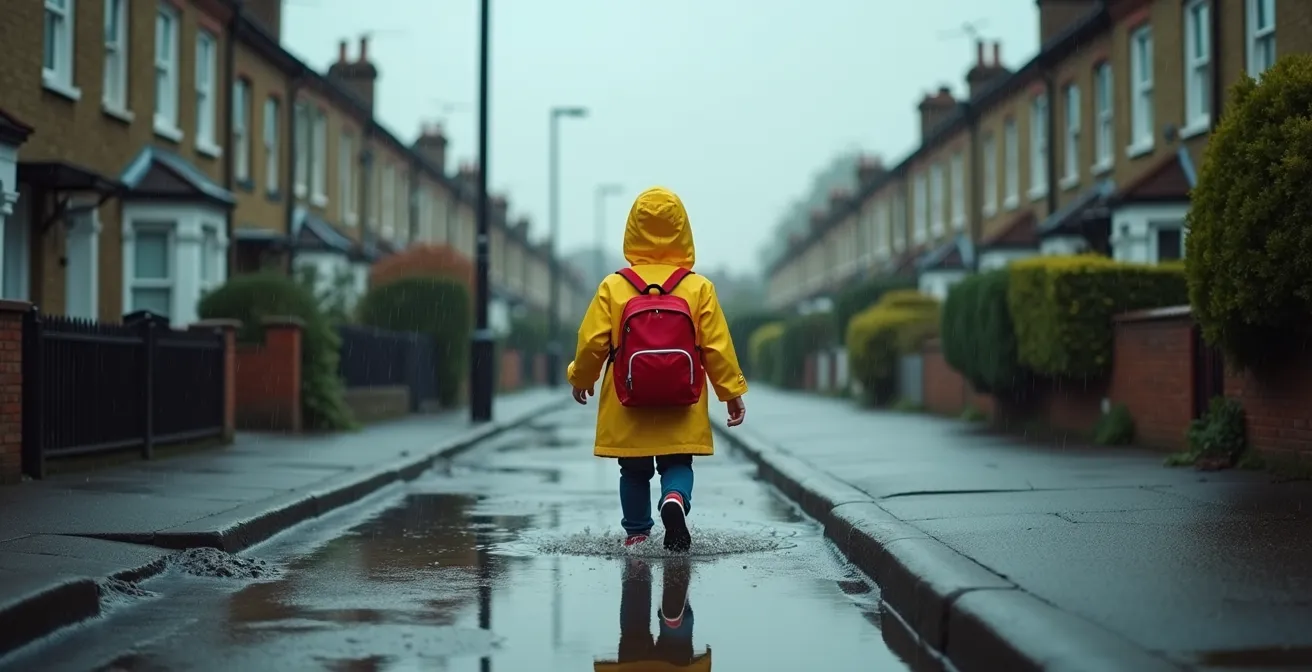
The frustration of a child arriving at school damp, despite wearing a “waterproof” jacket, isn’t a sign of a faulty coat but a failure in the system. True dryness isn’t just about the jacket; it’s about managing a complete micro-climate from your child’s skin outwards. This guide moves beyond simple labels to explain the science of hydrostatic pressure, moisture-wicking, and proper layering, equipping you to build a reliable defense against any urban downpour.
There’s a specific, quiet frustration every parent knows: the sight of your child’s shoulders, dark with dampness after a short walk from the car to the school gates. You bought the “waterproof” jacket. You checked the forecast. Yet, the persistent UK drizzle has once again defeated the technology, leaving your child chilly and uncomfortable for the day ahead. This daily battle against the elements feels like a lottery, one that parents too often lose.
The common advice is to look for “taped seams” or a “breathable” fabric. While not incorrect, this is like telling a chef to “use good ingredients” — it misses the fundamental technique. The market is flooded with jackets claiming to be the ultimate barrier, but they often fail to address the complete meteorological reality. The problem isn’t just the rain coming in; it’s also the sweat that can’t get out, creating a clammy, “boil-in-the-bag” effect that is just as unpleasant as the rain itself.
But what if the key wasn’t simply buying a better jacket, but understanding the jacket as one part of an integrated weather-defense system? The real secret to keeping your child dry and comfortable lies not in a single product, but in managing the entire micro-climate around them. This is where we, as urban meteorologists, can shift the odds in our favour. It’s about understanding the forces at play — hydrostatic pressure, moisture vapour transmission, and thermal dynamics — and using that knowledge to build a foolproof system from the base layer to the outer shell.
This guide will deconstruct the science of staying dry. We will analyse the critical waterproof ratings needed for UK weather, identify the non-negotiable construction details, and compare the materials that truly balance protection with comfort. By the end, you will be equipped not just to buy a raincoat, but to engineer a personal weather shield for your child, ensuring they arrive at school warm, dry, and ready for their day, no matter what the sky throws at them.
Summary: How to Choose a Child’s Raincoat That Actually Works
- Why 10,000mm Waterproofing Is Necessary for UK Winters?
- How to Identify Taped Seams Without Being an Expert?
- PU Rubber vs. Gore-Tex: Which Stops the “Boil-in-the-Bag” Sweat Effect?
- The Hood Mistake That Blinds Your Child When Crossing Roads
- When to Re-Proof: Signs Your Child’s Coat Has Lost Its Shield
- Why the Base Layer Is More Important Than the Jacket?
- Walking vs. Driving: Which Commute Sets Your Child Up for a Better Day?
- How to Layer Kids for School Without Them Losing Their Coats?
Why 10,000mm Waterproofing Is Necessary for UK Winters?
The term “waterproof” is not a simple yes-or-no quality; it is a measurable, scientific rating. This measurement, known as the Hydrostatic Head, is given in millimetres (mm) and quantifies the amount of water pressure a fabric can withstand before a single drop penetrates it. For a fabric to be legally called waterproof in the UK, it only needs to achieve a 1,500mm rating. This might be sufficient for a light, brief shower, but it stands no chance against the driving, persistent rain typical of a British school run.
Consider the forces at play. The pressure of wind-driven rain, or a child leaning against a wet wall or wearing a backpack, dramatically increases the force exerted on the fabric. A jacket with a low rating will fail under these common real-world conditions. For weather that moves beyond a drizzle into a proper downpour, a much higher level of defense is required. The consensus among outdoor gear experts is clear: for sustained, heavy rain, you need a significantly higher rating. In fact, gear rated between 11,000mm to 15,000mm is specifically designed to handle heavy rain and wet snow, providing a reliable shield.
Therefore, a 10,000mm rating should be seen as the absolute minimum for a child’s raincoat intended for a UK winter. Anything less is merely water-resistant and will eventually succumb to a prolonged downpour, leading to the familiar damp-shoulder syndrome. Investing in a jacket with a 10,000mm to 15,000mm rating isn’t overkill; it’s a calculated response to the predictable atmospheric assault your child will face. It’s the difference between a coat that looks the part and one that performs its duty.
How to Identify Taped Seams Without Being an Expert?
A high waterproof rating is an excellent start, but it’s rendered useless if the jacket’s weakest points are not fortified. Every stitch line in a garment creates thousands of tiny holes where water can penetrate. A top-tier fabric can be as impenetrable as a submarine’s hull, but if the seams are not sealed, it’s like leaving a porthole open. This is why taped seams are a non-negotiable feature of any truly waterproof garment.
Identifying them doesn’t require expertise. Simply turn the jacket inside out and look at the stitching lines. On a properly constructed coat, you will see a thin, glossy, plastic-like strip of tape fused over every seam. This is the waterproof barrier that seals the needle holes. If you see only thread and fabric, the jacket is, at best, water-resistant and will fail in a downpour. Some jackets may claim to be “critically taped,” which means only the most exposed seams (like the shoulders and hood) are sealed. For a child’s coat, which endures all manner of movement, fully taped seams are the only reliable option.
This small detail is a primary indicator of a manufacturer’s commitment to genuine waterproofing. As testers in the Pacific Northwest found, jackets with sealed seams consistently block serious rain, while those without them cannot withstand prolonged exposure. A jacket’s construction is as vital as its material.
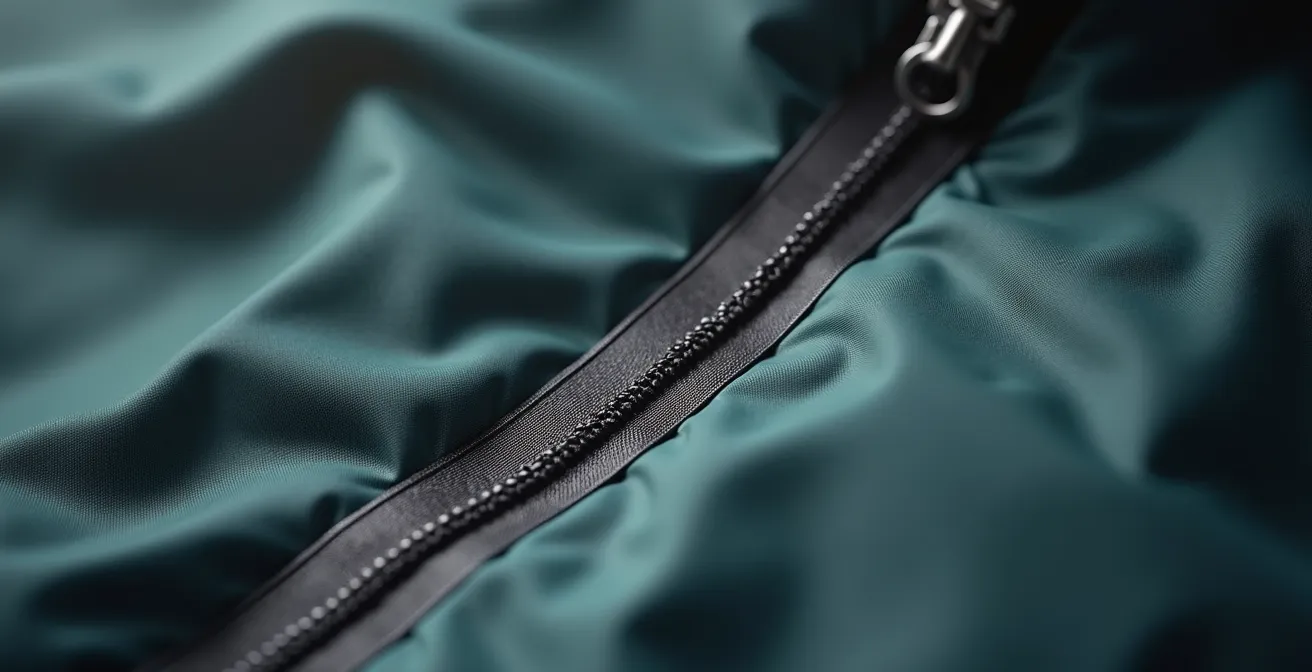
As this close-up shows, the tape creates a smooth, impermeable layer over the vulnerable stitching. When you’re assessing a potential coat, this visual check is your most reliable test. It takes only a few seconds and provides a definitive answer about the jacket’s ability to withstand a proper soaking. Don’t just trust the hang-tag; trust the tape.
PU Rubber vs. Gore-Tex: Which Stops the “Boil-in-the-Bag” Sweat Effect?
Keeping rain out is only half the battle. A child running for the school bus or playing at break time generates a significant amount of heat and moisture (sweat). If this moisture is trapped, it condenses on the inside of the jacket, leaving the child feeling clammy and cold, even if no rain has penetrated. This “boil-in-the-bag” effect is a failure of breathability. The choice of material is what determines whether a jacket is a sealed plastic bag or a functional micro-climate manager.
The two main philosophies in waterproof materials are impermeable barriers and breathable membranes. PU (polyurethane) rubber, found in classic fisherman-style slickers, is an example of the former. It is 100% waterproof and incredibly durable, making it fantastic for low-exertion activities like puddle jumping. However, it has virtually no breathability. For an active child on a longer walk, it can quickly become a personal sauna.
In contrast, technical membranes like Gore-Tex or other proprietary versions (e.g., ReimaTec) are engineered with microscopic pores. These pores are small enough to block liquid water droplets from entering but large enough to allow individual water vapour molecules (sweat) to escape. This is the key to managing the internal micro-climate. However, this technology requires maintenance and works best as part of a proper layering system. As the team at Reima notes, this technology is what keeps a child truly comfortable. As they state in their guide on children’s jackets:
Traditional rain gear is great at keeping the rain out but can leave you feeling clammy. ReimaTec is breathable and waterproof so you can stay comfortable in any weather.
– Reima US, Reima Children’s Rain Jackets Collection
The choice depends on the child and the activity. For a younger, less active child or for short-term, heavy-duty play in the wet, PU rubber is a robust and simple solution. For the school run, where activity levels can vary, a technical membrane offers a far more comfortable and versatile defense against both external rain and internal condensation. The following table breaks down the key differences:
| Feature | PU Rubber | Technical Membranes (Gore-Tex/ReimaTec) |
|---|---|---|
| Waterproofing | 100% waterproof | Waterproof & breathable |
| Best for | Younger kids, puddle jumping, forest school | Active kids, longer wear periods |
| Maintenance | Wipe clean, minimal care | Requires special washing, DWR renewal |
| Breathability | Minimal – can cause sweating | High when clean & properly maintained |
| Durability | Very high, handles rough use | High if cared for properly |
The Hood Mistake That Blinds Your Child When Crossing Roads
A jacket’s hood is not just a feature; it’s a critical piece of safety equipment. Yet, it is often the most poorly designed element. A common mistake is a hood that is too large or unstructured. When a child turns their head to check for traffic, the hood stays put, creating a tunnel that completely blocks their peripheral vision. This is a significant hazard when crossing roads, transforming a protective feature into a dangerous blinder.
Another overlooked issue is acoustics. Hard, crinkly waterproof material can dampen sound, making it difficult for a child to hear approaching vehicles or your instructions. This sensory deprivation can be unsettling for some children, leading them to refuse to wear their hood at all, defeating its purpose entirely. One parent’s experience highlights this common struggle: “It’s often a struggle to get her to put her hood up when it’s raining due to her aversion to the sound of the harder waterproof material.” Softer, fleece-lined hoods or advanced shell materials can mitigate this problem without compromising on protection.
A well-designed hood should function as an extension of the head, not a static helmet. When evaluating a jacket, pay close attention to the hood’s design and adjustability. It must move with your child’s head, preserving their field of vision and hearing. A safe hood is one that protects from the rain without compromising awareness of the surrounding environment. Before purchasing, run through this simple checklist:
- Stiffened Peak: Does the hood have a small, stiffened brim to keep rain from dripping onto your child’s face and obscuring their vision?
- Adjustability: Can it be adjusted both around the face (with toggles or velcro) and at the back of the head to ensure a snug, secure fit that doesn’t slip?
- Head Movement: When your child turns their head, does the hood turn with them, or does their face turn into the side of the hood? Test this in the store.
- Safety Features: For younger children, look for a breakaway or detachable hood, which can prevent accidents on playground equipment.
When to Re-Proof: Signs Your Child’s Coat Has Lost Its Shield
Even the most advanced waterproof jacket has a finite lifespan. Over time, its defenses weaken. The first line of defense on any technical jacket is not the membrane itself, but a chemical coating called the Durable Water Repellent (DWR) finish. This is what causes water to bead up and roll off the surface. When DWR is working properly, the jacket sheds water, allowing the breathable membrane beneath to function effectively. However, this finish is not permanent.
Dirt, oil from skin, and simple abrasion from backpack straps and daily wear will degrade the DWR. When this happens, the outer fabric becomes saturated with water in a process called “wetting out.” While water may not be penetrating the inner membrane, the saturated outer layer clogs the microscopic pores, completely killing the jacket’s breathability. This leads back to the “boil-in-the-bag” effect, as sweat vapour has nowhere to go. Many parents mistake this internal condensation for the jacket leaking and assume the coat is ruined.

The visual difference is stark. On the left, a healthy DWR finish forces water to bead. On the right, the fabric is “wetting out,” appearing dark and soaked. This is the key sign that your child’s coat has lost its primary shield and needs attention. According to research on apparel performance, maintaining the DWR is absolutely crucial for breathability, as a wetted-out fabric impairs performance regardless of the jacket’s technical specifications.
Fortunately, this is often fixable. The first step is to wash the jacket with a specialized technical wash designed for waterproof clothing (never use regular detergent or fabric softener, which destroy DWR). Often, simply cleaning the dirt and oils is enough to reactivate the existing DWR. If water still doesn’t bead up after washing, it’s time to re-proof by applying a new DWR finish, available as a spray-on or wash-in product. This simple maintenance can dramatically extend the life and performance of the garment.
Why the Base Layer Is More Important Than the Jacket?
We’ve focused heavily on the outer shell, the armor against the rain. But in the science of staying warm and dry, the most critical component is not the armor, but what is worn directly against the skin. A £300 jacket can be rendered useless by a £5 cotton t-shirt. The base layer is the foundation of the entire micro-climate system, and its primary job is moisture management from the inside.
Cotton is the enemy of a functional layering system. It is hydrophilic, meaning it loves water. When a child sweats, a cotton base layer absorbs that moisture and holds it against the skin. This wet layer rapidly draws heat away from the body, a process called conductive heat loss, making the child feel cold and clammy, regardless of how waterproof their jacket is. This is why you can feel cold even when you’re not technically wet from the rain.
A proper base layer must be hydrophobic. Materials like merino wool or synthetic fabrics (like polyester) are designed to be moisture-wicking. They act as one-way moisture gates, actively pulling sweat away from the skin and pushing it towards the outer layers where it can evaporate. This keeps the skin dry, which is the first and most important step to staying warm. For this system to work, breathability is key. The entire chain must be able to transport moisture. As experts point out, breathability ratings above 20,000 g/m²/24hr are considered excellent for high-exertion activities, and this performance is only unlocked when paired with a proper wicking base layer.
Investing in a good base layer is more impactful than upgrading a jacket. A simple, affordable polyester sports top will outperform an expensive cotton shirt from a designer brand every time. The base layer’s role is purely functional: to move moisture. By getting this foundation right, you enable the rest of the system—the mid layer and the waterproof shell—to do their jobs effectively. It is the unsung hero of the battle to stay dry.
Walking vs. Driving: Which Commute Sets Your Child Up for a Better Day?
Perfecting a child’s all-weather gear system isn’t just about avoiding the discomfort of a damp uniform; it’s an investment that unlocks significant cognitive and physical benefits. While the convenience of driving can be tempting on a rainy morning, the evidence overwhelmingly shows that an active commute, such as walking or cycling, fundamentally sets a child up for a better day at school.
The physical benefits are clear. The Child Heart and Health Study in England (CHASE), a comprehensive study of over 2,000 UK children, provided definitive proof. The research found that children who walked to school had significantly higher overall physical activity levels throughout the day. Those who travelled by car took, on average, 813 fewer steps per day. This daily deficit in activity has long-term health implications. An active commute is a simple, integrated way to build essential physical activity into a child’s daily routine.
More surprisingly, the cognitive benefits are just as profound. The act of navigating the environment, experiencing the weather, and engaging in light physical activity primes the brain for learning. Research shows that an active journey to school can improve a child’s concentration in the classroom for up to four hours. As the UK charity Governors for Schools highlights, the connection is direct and powerful.
Not only do they contribute significantly to their level of physical activity, but walking and cycling are linked to improved mood and concentration. Recent research directly links active commuting with positive wellbeing.
– Governors for Schools UK, An introduction to active travel and its potential in your school
Choosing to walk is not about enduring the weather; it’s about embracing the journey. By ensuring your child has the right gear to stay warm and dry, you are not just protecting them from the rain. You are giving them a tool that enhances their physical health, improves their mood, and sharpens their ability to learn. The 20-minute walk in a downpour becomes an investment in their entire school day.
Key Takeaways
- A 10,000mm waterproof rating is the minimum for UK rain; anything less is merely water-resistant.
- The entire clothing system, from a non-cotton base layer to the outer shell, must work together to manage moisture.
- A jacket’s performance degrades over time; “wetting out” is a sign it needs washing and re-proofing, not replacing.
How to Layer Kids for School Without Them Losing Their Coats?
The final piece of the puzzle is assembling the micro-climate system in a practical way for the daily school run. A proper three-layer system allows a child to adapt to changing conditions, from a cold, wet walk to a warm classroom, without overheating or losing essential items. The key is to think of each layer as having a distinct job: one for moisture, one for warmth, and one for weather.
The system must be simple enough for a child to manage independently. This involves choosing items with easy-to-use features, like chunky zips, and establishing a routine for storing layers when they’re removed. Labelling every single item is non-negotiable. The goal is a system that is both meteorologically sound and child-proof. Parents who have navigated this for multiple children often find that investing in quality, durable items pays off, as they can be handed down, making the initial cost more manageable over the long term.
By teaching your child not just what to wear, but how the layers work together and how to manage them, you empower them to stay comfortable all day. This systematic approach transforms the morning routine from a scramble for clothes into a strategic preparation for the day’s conditions.
Your Action Plan: Assembling the 3-Layer System
- Base Layer (The Wicking Layer): Start with the foundation. Choose a snug, long-sleeved top made of merino wool or a synthetic like polyester. This is the moisture-wicking layer that stays on all day, even indoors. Check that it has no cotton content.
- Mid Layer (The Insulation Layer): Add the removable warmth. A fleece jacket is ideal. Choose one in a bright, easily identifiable colour. This is the layer your child will likely take off in the classroom. Ensure it is clearly labelled with their name.
- Outer Shell (The Weather Shield): The final barrier. This is your waterproof, breathable raincoat with a 10,000mm+ rating and fully taped seams. Check for large zip pulls and an adjustable, safe hood.
- Loss Prevention Audit: Before leaving the house, verify that all three layers, plus hats and gloves, have a clear name label. Iron-on or permanent marker labels are essential.
- Integration & Storage Drill: Teach your child this simple trick: when taking the coat and fleece off together, stuff the fleece sleeves directly inside the raincoat sleeves. This keeps the two key items bundled together, dramatically reducing the chance of the mid-layer being left behind.
By implementing this systematic approach, you transform your child’s daily commute from a gamble against the weather into a predictable, comfortable, and beneficial part of their day. Your role as a parent expands to that of a personal meteorologist, armed with the knowledge to keep them perfectly protected.
Frequently Asked Questions About Layering for Kids
What materials should I choose for base layers?
Synthetic fabrics (polyester) and merino wool are the best choices because they are hydrophobic, meaning they wick moisture away from the skin. These materials act as one-way gates, pulling sweat towards the outer layers for evaporation, which is essential for keeping your child dry from the inside and warm.
Where can I find affordable base layers?
You don’t need to invest in expensive brands for functional base layers. Simple polyester sports tops, often marketed for football or running, work perfectly. Look in large sports retailers like Decathlon or even in supermarkets during their annual ski-wear sales for affordable and effective options.