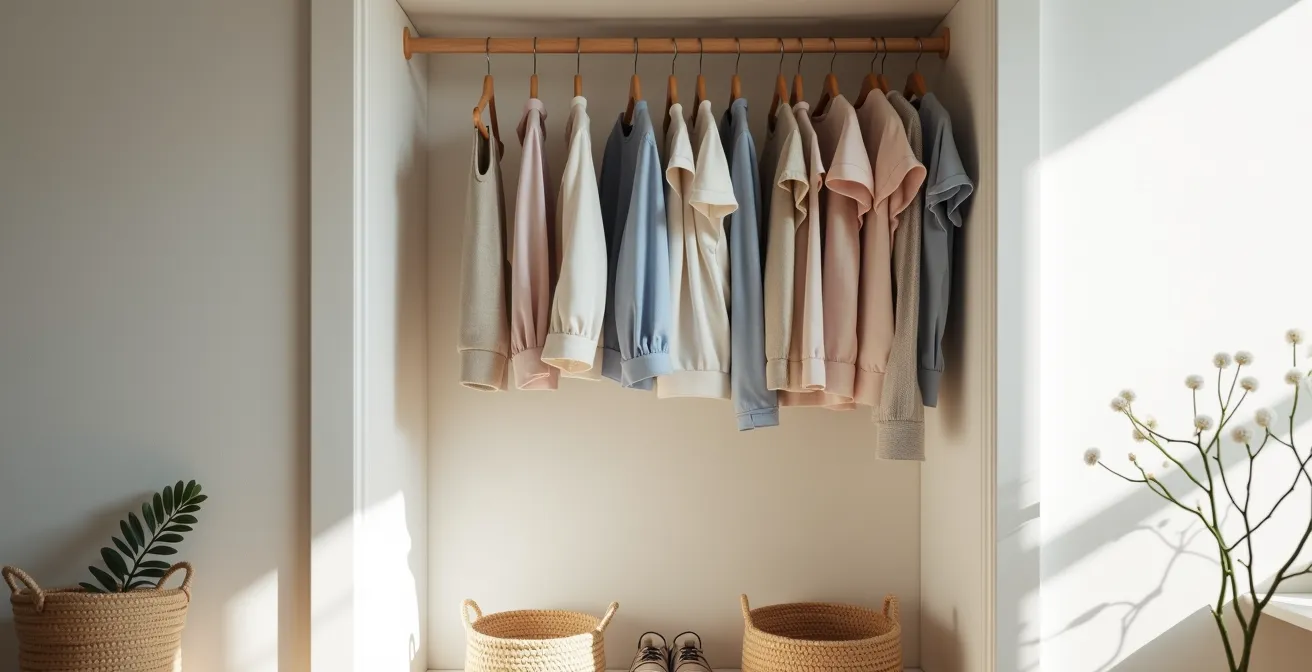
In summary:
- Focus on long-term value by calculating the Cost-Per-Wear (CPW) rather than the initial price tag.
- Build a cohesive color palette with neutrals and a few accents to make every item match, empowering your child to dress independently.
- Embrace a “less is more” approach with 15-20 high-quality items to drastically reduce laundry volume and decision fatigue.
- Implement a garment lifecycle plan to maximize use, from school wear to play clothes and finally to recycling.
The scene is familiar to almost every parent: a laundry basket that never seems to empty, a drawer of clothes that don’t match, and beautiful outfits outgrown before they were ever worn for that “special occasion.” The daily struggle with children’s clothing can feel like a chaotic, never-ending cycle. Many attempt to solve this with more organization bins or by simply buying more, hoping to fill the gaps. However, this often exacerbates the problem, leading to more clutter and decision fatigue for both you and your child.
The common advice is to “declutter” or “buy neutrals,” but these are just tactics, not a strategy. What if the solution wasn’t about organizing chaos, but about designing a system that prevents it from ever taking hold? This is the core principle of a kids’ capsule wardrobe. It’s not a restrictive minimalist trend; it’s a form of wardrobe architecture. By shifting your perspective from upfront cost to long-term value and from quantity to quality, you can build a small, functional, and beautiful collection of clothes that serves your family for an entire season.
This guide will walk you through the strategic principles of building that system. We will deconstruct the true cost of clothing, establish a functional color palette, and address the psychological habits that lead to unworn clothes. The goal is to transform your child’s wardrobe from a source of stress into a tool for calm, independence, and conscious consumption.
text
This article provides a complete blueprint for creating a sustainable and stylish capsule wardrobe for your child. Explore the sections below to master each step of the process.
Summary: A Strategic Guide to Your Child’s Capsule Wardrobe
- Why a £30 Shirt Can Be Cheaper Than a £5 One Over Six Months?
- How to Choose a Color Palette That Makes Dressing Independent Easy?
- 10 High-Quality Items vs. 30 Cheap Ones: Which Reduces Laundry Stress?
- The Wardrobe Mistake That Leaves Nice Clothes Unworn Before Outgrowing
- When to Size Up: Signs Your Child Is Ready for the Next Wardrobe Tier
- Why the “Shoe Battle” Is Actually About Transition Anxiety?
- When to Downgrade: Turning School Pants into Garden Play Clothes
- How to Spot Greenwashing in Kids’ Fashion Brands?
Why a £30 Shirt Can Be Cheaper Than a £5 One Over Six Months?
The magnetic pull of a low price tag is powerful, especially when dressing a rapidly growing child. However, the initial cost is only one part of a garment’s true financial impact. The most effective way to reframe this thinking is to adopt the metric of Cost-Per-Wear (CPW). A £5 fast-fashion shirt may seem like a bargain, but if it shrinks, fades, or loses its shape after five washes, its CPW is £1. In contrast, a £30 shirt made from durable, high-quality fabric that endures 50 wears has a CPW of just 60p.
This long-term perspective fundamentally changes the definition of “value.” It moves beyond the checkout and considers durability, maintenance, and even resale potential. High-quality items are not just more pleasant to wear; they are an investment. They withstand the rigors of play, require fewer replacements, and maintain their integrity. This durability is a cornerstone of a functional capsule wardrobe, as the system relies on a small number of items being worn and washed frequently.
Furthermore, quality pieces often have a second life. As an analysis of the children’s clothing market shows, quality and durability are major priorities for parents who see longevity as true value. Premium items, such as those made from merino wool, can retain 30-50% of their original price on resale platforms. The £5 shirt, on the other hand, almost invariably ends up in a landfill, its value depreciated to zero after just a few wears. When you factor in the entire garment lifecycle, the more expensive initial purchase often proves to be the most economical choice.
Your Action Plan: Calculate the True Cost of Ownership
- Initial Price vs. Wears: Calculate the initial purchase price divided by the expected number of wears before it’s outgrown or worn out.
- Maintenance Costs: Factor in any special washing requirements or delicate handling that consumes time and resources.
- Replacement Frequency: Honestly assess how often you would need to replace the cheaper item versus the quality one within a six-month period.
- Resale Value: Research the potential resale value for the quality item on second-hand marketplaces to subtract from its total cost.
- Compare Lifetime Cost: Add up the costs for both the budget and premium options to see the true total cost of ownership over the season.
How to Choose a Color Palette That Makes Dressing Independent Easy?
A successful capsule wardrobe is built on a foundation of thoughtful color selection. The goal is simple: create a collection where almost every top can be paired with every bottom. This strategic approach to wardrobe architecture not only creates a cohesive and aesthetically pleasing look but also serves a powerful functional purpose. It eliminates the morning “nothing matches” dilemma and drastically reduces the cognitive load for both you and your child.
By providing a curated selection of clothes that are guaranteed to work together, you empower your child to dress themselves successfully. This fosters a sense of independence and competence, turning a potential point of friction into a moment of achievement. Instead of facing a chaotic drawer of clashing colors and patterns, they are met with a calm, orderly set of options where there is no wrong answer.
As minimalist stylist Elle from Modern Minimalism advises in her kids’ capsule wardrobe guide:
Stick with neutrals and no more than 2–3 accent colors per season
This formula provides a perfect balance of versatility and personality. Neutrals like navy, grey, cream, and khaki form the backbone, ensuring everything has a potential partner. The accent colors—perhaps a mustard yellow, a soft blush, or a rich teal—inject life and allow for your child’s preferences to shine through. The key is that these accents are chosen to complement each other and all the neutrals, maintaining the system’s integrity.
There are several strategies for building this palette, each with its own benefits. This comparison can help you decide which approach best fits your family’s style, as detailed in a helpful guide on creating a fall capsule wardrobe for kids.
| Approach | Number of Colors | Benefits | Challenges |
|---|---|---|---|
| Minimalist | 2-3 neutrals only | Everything matches | May feel boring |
| Collaborative | 1 neutral + 2 core + 1 accent | Child buy-in, some variety | Requires planning |
| Pattern as Neutral | 3-4 colors + patterns | Visual interest maintained | Slightly more complex |
10 High-Quality Items vs. 30 Cheap Ones: Which Reduces Laundry Stress?
The math seems counterintuitive: how can fewer clothes lead to less laundry? The answer lies in the reduction of both physical volume and mental clutter. A wardrobe overflowing with 30 cheap, ill-fitting, or mismatched items creates a constant, low-grade stress. Every laundry cycle is a massive undertaking, and folding becomes a game of Tetris with a drawer that never quite closes. The sheer volume of clothing creates an illusion of choice while in reality making it harder to find a complete, wearable outfit.
Conversely, a capsule wardrobe of 10-20 high-quality, coordinated items radically simplifies the entire process. According to research, a kids capsule wardrobe typically includes 15-20 core clothing pieces for a season. With fewer items, laundry loads are smaller and more manageable. Because every piece has a purpose and coordinates with others, you are never left with “laundry orphans”—that one shirt that matches nothing or the pants saved for a non-existent occasion.
This minimalist approach dramatically lowers the cognitive load associated with clothing management. You no longer have to sort through a mountain of clothes to find what’s clean, what fits, and what goes together. The visual difference is stark, transforming a source of household chaos into a system of calm efficiency.
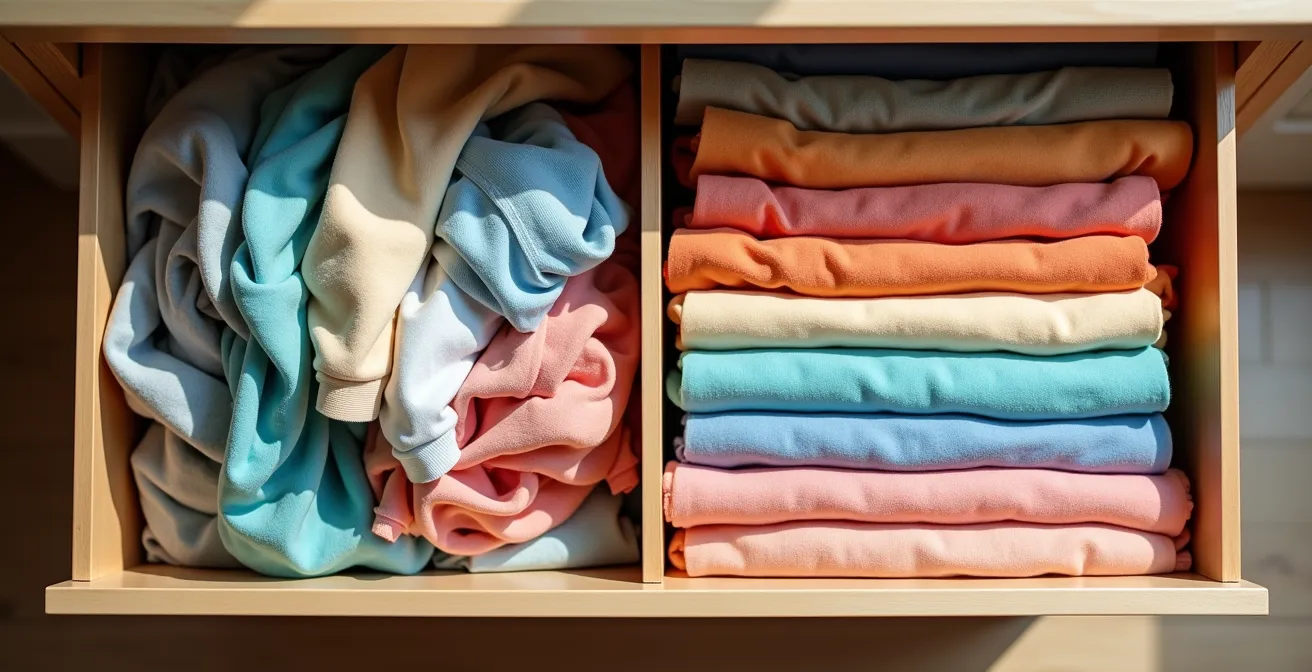
As the image above illustrates, the curated drawer on the right isn’t just neater; it’s more functional. Every item is visible and accessible. This clarity makes dressing the child, doing laundry, and putting clothes away faster and less stressful. The focus shifts from managing excess to enjoying a system that works. With a smaller, more durable collection, you do laundry based on need, not because the basket is overflowing with unworn items.
The Wardrobe Mistake That Leaves Nice Clothes Unworn Before Outgrowing
One of the most common and frustrating wardrobe mistakes is the “save for best” mentality. Parents carefully purchase beautiful dresses, smart shirts, or expensive sweaters, only to designate them for special occasions. The intention is good—to preserve these lovely items—but the reality is often disappointing. Children grow so quickly that the “perfect moment” may never arrive, leaving a collection of pristine, unworn, and now too-small clothes in the back of the closet.
This habit stems from a mindset of scarcity, treating nice clothes as too precious for everyday life. A capsule wardrobe challenges this idea directly. Its philosophy is that a child’s life, full of play, learning, and discovery, is the special occasion. Every item in the wardrobe should be durable and comfortable enough for daily wear, while also being beautiful enough to make the child feel good. There should be no “B-team” of old, stained, or ill-fitting clothes for playing at home.
This approach ensures that you get the full value out of every single garment you own. It eliminates the guilt of discovering an outgrown item with the tags still on. One parent’s experience perfectly captures this common frustration:
I found that Annie might only wear an outfit two times because she had so much! The beautiful dresses saved for special occasions often went unworn as she outgrew them while waiting for the perfect moment that never came.
To break this habit, a mental shift is required. Redefine “best clothes” as “celebration clothes” that can be worn any day to celebrate the joy of being a child. By integrating all items into a single, accessible daily rotation, you honor both your child’s daily life and the investment you made in their clothing. Every piece is there to be worn, loved, and eventually, worn out.
When to Size Up: Signs Your Child Is Ready for the Next Wardrobe Tier
Managing a capsule wardrobe requires a proactive approach to growth. Since the collection is small and every item is in active rotation, a poor fit can’t be hidden at the bottom of a drawer. It’s essential to recognize the subtle signs that your child is ready for the next size before their clothes become uncomfortably tight or restrictive. This ensures their comfort and keeps the capsule system functioning smoothly.
Children’s growth isn’t always linear; it often happens in sudden spurts. In fact, market data suggests that during peak growth phases, children typically outgrow their clothes every 6-12 months. Staying ahead of this curve means paying attention to specific fit indicators. Don’t just rely on the age on the label, as every child’s proportions are unique. Instead, become an observer of fit and movement.
Key signs that it’s time to size up include:
- Sleeve and Trouser Length: When your child raises their arms, do their sleeves ride up to expose their entire wrist? Are their trouser cuffs sitting above the ankle bone? These are the earliest and most reliable indicators.
- Torso and Rise: T-shirts that no longer cover the waistband of their trousers when they reach or bend are a clear sign the top is too short. Similarly, if the crotch of their trousers (the rise) is sitting too low or seems tight, it’s time for the next size.
- Shoulder Seams and Buttons: The seam of a shirt should sit right on the edge of the shoulder. If it’s creeping inward, the fit is too narrow. Any pulling or gaping around buttons on shirts or cardigans also signals a tight fit.

The image above highlights a key detail: the small gap between the end of the sleeve and the wrist. This indicates a good fit with room to grow. When this gap disappears and the fabric strains, it’s the signal to transition those items out and bring in the next size. Regularly assessing these fit points, perhaps once a month, prevents the discomfort of a too-tight wardrobe and maintains the effortless function of the capsule.
Why the ‘Shoe Battle’ Is Actually About Transition Anxiety?
The daily “shoe battle” is a familiar scene for many parents: a child refusing to put on their shoes, melting down over which pair to wear, or struggling with complicated fastenings. While it’s easy to label this as defiance, it often has deeper roots in a child’s developmental stage. More often than not, this struggle is a manifestation of decision friction and transition anxiety. For a young child, the moment of putting on shoes signifies a major transition—from the comfort of home to the outside world, from playtime to an appointment. This can be overwhelming.
When this inherent anxiety is combined with too many choices, the situation escalates. Being asked to choose between five different pairs of shoes, each with its own look and feel, can trigger decision fatigue in a small child. Their brain, already managing the stress of the upcoming transition, becomes overloaded. The resulting meltdown isn’t about the shoes themselves; it’s a protest against the overwhelming cognitive load of the decision-making process.
A minimalist shoe collection is a powerful antidote. By drastically limiting the options, you remove the decision friction from the equation. The capsule wardrobe philosophy extends perfectly to footwear, and its impact on morning routines can be profound.
Case Study: Reducing Decision Friction with a Minimalist Shoe Collection
Families implementing a capsule wardrobe system often report a dramatic decrease in morning stress. As noted by one minimalist guide, less overwhelm from too many choices reduces decision fatigue for everyone. By limiting a child’s seasonal footwear to just one pair of versatile sneakers and one pair of weather-appropriate boots (both with easy, child-friendly closures like Velcro), the “which shoes” debate is eliminated entirely. The choice is made for them, freeing up their mental energy to cope with the actual transition of leaving the house. This small change transforms a daily battleground into a smooth, predictable routine.
Understanding this psychological dynamic is key. The shoe battle isn’t a power struggle to be won, but a signal of overwhelm to be addressed. By architecting a simpler choice environment, you provide the structure and predictability your child needs to navigate transitions calmly and confidently.
To remember
- A garment’s true value is its Cost-Per-Wear, not its price tag; quality is an investment.
- A well-chosen color palette is the foundation of a functional wardrobe that empowers child independence.
- The “save for best” mentality is a trap; all clothes should be for celebrating the everyday.
When to Downgrade: Turning School Pants into Garden Play Clothes
A truly sustainable capsule wardrobe doesn’t end when an item is outgrown or shows its first signs of wear. Instead, it operates on a “waterfall” system, where garments gracefully transition through different stages of use. This concept of a garment lifecycle is not only economically and environmentally responsible, but it also provides a powerful, tangible lesson for children about resourcefulness and the value of their belongings.
The process begins when an item is no longer suitable for its primary purpose. For example, a pair of school trousers might get a small, permanent grass stain or become slightly too short. They are no longer pristine enough for school or outings, but they are perfectly functional. Instead of being discarded, they are “downgraded” and enter the next tier of the wardrobe: play clothes. This creates a dedicated, guilt-free collection for messy, high-intensity activities like gardening, painting, or exploring in the woods.
This systematic approach maximizes the utility of every single piece of clothing. It teaches children that items have value even when they are not perfect. This practical hierarchy can be structured in several stages:
- Primary Use: The garment’s main purpose (e.g., school, outings).
- Secondary Use: Downgraded to home and garden play clothes after showing minor wear.
- Repurpose: Once too worn for play, cut into shorts, cleaning rags, or patches for crafts.
- Consign/Sell: If an item is outgrown but still in excellent condition, it can be sold or consigned.
- Donate/Swap: Share good-condition items with the community, friends, or family.
- Textile Recycle: As the absolute final step, find a local textile recycling program for items beyond repair.
Implementing this system transforms how a family views “stuff.” It shifts the narrative from a linear “buy-use-discard” model to a circular one of “buy-use-reuse-repurpose.” By giving every garment a full and useful life, you reduce waste, save money, and instill a deep and lasting appreciation for the resources you consume.
How to Spot Greenwashing in Kids’ Fashion Brands?
As conscious consumption becomes more mainstream, many parents actively seek out sustainable and ethical clothing for their children. In fact, one report indicates that about 35% of parents prioritize sustainability when shopping for their kids. Unfortunately, this growing demand has led to a rise in “greenwashing”—the practice where brands use vague, misleading, or unsubstantiated claims to deceive consumers into believing their products are environmentally friendly.
Navigating this landscape requires a discerning eye. Terms like “eco-friendly,” “natural,” or “conscious” are often used without any real meaning or certification to back them up. They are marketing buzzwords designed to appeal to your values without committing the brand to any verifiable standards. A truly sustainable brand is transparent and relies on third-party certifications to prove its claims.
To become a savvy consumer, it’s crucial to learn the difference between legitimate certifications and greenwashing red flags. Look for specific, internationally recognized labels on a product’s tag or website. These certifications are your guarantee that an independent body has verified the brand’s claims regarding organic content, chemical safety, or ethical labor practices.
This table, based on information from ethical fashion advocates like Eco-Stylist, breaks down what to look for versus what to be wary of.
| Legitimate Certification | What It Guarantees | Greenwashing Alternative |
|---|---|---|
| GOTS (Global Organic Textile Standard) | Certified organic fibers, ethical labor standards, and chemical safety from farm to finished product. | Vague ‘eco-friendly’ or ‘green’ claims with no proof. |
| OEKO-TEX Standard 100 | The finished product has been tested and found free from a long list of harmful substances. | Use of the word ‘natural’ without specifying the material or any certifications. |
| B Corp Certification | The entire business meets high standards of verified social and environmental performance, public transparency, and legal accountability. | A self-declared ‘conscious collection’ or ‘sustainable edit’ without company-wide verification. |
| Fair Trade Certified | The product was made in a facility that ensures fair wages, safe working conditions, and community development funds for workers. | The phrase ‘ethically made’ without any third-party verification or factory details. |
By prioritizing brands that carry these certifications, you can confidently invest in clothing that aligns with your values. It moves your purchasing decisions beyond aesthetics and into the realm of real-world impact, ensuring your child’s capsule wardrobe is not only good for your home but also better for the planet and the people who make the clothes.
By applying these principles, you are not just organizing a closet; you are designing a calmer, more intentional life for your family. The next logical step is to begin auditing your child’s current wardrobe and start building a thoughtful capsule for the season ahead.