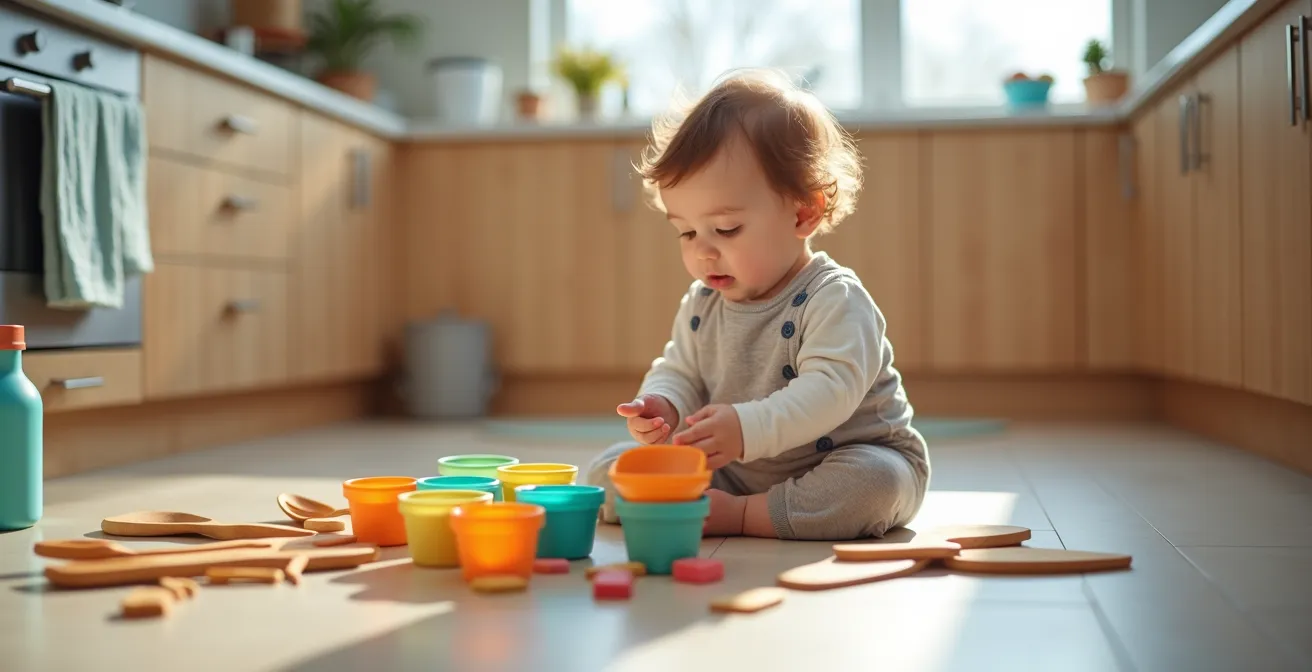
The secret to boosting your toddler’s brainpower isn’t in expensive tech toys, but in creatively using the everyday items you already own.
- Simple chores like laundry can become profound lessons in math and categorization.
- Narrating your daily activities (“sportscasting”) is a more effective vocabulary builder than flashcards.
- Play-based learning with household objects builds critical thinking and spatial skills essential for future STEM success.
Recommendation: Reframe your daily routines. Instead of seeing chores as tasks, view them as priceless opportunities to engage in brain-building “serve-and-return” interactions with your child.
As a parent, you’re constantly bombarded with messages about the importance of early brain development. The market is flooded with “educational” toys, learning apps, and high-tech gadgets all promising to give your child a cognitive edge. It’s easy to feel pressured into believing that a smarter child requires a bigger budget for specialized tools. Many well-intentioned parents turn to flashcards, structured lessons, or screen-based programs, hoping to fast-track learning.
But what if the most powerful tools for cognitive growth aren’t found in a toy store, but are already scattered throughout your home? What if the key to unlocking your toddler’s potential lies not in scheduled “learning time,” but in the simple, mundane interactions of your daily life? The real magic happens during diaper changes, while folding laundry, or preparing a snack. This approach isn’t about adding more to your plate; it’s about transforming what you already do into rich, brain-building experiences.
This guide will show you exactly how to do that. We will move beyond the platitudes and delve into the science-backed reasons why everyday household activities are often superior to their commercial counterparts. We’ll explore how to turn your home into a dynamic learning environment, fostering everything from mathematical thinking to emotional regulation, all without spending an extra dime. You’ll learn to see your world through a new lens, recognizing the countless opportunities for cognitive development hidden in plain sight.
To help you navigate these powerful concepts, this article is structured to build from the foundational “why” to the practical “how.” Discover the simple, ingenious, and free strategies to nurture a curious and capable mind.
Summary: A Practical Guide to At-Home Cognitive Development
- Why the First 1,000 Days Are Critical for Your Child’s Future IQ?
- How to Turn Laundry Time into a Math Lesson for Preschoolers?
- Screens vs. Books: Which Builds Better Attention Spans Before Age 5?
- The Danger of Forcing Reading Too Early That Schools Don’t Tell You
- When to Introduce Abstract Concepts: The 3 Stages of Cognitive Readiness
- How to Use “Sportscasting” to Teach Verbs During Playtime?
- Why Sensory Play Calms High-Energy Kids Before Bedtime?
- Why Play-Based Learning Prepares Kids Better for STEM Than Worksheets?
Why the First 1,000 Days Are Critical for Your Child’s Future IQ?
The period from conception to a child’s second birthday—roughly 1,000 days—is the most rapid and crucial phase of brain development in a human’s life. During this time, more than one million new neural connections are formed every second. These connections, shaped by a child’s environment and interactions, create the fundamental architecture of the brain. This isn’t about innate intelligence; it’s about building the foundation upon which all future learning, behavior, and health depend. A strong foundation makes it easier to acquire more complex skills later on.
The key mechanism driving this construction is “serve and return” interaction. When a baby babbles, gestures, or cries (the “serve”), and a parent responds appropriately with eye contact, words, or a hug (the “return”), it builds and strengthens neural pathways. These aren’t just sweet moments; they are active brain-building exercises. This back-and-forth dynamic is vital for developing communication, social skills, and executive function—the set of mental skills that include working memory, flexible thinking, and self-control.
Crucially, these powerful interactions don’t require special equipment. They happen naturally during everyday routines. Narrating a diaper change, responding to your toddler’s pointing during a walk, or singing a song while making dinner are all potent forms of “serve and return.” The consistency and quality of these responsive relationships are what shape the brain’s architecture, having a far greater impact on a child’s future cognitive potential than any single toy or class ever could. The investment in these early days is one of responsive presence, not financial outlay.
Understanding this critical window reframes parenting. The goal isn’t to “teach” in a formal sense, but to create a rich, responsive environment where a child’s brain can build itself optimally through simple, loving interactions.
How to Turn Laundry Time into a Math Lesson for Preschoolers?
Many parents see chores as obstacles to playtime, but with an ingenious mindset, they become the playground. Laundry, a seemingly mundane task, is a treasure trove of early mathematical and scientific learning opportunities. It provides tangible, real-world materials for developing foundational cognitive skills like sorting, classifying, and pattern recognition—the very building blocks of mathematical thinking.
This is where the concept of cognitive scaffolding comes into play. You start with a simple task a child can master and gradually add layers of complexity. Initially, a toddler can help by simply putting clothes into the basket. Soon, they can tackle a basic sorting task: “your clothes” versus “my clothes.” This simple act of categorization is a fundamental step in logical reasoning. As they grow, the challenges can evolve. Sorting by color (lights, darks) introduces new attributes, while sorting by type (shirts, pants, socks) builds more complex classification skills.
This hands-on experience is far more effective than a worksheet because it’s multi-sensory and contextually relevant. The child isn’t just looking at pictures; they are feeling textures, seeing colors, and manipulating 3D objects. This process also builds working memory as they hold categories in mind (“I am looking for all the blue things”) and practice one-to-one correspondence when they count the items in each pile. The illustration below captures this moment of focused, playful learning.
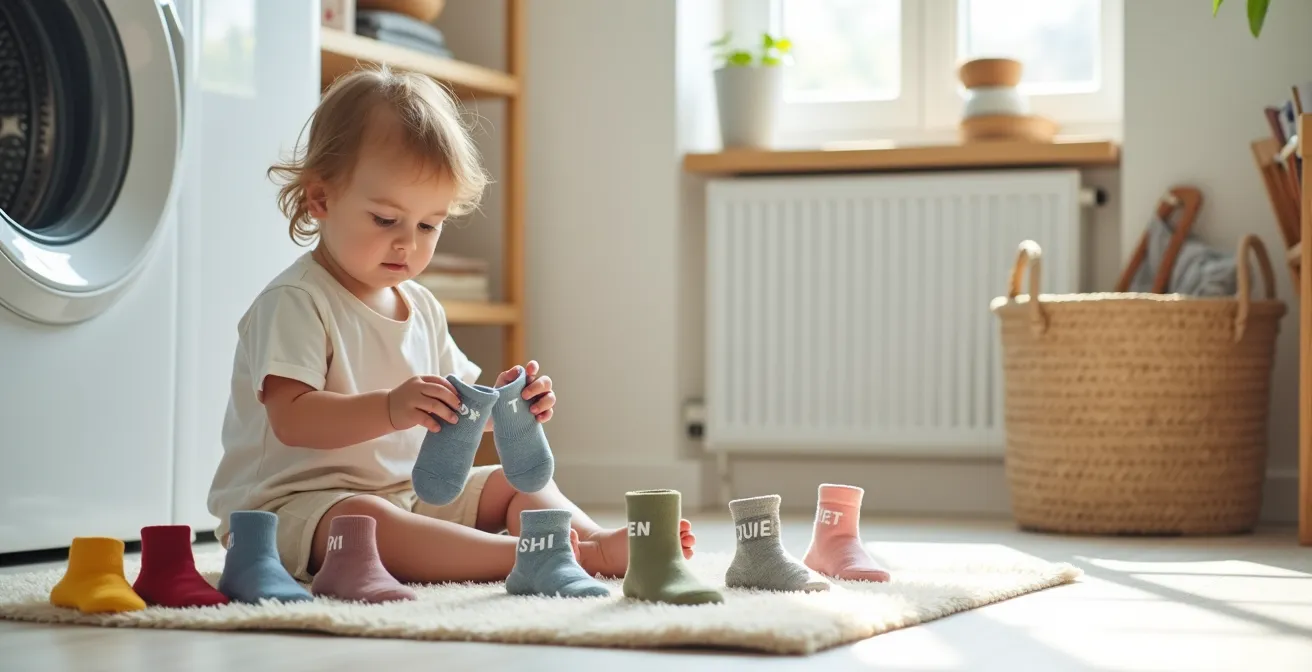
As you can see, the simple act of matching socks provides a perfect opportunity to practice visual discrimination and problem-solving. By turning a chore into a game, you’re not only getting help with the laundry, but you’re also laying down the neural pathways for future success in math and science, proving that meaningful learning is all around us.
Your Action Plan: The 6 Stages of Laundry Math
- Stage 1 – Basic Sorting: Separate clothes by owner first (Mommy’s pile, Daddy’s pile, baby’s pile).
- Stage 2 – Color Classification: Within each pile, sort by color groups (lights, darks, colors).
- Stage 3 – Type Categories: Further sort by clothing type (shirts, pants, socks, towels).
- Stage 4 – Counting Practice: Count items in each category and compare quantities (‘Which pile has more?’).
- Stage 5 – Pattern Recognition: Create patterns with sorted items (sock-shirt-sock-shirt).
- Stage 6 – Early Division: Group socks into pairs and count how many pairs you can make from the total number of socks.
This approach highlights a core principle: the process of discovery and manipulation is more valuable than finding the “right” answer. A mismatched pair of socks isn’t a failure; it’s an opportunity to discuss attributes like size, color, and pattern.
Screens vs. Books: Which Builds Better Attention Spans Before Age 5?
In the debate over cognitive development tools, the screen versus the book is a central battleground. While many “educational” apps claim to teach letters and numbers, their impact on a young child’s attention span can be counterproductive. The core issue lies in the pacing and nature of the interaction. Fast-paced, flashy screen content often trains the brain for attentional switching—rapidly reorienting to new stimuli. In contrast, reading a physical book with a caregiver nurtures task persistence, the ability to maintain focus on a linear, self-paced activity.
The difference in cognitive load is significant. With a book, a child controls the pace. They can pause to point at a picture, ask a question, or predict what will happen on the next page. This active engagement strengthens neural pathways for language, imagination, and sequential thinking. The physical act of turning pages also builds spatial memory, associating parts of the story with their location in the book. This slower, more deliberate interaction is a workout for the developing prefrontal cortex, which governs attention and self-control.
Conversely, much of children’s screen content is externally paced. The rapid cuts, sound effects, and constant flow of information can be overwhelming for a young brain. Instead of encouraging deep focus, it promotes a passive intake of information. In fact, neuroscience research indicates that exposure to fast-paced videos makes learning 40% more challenging for children under 5, as it can disrupt the development of sustained attention. The following comparison, based on a comparative analysis of cognitive impacts, makes the distinction clear.
| Aspect | Physical Books | Screen-Based Content |
|---|---|---|
| Attention Type Developed | Task persistence (sustained linear focus) | Attentional switching (rapid reorientation) |
| Parent Interaction Level | High – natural pauses for discussion | Variable – depends on co-viewing practices |
| Cognitive Processing | Self-paced, allows prediction at page turns | Externally paced, continuous flow |
| Memory Formation | Strong spatial memory (page location) | Weaker spatial anchoring |
| Recommended Daily Time (Under 2) | Unlimited with caregiver | None except video calls (AAP guidelines) |
This doesn’t mean all screens are inherently bad, especially when used interactively with a caregiver. However, for building the deep, sustained attention necessary for academic success, the simple, quiet technology of a physical book remains an unparalleled and cost-free household tool.
The Danger of Forcing Reading Too Early That Schools Don’t Tell You
In our achievement-oriented culture, there’s immense pressure on parents to produce early readers. The sight of a three-year-old sounding out words is often seen as the ultimate sign of advanced intelligence. This has led to a surge in phonics drills, letter-of-the-day activities, and a push for academic skills at ever-younger ages. However, this focus on early formal reading can be detrimental, paradoxically hindering the very skills required for true, lifelong literacy.
Reading is not a natural skill like walking or talking; it’s a complex cognitive process that relies on a host of prerequisite abilities. These include strong oral language, phonological awareness, a rich vocabulary, and the ability for symbolic thought. Forcing a child to decode letters before their brain is developmentally ready can create frustration and anxiety, leading to a negative association with reading. It’s a classic case of putting the cart before the horse. As early childhood development experts warn, the time spent on rote memorization is time taken away from foundational play. This point is powerfully made in a report on early intervention services:
Every minute spent on forced phonics drills is a minute stolen from developing foundational cognitive skills that are precursors to reading, like spatial reasoning from block-building.
– Early Childhood Development Experts, ECCM Early Intervention Services Report
The most effective pre-reading activities don’t involve letters at all. They involve rich, back-and-forth conversations that build vocabulary. They involve telling stories with puppets made from socks, which develops narrative skills. They involve pretend play where a cardboard box becomes a spaceship, fostering the symbolic thinking needed to understand that a squiggle on a page can represent a sound. These play-based experiences build the deep cognitive structures that make learning to read effortless and joyful when the time is right.
Instead of drilling with flashcards, a parent’s energy is better spent building a “language-rich” environment through conversation, storytelling, and imaginative play using the simple props available in any home.
When to Introduce Abstract Concepts: The 3 Stages of Cognitive Readiness
One of the most common frustrations for parents is trying to teach a concept their child simply isn’t ready for. Explaining “two” to a toddler who can’t yet grasp one-to-one correspondence can feel like talking to a wall. This isn’t a failure of the child, but a misunderstanding of a fundamental principle of cognitive development: learning progresses from the concrete to the abstract. A child must be able to experience a concept with their senses before they can understand it as a symbol.
This progression generally unfolds in three stages. The first is the Concrete Stage (roughly 18-24 months), where learning is purely physical and sensory. A child at this stage understands “two” only by holding two real objects in their hands. They are learning through direct manipulation and experience. The illustration below perfectly captures this stage: the child is not just seeing apples, they are physically interacting with them, building a tangible understanding of quantity.

The next step is the Representational Stage (around 2-3 years). Here, the child can connect a real object to a picture of it. They understand that a photo of an apple stands for a real apple. This is a crucial leap, as they are beginning to grasp that one thing can symbolize another. A great household activity for this stage is creating a picture-based grocery list and having your toddler match the items in the cart to the pictures.
Finally, a child reaches the Abstract Stage (around 3-4 years and beyond). Now, they can understand that a numeral (‘2’) or a word (“two”) represents the quantity without needing a physical object or a picture. This is the culmination of the previous stages. Forcing this final stage too early is ineffective because the child lacks the concrete and representational experiences to anchor the abstract symbol. Using kitchen timers to represent “five more minutes” or talking about “yesterday” and “tomorrow” in the context of daily routines helps build these abstract time concepts on a concrete foundation of experience.
By using household items to guide your child through this natural progression, you are providing the perfect cognitive scaffolding for them to build a deep, lasting understanding of the world.
How to Use “Sportscasting” to Teach Verbs During Playtime?
One of the most powerful, yet simple, language-building techniques available to any parent is called “sportscasting.” Just as a sports commentator describes the action on a field, you narrate your child’s actions in real-time. This technique requires no special materials—only your voice and your attention. It’s an incredibly effective way to build vocabulary, teach sentence structure, and model conversational turn-taking, all within the natural flow of play and daily routines.
The magic of sportscasting lies in its context. When you say, “You are stacking the red block on top of the blue one,” you are giving your child the word “stacking” at the exact moment they are performing the action. This direct link between the word and the experience forges a strong neural connection, making vocabulary retention much more effective than learning from a picture in a book. You are essentially providing a live soundtrack to their world, flooding them with rich, descriptive language that is immediately relevant to their focus of attention.
This technique can be progressively layered to match a child’s development. It starts with simple action words (verbs) and descriptions. “You’re reaching for the spoon. Now you’re stirring the oatmeal.” As they grow, you can introduce more complex concepts like cause-and-effect and emotional states. “You pushed the tower, and now it’s falling down!” or “You look frustrated because the puzzle piece won’t fit.” This helps children connect their actions to outcomes and their feelings to words, building both linguistic and emotional intelligence.
You can also “sportscast” your own actions, modeling self-talk and problem-solving. “I need to open the jar. I’m twisting the lid. It’s stuck! I’ll try tapping it on the counter.” This shows them how language is used to think, plan, and navigate challenges. It’s a free, continuous language lesson that turns every moment into a learning opportunity.
By consciously adopting this narrative style, you provide a constant stream of high-quality linguistic input that is one of the single best predictors of a child’s future vocabulary and reading comprehension.
Why Sensory Play Calms High-Energy Kids Before Bedtime?
For many parents of high-energy children, bedtime can feel like a battle. The conventional wisdom is to wind down with quiet activities, but this often fails because it doesn’t address the child’s underlying physiological need. The secret to a calm transition to sleep often lies not in enforced quiet, but in targeted sensory play that helps to regulate the nervous system. Specifically, activities that provide proprioceptive input—information from the muscles and joints—have a uniquely organizing and calming effect.
Proprioception is often called our “body awareness” sense. Activities that involve heavy work, like pushing, pulling, or squeezing, send powerful signals to the brain that help to down-regulate an overstimulated or disorganized nervous system. This is what experts refer to as the “Proprioceptive Reset Effect.” It activates the vagus nerve, which shifts the body from a “fight or flight” state to a “rest and digest” state. For a child who has been running and jumping all day, a few minutes of deep pressure activity can be far more effective at calming them than sitting still with a book.
You don’t need a specialized sensory room to achieve this. Simple household items and activities are perfect. Having your child help push the laundry basket to their room provides heavy work. Squeezing playdough or stress balls engages hand muscles. A warm bath provides both tactile and temperature input. Even the simple act of rolling your child up snugly in a blanket to play “burrito” provides calming, all-over deep pressure that can feel incredibly grounding and secure for a child.
A short, 15-minute sensory routine before bed can completely transform the evening. By incorporating activities like firm towel drying, toothbrushing (which provides oral proprioceptive input), and story time under a heavy blanket, you are proactively meeting your child’s sensory needs. This helps their body feel calm, organized, and ready for sleep. It’s an ingenious approach that works with a child’s biology, not against it.
This method acknowledges that cognitive function, including the ability to self-regulate and fall asleep, is deeply intertwined with the body’s sensory processing system.
Key Takeaways
- Your home is already a fully equipped learning lab; the key is to reframe everyday chores and routines as powerful brain-building activities.
- Hands-on, play-based learning with real objects (like sorting socks) builds deeper cognitive skills than abstract worksheets or screen-based apps.
- Focus on developing foundational skills like vocabulary, narrative thinking, and sensory regulation before pushing formal academics like reading.
Why Play-Based Learning Prepares Kids Better for STEM Than Worksheets?
There’s a common misconception that preparing children for STEM (Science, Technology, Engineering, and Math) fields requires an early start with academic drills, math facts, and structured problems. However, a growing body of research suggests the opposite is true. The foundational skills for STEM success—problem-solving, spatial reasoning, and critical thinking—are best developed not through worksheets, but through unstructured, hands-on, play-based learning.
Consider a child building a fort with cushions and blankets. They are engaged in an intuitive engineering project, learning about structural integrity, load distribution, and tension. When a tower of blocks collapses, they don’t get a red ‘X’; they get immediate, tangible feedback. This fosters an iterative mindset, where failure is seen as data for the next attempt. This is the very essence of the scientific method: hypothesis, test, revise. A worksheet, with its single right answer, teaches a fear of mistakes and discourages the creative problem-solving that is central to all scientific innovation. In fact, longitudinal educational research reveals that 3D spatial reasoning ability is a 2x stronger predictor of future STEM success than memorizing early math facts.
Household items are the perfect tools for this kind of learning. Water play with different-sized containers teaches volume and fluid dynamics. Mixing flour and water to make goop is a lesson in non-Newtonian fluids. These hands-on experiences create a deep, intuitive understanding of physical principles that can’t be replicated on a 2D page. The table below starkly contrasts the learning outcomes of these two approaches.
| Learning Aspect | Play-Based Approach | Worksheet Approach |
|---|---|---|
| Failure Response | Iterative mindset – failure is data | Right/wrong binary – fear of mistakes |
| Problem-Solving | Multiple solutions encouraged | Single correct answer |
| Spatial Skills | 3D manipulation with blocks/materials | 2D representation only |
| Scientific Method | Natural hypothesis-test-revise cycle | Memorization of steps |
| Engagement Level | Intrinsically motivated exploration | Extrinsic completion pressure |
By encouraging play, exploration, and experimentation with the objects you already have, you are not just entertaining your child. You are cultivating the curiosity, resilience, and complex problem-solving skills of a future scientist, engineer, or innovator.