In summary:
- Rainy day play isn’t an obstacle; it’s a tool for building a robust immune system through natural exposure to soil microbes.
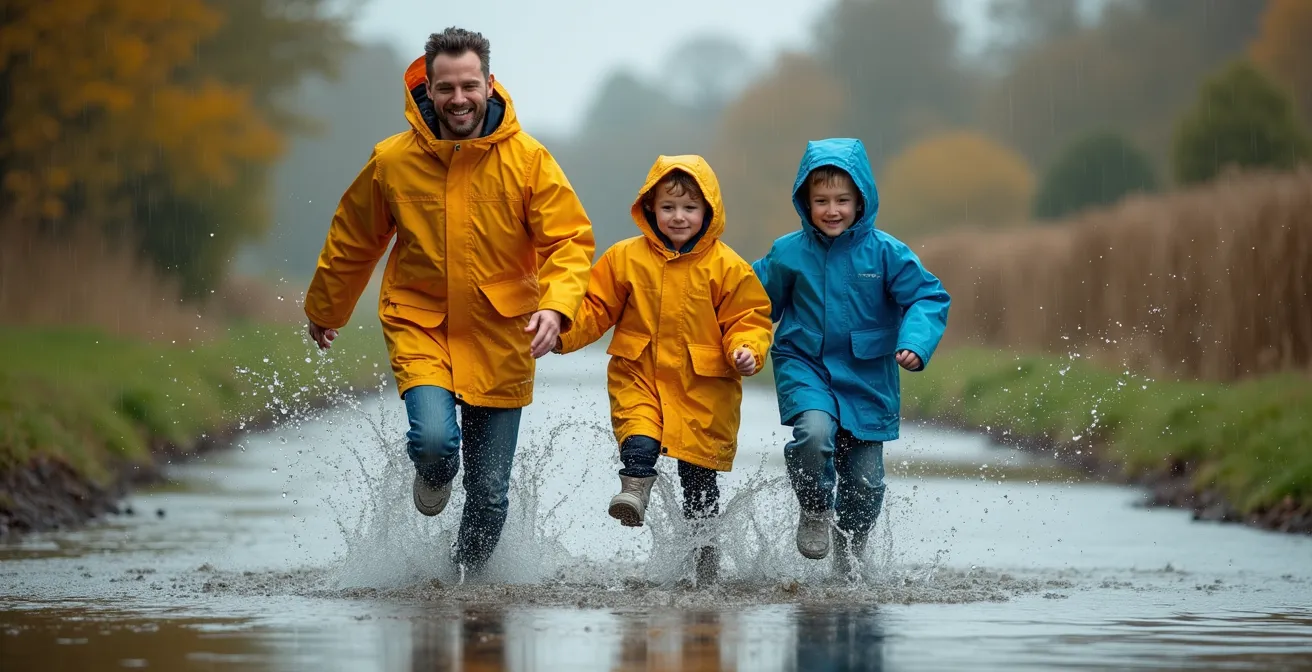
- The right gear (a 10,000mm+ waterproof rating) and layering system (no cotton) are non-negotiable for comfort and safety.
- Forest environments are neurologically superior to playgrounds for developing balance and coordination.
- Managing risk, not avoiding it, teaches children resilience and reduces anxiety.
- Creating a simple “Adventure Landing Zone” at home makes managing mud and mess a stress-free ritual.
The familiar drumming of rain on a British windowpane often signals a day indoors. For many parents, the grey skies and persistent drizzle feel like a barrier, a reason to retreat to screens and central heating. We’ve been conditioned to see rain as an inconvenience, something to be avoided. The common advice revolves around enduring it: get better waterproofs, find a puddle to splash in, and hope for the best. We worry about the cold, the dirt, and the seemingly inevitable sniffles that follow.
But what if we’ve been looking at it all wrong? What if the rain isn’t the problem, but part of the solution? As a Forest School educator, I’ve seen firsthand that the true benefits of outdoor play aren’t just found on sunny days. The magic happens when we lean into the weather, not just tolerate it. The key isn’t simply to survive the rain; it’s to understand and harness its unique, scientifically-backed power to build healthier, more resilient, and mentally robust children. It’s time to move beyond the fear of mud and dampness and embrace the profound developmental opportunities that a truly British downpour provides.
This guide will walk you through the science and strategy behind all-weather play. We will explore why mud is a crucial ally for your child’s immune system, how to create a thermal shield with proper layering, and why an uneven, mossy log is a far better teacher of balance than any perfectly engineered climbing frame. Get ready to transform your perspective on rainy days.
Summary: A UK Parent’s Guide to Daily Outdoor Play
- Why Playing in the Mud Is Actually Good for Your Child’s Immune System?
- How to Layer Kids for Winter Play Without Overheating Them?
- Playground vs. Forest: Which Environment Develops Better Balance?
- The Safety Myth That Keeps Kids Locked Inside and Anxious
- Where to Find Nature in the Concrete Jungle of a Big City?
- The Sanitizer Mistake That Weakens Natural Bacterial Defenses
- Why 10,000mm Waterproofing Is Necessary for UK Winters?
- How to Manage Tactile Experimentation Without Ruining Your Home?
Why Playing in the Mud Is Actually Good for Your Child’s Immune System?
The modern parental instinct is to reach for the wet wipes at the first sign of dirt. Yet, this drive for sterility may be undermining the very system we seek to protect. Playing in mud is not just fun; it’s a critical biological process that educates your child’s developing immune system. The soil is a rich tapestry of bacteria, fungi, and microbes, and this exposure is fundamental. It helps the immune system learn to differentiate between genuine threats and harmless environmental organisms, a process that can lead to a significant 50% reduction in allergy and autoimmune risk in later life.
This isn’t just about general exposure; specific microorganisms play a powerful role. The earth is not just dirt; it’s a pharmacy. The tactile, messy joy of squishing mud between their fingers is a direct dose of nature’s best medicine, building a foundation for lifelong health.
Case Study: The ‘Happy’ Bacteria in the Soil
This connection between mood and mud is backed by compelling science. Researchers at the University of Bristol discovered that exposure to a common, friendly soil bacterium called Mycobacterium vaccae had a remarkable effect. It was found to stimulate the production of serotonin in the brain, functioning in a way that is strikingly similar to antidepressant medication. This demonstrates that playing in the mud doesn’t just offer immune benefits; it actively contributes to your child’s mental health and happiness, providing a natural mood boost directly from the earth itself.

As you can see, the rich, granular texture of the soil offers an unparalleled sensory experience. This direct contact is where the microbial exchange happens, allowing the skin to become a gateway for building a diverse internal ecosystem. Encouraging this kind of play is one of the most powerful things you can do for your child’s long-term well-being.
How to Layer Kids for Winter Play Without Overheating Them?
The classic image of a child in winter is a figure so bundled in a puffy jacket they can barely move their arms. While well-intentioned, this “more is more” approach often backfires, leading to overheating, sweating, and ultimately, a dangerous chill. The secret to all-day comfort in the damp UK cold is not thickness, but a strategic, three-part layering system designed for active bodies.
The system works by trapping air for insulation while actively moving moisture away from the skin. Each layer has a specific job:
- The Base Layer: This is the moisture-management layer worn next to the skin. Its only job is to wick sweat away to keep the skin dry. Choose materials like merino wool or synthetic fabrics. Crucially, you must avoid cotton at all costs. Cotton acts like a sponge, holding moisture against the skin and rapidly cooling the body once activity stops.
- The Mid Layer: This is the insulation layer. Its job is to trap body heat. Fleece and wool are perfect choices as they maintain their insulating properties even when they get a little damp.
- The Shell Layer: This is the weather-protection layer. It must be waterproof and windproof to shield your child from the elements, but also breathable to allow the moisture wicked by the base layer to escape.
The key to success is active management. Before your child starts running around, they should feel slightly cool. Check for warmth not by feeling their hands or feet (which are naturally cooler), but by placing a hand on the back of their neck or their upper back. If it’s sweaty, they’re too hot. Remove a layer *before* they start sweating to prevent the cycle of dampness and chilling.
Playground vs. Forest: Which Environment Develops Better Balance?
We often think of playgrounds as the designated zone for physical development. They have swings for vestibular input and climbing frames for strength. Yet, these environments are predictable. The ground is flat, the rungs are evenly spaced, and the surfaces are uniform. A forest floor, by contrast, is a neurological gymnasium. It’s an unpredictable, ever-changing landscape of mossy banks, gnarled roots, fallen logs, and squelchy mud.
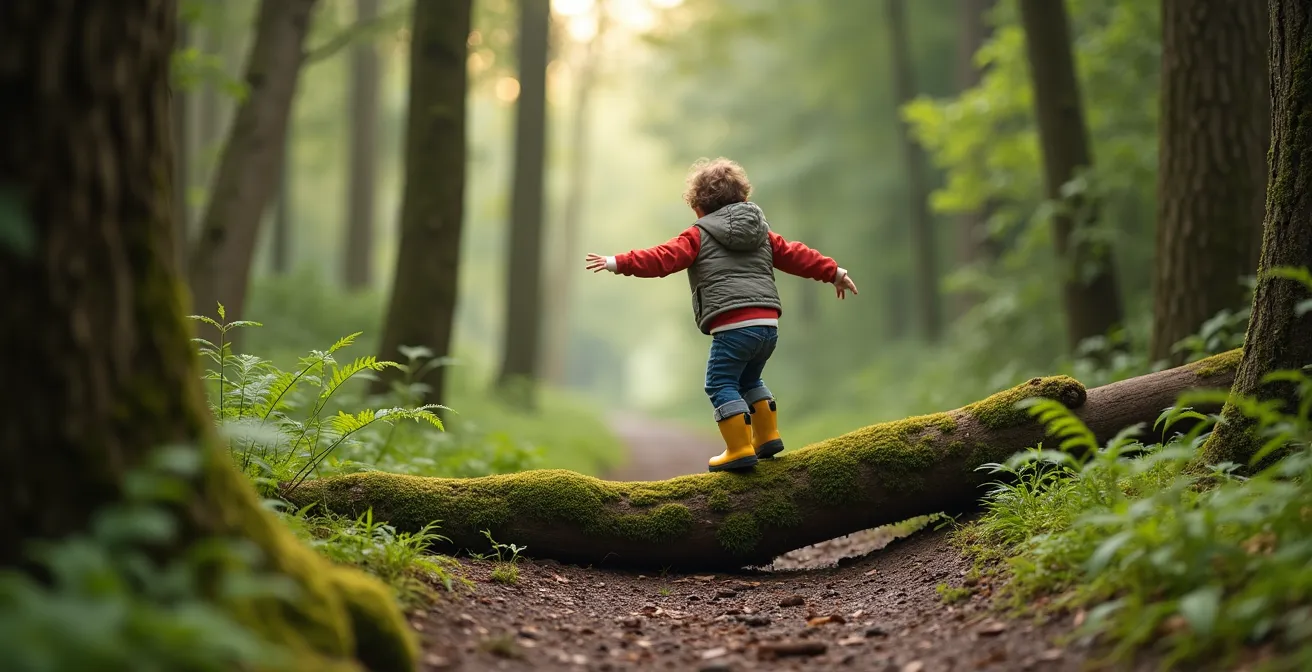
Every step a child takes in a woodland environment sends millions of pieces of information from the nerves in their feet and joints to their brain. This process, known as proprioception, is the body’s sense of its own position in space. Navigating an uneven surface forces the brain to make constant, micro-adjustments to maintain balance, building complex neural pathways that a flat playground simply cannot replicate. A fallen log becomes a balance beam that is far superior to a perfectly sawn plank because its texture, angle, and slight instability demand a higher level of focus and physical response.
This is not just a theory; it’s a proven benefit of nature-based education. As a leading expert in the field notes, the unique challenges of the natural world are a catalyst for holistic development.
Exposure to Forest School on a regular basis can benefit young children’s psychological resilience, their motor and physical development, creativity and problem-solving, and connection to nature.
– Sara Knight, British Educational Research Journal 2024
A 2024 UK study confirmed that regular Forest School attendance significantly benefits young children’s motor skills precisely because these varied, natural environments provide a richer sensory and physical education. By choosing the woods over the park, you are giving your child’s brain and body a more complex and effective workout.
The Safety Myth That Keeps Kids Locked Inside and Anxious
Our world has become obsessed with eliminating all risk. Playgrounds are covered in rubber, and the parental mantra has become a constant chorus of “Be careful!” While this comes from a place of love, this hyper-vigilance can inadvertently teach children that the world is a dangerous place and that they are not competent to navigate it. This can foster anxiety and prevent them from developing crucial skills in risk assessment.
A Forest School approach doesn’t ignore safety; it reframes it. The goal is not to eliminate all risk, but to differentiate between a “good risk” and a “bad hazard.” A bad hazard is a danger the child cannot see or evaluate, like a rotten branch overhead. A good risk is a challenge the child can see, assess, and choose to take on, like climbing a small, sturdy tree. This type of risky play is essential for development. It teaches children to trust their bodies, understand their limits, and build confidence. Research from Forest School settings clearly shows that after engaging in these managed risks, children rated themselves as calmer and happier after 12 weeks.
Instead of intervening immediately, we can empower them with language that encourages self-assessment. Swapping “Be careful!” for “What’s your plan for that?” or “Do you feel steady?” shifts the responsibility to the child. It tells them, “I trust you to make a good decision.” This builds an internal sense of competence that is the true foundation of safety and a powerful antidote to anxiety.
Your Action Plan: Risk-Benefit Analysis for Parents
- Identify the Risk vs. the Hazard: Is this a “good risk” (visible challenge, develops skills, child can self-assess) or a “bad hazard” (hidden danger, no learning benefit, beyond child’s ability)?
- Change Your Language: Replace prohibitive commands like “Get down!” or “Be careful!” with empowering questions. Ask, “What’s your plan for climbing that?” or “Where will you put your foot next?”
- Encourage Self-Assessment: Instead of intervening, prompt them to check in with their own bodies. Ask, “Do you feel steady?” or “How does that branch feel?”
- Observe and Spot: Stand back and allow them to test their limits, but remain close enough to “spot” them or assist if they misjudge. This provides a safety net without removing the challenge.
- Celebrate the Process, Not Just the Success: Praise their careful planning or their decision to climb down if they felt unsure, not just reaching the top. This values judgment over mere achievement.
Where to Find Nature in the Concrete Jungle of a Big City?
For families living in dense urban areas, the idea of a “forest adventure” can seem like a distant dream. The daily reality is one of concrete, tarmac, and sirens. However, nature is resilient and opportunistic. It thrives in the cracks and forgotten corners of our cities, offering a wealth of opportunities for exploration if we only adjust our perspective on what “nature” is.
You don’t need a pristine ancient woodland to connect with the natural world. A rainy day is the perfect time for an urban nature safari. The water changes the environment, bringing different aspects of the city’s hidden ecosystem to life. A simple walk around the block can become a scientific expedition.
- Follow the Water: Watch how raindrops race down a windowpane. Follow a rivulet of water as it journeys from the pavement to a storm drain, observing how it navigates different urban surfaces.
- Hunt for Mini-Beasts: The rain brings out creatures that usually hide. Hunt for snails and worms on wet pavements and walls. Look at the intricate patterns on a snail’s shell.
- Find the Survivors: Look for plants growing in unlikely places—buddleia bushes thriving in derelict lots, or tiny mosses and ferns colonising the cracks in a brick wall. These are extremophiles, masters of survival.
- Become a Rain Artist: Take washable markers and a piece of paper outside. Draw a picture and then let the rain blur and bleed the colours to create a unique piece of art.
Case Study: The National Trust’s Urban Safari
Proving that adventure is a mindset, not a location, the National Trust’s ’50 things to do before you’re 11¾’ programme is filled with brilliant urban nature activities. It encourages kids to hunt for extremophile plants in pavement cracks, observe the complex flight patterns of starling murmurations over supermarket car parks, and trace the journey of rainwater through the city’s drainage system. These activities demonstrate that meaningful nature exploration doesn’t require a trip to the countryside; it just requires a curious eye and a willingness to look closer at the world right outside your door.
The Sanitizer Mistake That Weakens Natural Bacterial Defenses
In our quest for cleanliness, hand sanitiser has become a ubiquitous accessory. While useful in specific high-risk situations (like a hospital visit), its overuse in daily life is a significant mistake, particularly after a session of outdoor play. Sanitiser is indiscriminate. It wipes out everything on the skin’s surface, including the beneficial bacteria that form a crucial part of our natural defences.
A leading expert in immunology offers a powerful analogy for understanding the difference between sanitiser and traditional hand washing.
Hand sanitiser acts as a ‘scorched earth’ policy that kills beneficial bacteria, while soap and water is a ‘targeted removal’ system.
– Dr. Graham Rook, The Old Friends Hypothesis
Soap and water works differently. The soap molecules bind to dirt, grease, and harmful germs, and the physical act of rinsing with water washes them away. This process is far more effective at removing actual dirt and is less damaging to the skin’s protective microbiome. It leaves many of the beneficial “old friends”—the microbes we have co-evolved with—in place to continue their protective work. After a muddy play session, washing with soap and water is the correct and most effective choice.
The importance of this natural exposure is not theoretical. A trial in Finland found that after bringing forest-floor soil and vegetation into urban daycare playgrounds, the children playing there showed more immune-regulatory T-cells in their blood within just one month. This shows a direct, rapid, and positive biological response to increased environmental biodiversity. Wiping away this biodiversity with sanitiser is counterproductive to building a resilient immune system.
Why 10,000mm Waterproofing Is Necessary for UK Winters?
Not all waterproof clothing is created equal. A jacket labelled “water-resistant” or “showerproof” might suffice for a brief dash from the car, but it will fail completely during a proper outdoor play session in the UK. For a child who will be kneeling in puddles, sitting on damp logs, and enduring persistent drizzle, you need to understand the technical specification known as the hydrostatic head rating, measured in millimetres (mm).
This rating measures how much water pressure a fabric can withstand before it starts to leak. A rating of 5,000mm can handle a light shower, but the pressure of a child kneeling or sitting down in a puddle will easily force water through the fabric. For the kind of sustained, damp conditions typical of a UK winter, a 10,000mm rating is the minimum standard for true waterproof performance. Anything less is a compromise that will likely end in a cold, wet, and unhappy child.
The table below breaks down what these numbers mean in the context of real-world British weather.
| Rating (mm) | Water Pressure Test | Real UK Conditions | Breathability Need |
|---|---|---|---|
| 5,000mm | 5m water column | Light shower, standing play | Moderate |
| 10,000mm | 10m water column | Heavy rain, kneeling in puddles, Welsh rain | High |
| 15,000mm+ | 15m+ water column | Driving sideways rain, full puddle immersion | Essential |
Case Study: The Real-World Value of High-Quality Gear
The investment in higher-rated gear pays off. In a survey of over 200 UK parents by outdoor brand Wet Wednesdays, it was found that 10,000mm rated suits were the key enabler for year-round outdoor play. Parents who calculated the ‘cost per wear’ discovered that high-quality waterproofs provided far better long-term value. Cheaper alternatives often failed after a few uses, leading to aborted adventures and wasted money, while the robust gear was used hundreds of time, keeping children warm, dry, and happy to be outdoors in any weather.
Key takeaways
- Embrace Dirt: Regular exposure to soil microbes is a scientifically-backed method to strengthen the immune system and improve mood.
- Layer Intelligently: A three-layer system (moisture-wicking base, insulating mid, waterproof shell) is essential for warmth. Never use cotton as a base layer.
- Seek Uneven Ground: Natural environments like forests are superior to flat playgrounds for developing balance, coordination, and proprioceptive sense.
How to Manage Tactile Experimentation Without Ruining Your Home?
Let’s be honest: one of the biggest barriers to embracing muddy play is the vision of a trail of filth being tramped through the house. This is a valid and practical concern. However, the solution is not to avoid the mess, but to manage it with a simple, repeatable system. By creating a dedicated transition space, you can contain the chaos and turn the clean-up process into a calm, predictable part of the adventure ritual.
This is what we call an “Adventure Landing Zone.” It’s a designated area just inside the door (or in a utility room or garage) where the transformation from muddy explorer back to indoor child happens. Involving children in this ritual teaches them responsibility and respect for their home environment.
- Designate the Zone: Place a waterproof mat, a piece of tarpaulin, or some old towels on the floor just inside the entrance. This is the only place where muddy boots are allowed.
- Equip the Zone: Set up a boot jack to make removing boots easier for little legs. Have a designated basket or a “trug” for wet waterproofs and a separate one for muddy boots.
- Prepare for Clean-Up: Keep a flask of warm water, a bowl, and some old flannels or towels ready for an immediate rinse of hands and faces before they venture further into the house.
- Establish the Ritual: Teach children the sequence: shake suits outside, step into the muddy zone, remove boots, then remove waterproofs. Making it a consistent routine turns it into an automatic habit.
This system removes the stress and anger from the homecoming, reframing it as the final, calm stage of the day’s exploration. It respects both the child’s need for messy play and the parent’s need for a clean home. This perspective is often shared by parents who grew up with the freedom to get messy.
My mom used to hose us down in the driveway before we could come in the house! She always let me strip down to just my underwear to play in the rain. I don’t know if my childhood would have been the same without her letting me play in the rain – great memories!
– Parent, Mother Natured
So, the next time the clouds gather and the rain begins to fall, see it not as an obstacle, but as an invitation. By reframing your mindset and preparing with the right gear and systems, you can unlock a world of developmental benefits that sunny days alone cannot provide. You are not just keeping your child entertained; you are actively building their resilience, strengthening their body, and nurturing their spirit. The adventure is waiting, just outside your door.