Education & Activities
The landscape of childhood education and activities has shifted dramatically in recent years, with parents navigating an overwhelming array of enrichment programs, educational apps, and conflicting advice about what children truly need to thrive. Yet beneath the noise of marketed solutions lies a reassuring truth: the most powerful developmental experiences happen not in expensive classes, but in the everyday interactions, unstructured play, and simple conversations that fill ordinary family life.
Understanding how children learn, what drives their cognitive and emotional growth, and how to create environments that nurture curiosity without pressure forms the foundation of effective parenting. This comprehensive look at education and activities explores the neuroscience behind early development, the critical role of play, and practical approaches to language, socialization, and activity choices that respect both a child’s natural learning drive and family wellbeing.
How Children Learn: The Neuroscience of Early Development
The developing brain operates on principles vastly different from adult learning, with critical windows of opportunity where neural pathways form at astonishing rates. During the first five years, a child’s brain creates over one million neural connections per second, building the architecture that supports all future learning, behavior, and health.
This explosive growth doesn’t require expensive educational tools or structured curricula. Research consistently shows that responsive interactions—the back-and-forth exchanges during everyday moments—provide the richest developmental stimulus. When a parent narrates folding laundry (“Let’s match the blue socks together”), waits for a toddler’s response during peek-a-boo, or describes the steam rising from bathwater, they’re actively constructing neural pathways for language, reasoning, and emotional regulation.
The danger of “hothousing”—pushing academic content before a child’s brain is developmentally ready—lies not in challenging children, but in replacing these fundamental interactive experiences with passive learning. A three-year-old memorizing flashcards misses the spatial reasoning developed through building blocks, the executive function practice of cleaning up toys, and the problem-solving inherent in fitting puzzle pieces. Cognitive readiness must guide activity selection, not parental anxiety about future academic performance.
Language Acquisition: Closing the Word Gap Through Daily Conversation
By age three, children from high-verbal households have heard roughly 30 million more words than peers in language-poor environments—a gap that correlates powerfully with later academic success. Yet quantity alone doesn’t drive language development; the quality and context of language exposure matter enormously.
Rich language—using varied vocabulary, complex sentence structures, and descriptive phrases—builds verbal architecture far more effectively than simplified “baby talk.” When describing actions (“I’m whisking the eggs until they’re frothy” versus “mixing”), parents model grammatical structures and introduce nuanced vocabulary within meaningful contexts where children can construct understanding.
The most effective language-building strategy costs nothing: narrating the day. Describing what you see, what you’re doing, and what might happen next creates a constant linguistic bath that children absorb naturally. Optimizing reading time enhances this further—pausing to discuss pictures, asking prediction questions, and connecting story elements to the child’s experience transforms passive listening into active language processing.
Equally important is avoiding the “question trap,” where parents fill silence with interrogations (“What color is this? What does the cow say?”). While well-intentioned, this pattern positions children as test-takers rather than conversational partners. Genuine exchanges, wondering statements (“I wonder why the leaves change color”), and open-ended questions that invite thinking rather than recall build both language and reasoning skills simultaneously.
The Irreplaceable Role of Play in Academic Readiness
Perhaps no aspect of childhood education faces more misunderstanding than the relationship between play and learning. Pressured by academic expectations, many parents view play as mere entertainment—something to limit in favor of “educational” structured activities. Yet neuroscience reveals the opposite: unstructured play serves as the primary engine for the executive function, creativity, and social-emotional skills that predict academic success far more reliably than early reading or arithmetic.
Understanding Play Stages and Development
Children progress through predictable play stages, each building critical capabilities. Solitary play develops focus and imagination. Parallel play (playing alongside but not with other children) teaches observation and imitation. Cooperative play requires negotiation, perspective-taking, and flexible thinking—the very skills needed for classroom success and collaborative work.
Rushing these stages or forcing interaction before children are developmentally ready creates anxiety rather than growth. A two-year-old who won’t “share” isn’t being selfish; they’re operating within normal developmental parameters where object permanence and turn-taking concepts are still forming.
Structured Activities Versus Free Play
While structured activities (music lessons, sports teams) offer value, they engage different neural pathways than child-directed free play. In structured settings, adults determine the rules, timing, and objectives. In free play, children must generate their own goals, negotiate conflicts, adjust plans when initial ideas fail, and regulate emotions without adult scaffolding—practicing the executive function skills that underpin academic achievement.
The most developmentally rich play often appears purposeless to adults: repeatedly filling and dumping containers, elaborate pretend scenarios, or “destroying” block towers. Yet these activities build spatial reasoning, cause-and-effect understanding, symbolic thinking, and frustration tolerance. Experiential learning through play creates deeper, more transferable knowledge than rote memorization of facts.
Sensory Experiences: The Foundation for Regulation and Learning
The sensory system provides the scaffolding for all higher-level learning. Children who struggle to process sensory input—whether oversensitive to textures, undersensitive to movement, or difficulty filtering background noise—often face challenges with focus, behavior, and emotional regulation that interfere with learning regardless of cognitive ability.
Sensory experiences directly influence neurodevelopment by helping children understand their bodies in space, regulate arousal levels, and process information efficiently. A child who spins repeatedly isn’t being defiant; they’re seeking vestibular input that helps organize their nervous system. Messy play with sand, water, playdough, or even supervised cooking activities provides tactile input that builds sensory tolerance and body awareness.
Creating effective sensory opportunities doesn’t require specialized equipment. A budget-friendly sensory station might include:
- A large plastic bin with dried rice or beans for scooping and pouring
- Various textures (smooth stones, rough fabric, soft cotton balls) for tactile exploration
- Safe items to mouth for younger children still learning through oral exploration
- Heavy work activities like pushing laundry baskets or carrying groceries
- Movement opportunities: jumping, spinning, hanging from playground equipment
Timing matters significantly. Sensory-seeking activities work best before situations requiring focus (before homework or quiet activities), while calming sensory input (gentle rocking, soft music, dim lighting) supports wind-down routines. Understanding each child’s unique sensory profile—what regulates versus overwhelms them—transforms challenging behaviors into manageable needs.
Cultivating Curiosity: Interest-Led Learning and Critical Thinking
Children are born scientists, driven by powerful intrinsic curiosity to understand how their world works. Yet traditional educational approaches can inadvertently extinguish this natural learning drive by replacing child-generated questions with adult-determined curricula and valuing correct answers over the process of inquiry.
Interest-led learning harnesses the motivational power of curiosity by allowing children’s natural fascinations to guide educational exploration. A child obsessed with dinosaurs isn’t just memorizing names—they’re practicing categorization, timeline sequencing, hypothesis formation, and research skills that transfer across domains. Following these natural interests creates what educators call “flow states,” where learning becomes effortless because motivation is intrinsic.
“Strewing”—deliberately leaving interesting materials in a child’s environment without instruction or expectation—sparks investigation without pressure. A magnifying glass left near the garden, unusual art supplies on the table, or an intriguing book casually placed invite discovery while preserving the child’s sense of agency and ownership over their learning.
Asking Questions That Build Thinking
The cognitive load of questions varies enormously. Closed questions requiring yes/no or single-word answers (“Is this red?” “What number is this?”) demand only recall. Open-ended questions requiring explanation, prediction, or reasoning (“What do you think will happen if…” “How might we…” “Why do you suppose…”) engage higher-order thinking.
“I wonder” statements model curiosity without the pressure of interrogation: “I wonder why some leaves fell but others stayed on the tree” invites joint investigation rather than testing knowledge. This approach positions parent and child as co-learners, preserving the intrinsic motivation that drives genuine understanding rather than performance.
Equally critical: resisting the answer-giving habit. When children ask questions, reflecting them back (“What do you think?” “How could we find out?”) builds problem-solving confidence and research skills. The process of investigation creates deeper learning than any provided answer ever could.
Social Development: Learning to Navigate Relationships
While academic skills receive enormous parental focus, social-emotional capabilities predict life outcomes—including career success, relationship quality, and mental health—more powerfully than IQ or test scores. These skills develop primarily through unstructured interaction with peers, where children navigate the complex landscape of friendship, conflict, and collaboration without adult scripts.
Managing toy-sharing conflicts, for instance, teaches negotiation, compromise, and perspective-taking when parents facilitate rather than impose solutions. The forced apology (“Say you’re sorry!”) teaches only compliance, not empathy or genuine remorse. More effective approaches help children name emotions (“You seem angry that he took your truck”), understand impact (“Look at his face—how do you think he feels?”), and generate solutions (“What could help fix this?”).
Sequencing playdates for success—keeping them short for young children, limiting to one playmate initially, having duplicate toys available, and scheduling during well-rested times—creates conditions where positive interactions become more likely. As children develop social skills, these scaffolds gradually reduce, allowing increasingly complex peer navigation.
Balancing Enrichment With Wellbeing: The Overscheduling Trap
The modern tendency to pack children’s schedules with enrichment activities—sports, music, languages, tutoring—often stems from parental love and desire to provide opportunities. Yet research on child development reveals that breadth of experience during early childhood typically serves development better than early specialization, which can lead to burnout, reduced intrinsic motivation, and higher injury rates.
The “vicarious living trap” occurs when parents unconsciously pursue their own unfulfilled ambitions through children’s activities. Recognizing this requires honest self-reflection: Is this activity chosen because the child shows genuine interest and enjoyment, or because it satisfies parental aspirations or anxieties about future success?
Effective scheduling preserves time for three essential elements often squeezed out by structured activities:
- Unstructured free time for the play and exploration that builds creativity and executive function
- Family connection through shared meals, conversations, and low-key togetherness that builds secure attachment
- Rest and downtime where the brain consolidates learning and the nervous system recovers from stimulation
A child exhausted from rushing between activities, completing homework in the car, and collapsing into bed with no time for imaginative play or family conversation may be “enriched” on paper while impoverished in the experiences that actually build resilient, capable humans.
School Choices and Educational Transitions
Navigating educational systems—whether state or private, traditional or alternative—requires understanding both the child’s individual needs and the specific mechanisms of local schooling. For families in Britain, this includes decoding Ofsted ratings, understanding catchment area priorities, managing the reception year transition, and potentially preparing for selective entry like the 11-plus examination.
Yet regardless of system specifics, the transition to formal schooling represents a significant developmental milestone best supported by focusing on foundational capabilities rather than academic content. A child entering school with strong emotional regulation, basic social skills, curiosity about learning, and confidence in their ability to solve problems will adapt more successfully than one who can read early but melts down when challenged or struggles to separate from caregivers.
Sequencing this transition involves gradually building independence skills (managing their belongings, using the toilet independently, following multi-step instructions), familiarizing them with the school environment through visits, and maintaining calm parental confidence that communicates “this is a positive next step” rather than anxiety about performance.
The goal of all education and activities during early childhood isn’t creating precocious achievement, but rather building the secure foundation—cognitive flexibility, emotional regulation, intrinsic motivation, and social capability—upon which all future learning rests. When parents trust developmental processes, follow children’s natural curiosity, and prioritize connection and play over resume-building, they create conditions where genuine learning flourishes.

How to Pack a Kid’s Rucksack so They Actually Carry It?
The key to a child carrying their own pack isn’t what’s inside, but eliminating the “failure points” of discomfort and disengagement. Success depends on comfort engineering: gear that fits perfectly (boots), manages moisture (base layers), and performs when wet (synthetics)….
Read more
How to Secure Your First Choice State School in a Competitive Catchment Area?
Securing a top state school place is not about luck; it’s a long-term strategic mission combining forensic data analysis with a focus on your child’s well-being. Look beyond simplistic Ofsted ratings to uncover a school’s true culture and pastoral strength….
Read more
How to Choose Extracurriculars That Build Character Without Burnout?
The key to avoiding burnout isn’t a better schedule, but a shift in mindset: from activity manager to Character Architect. Matching activities to a child’s core temperament boosts engagement and prevents friction. Prioritizing a “portfolio” of diverse experiences before puberty…
Read more
How to Manage Your Child’s Tactile Experiments Without Sacrificing Your Home
Messy play isn’t the enemy of a clean home; it’s your child’s first, most important science lab. Sensory sensitivities are neurological, explaining why some kids crave slime while others recoil. Exposure to natural soil isn’t just messy; it’s a crucial…
Read more
Why Play-Based Learning Prepares Kids Better for STEM Than Worksheets?
Pushing worksheets to boost a child’s STEM readiness is a fundamental misunderstanding of how their brain actually builds long-term knowledge. Child-led play builds flexible, problem-solving neural pathways, while worksheets often encourage rigid, short-term memorization. Emotionally rich, experience-based learning creates durable,…
Read more
How to Reignite Your Child’s Natural Curiosity If School Has Dimmed It?
Contrary to the belief that children need more structured academics, the real key to future success lies in protecting their innate curiosity from the rigid, answer-focused nature of formal schooling. This guide provides a powerful, reformist toolkit for parents to…
Read more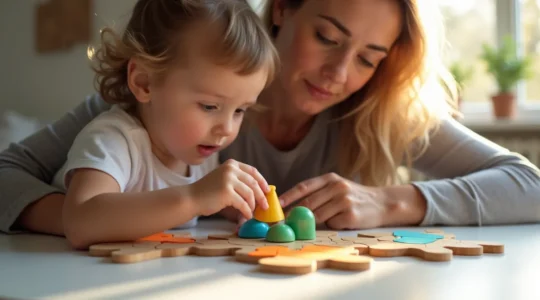
How to Choose STEM Puzzles That Challenge Without Frustrating Your Child?
The secret to a successful STEM puzzle isn’t its age rating; it’s selecting a ‘calibrated struggle’ that perfectly matches your child’s cognitive edge. Early puzzle play directly predicts future mathematical ability by building foundational spatial literacy. Physical puzzles like wooden…
Read more
How to Ask Questions That Get Your Child Talking About Their Day?
In summary: The question “How was school?” is often too broad for a tired child’s brain, causing them to shut down. Effective communication isn’t about finding a magic list of questions, but about engineering the conversation with specific, strategic techniques….
Read more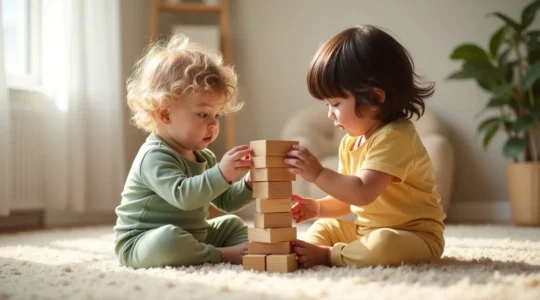
How to Facilitate Peer Play Dates That Don’t End in Tears?
In summary: Reframe playdate conflicts as vital learning opportunities, not parenting failures. Focus on teaching social tools like turn-taking and emotional language instead of imposing rules. Observe your child’s developmental stage, play style, and fatigue cues to set them up…
Read more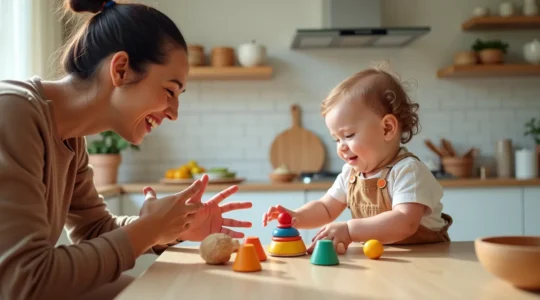
How to Narrate Your Day to Boost Your Baby’s Vocabulary Without Feeling Silly?
In summary: Feeling awkward talking to your baby is normal, especially for introverted parents. The key isn’t a constant monologue. Focus on “narration micro-habits”—small, specific techniques like “Sportscasting” playtime or using “Parentese”—to make talking feel natural. Quality of interaction (conversational…
Read more