Development & Psychology
Every parent watches their child grow and wonders: am I doing this right? Behind the daily chaos of tantrums, power struggles, and emotional outbursts lies a profound truth—childhood is not just about getting through the tough moments, but about building the psychological foundations that will serve your child for a lifetime. Developmental psychology offers parents a roadmap for understanding how children learn to regulate emotions, build resilience, develop confidence, and navigate their inner worlds.
This comprehensive resource explores the essential concepts that bridge child development research with everyday parenting. From understanding why frustration is actually beneficial for learning, to recognizing the subtle body language cues that reveal what your child needs before they can articulate it, these evidence-based insights will transform how you approach the most challenging—and most important—aspects of raising emotionally healthy children.
Building Resilience Through Problem-Solving and Autonomy
Resilience isn’t something children are simply born with—it’s a skill developed through repeated experiences of facing challenges, feeling frustration, and discovering their own capacity to overcome obstacles. When parents rush to solve every problem their child encounters, they inadvertently communicate a damaging message: “I don’t believe you can handle this.”
The Critical Role of Frustration in Learning
Think of frustration as the mental equivalent of muscle soreness after exercise—uncomfortable in the moment, but essential for growth. When a toddler struggles to fit puzzle pieces together or a school-aged child wrestles with a difficult math concept, their brain is actively building new neural pathways. Productive struggle teaches children that effort leads to mastery, and that temporary discomfort doesn’t equal failure.
The key is distinguishing between productive frustration (where success is within reach with effort) and destructive frustration (where the task is genuinely beyond current capabilities). Parents can scaffold support by offering hints rather than solutions, asking guiding questions like “What have you tried so far?” or “What might happen if you approached it from this angle?”
Avoiding Learned Helplessness
When children repeatedly experience situations where their actions have no impact on outcomes—or where adults consistently intervene before they can try—they develop learned helplessness. This psychological state, where individuals stop attempting challenges because they believe their efforts are futile, can persist into adulthood and affect everything from academic performance to career ambition.
Daily life offers countless opportunities for age-appropriate problem-solving:
- Letting a three-year-old figure out how to put on their own jacket, even if it takes five extra minutes
- Allowing a seven-year-old to resolve a minor conflict with a sibling before stepping in
- Encouraging a teenager to advocate for themselves with a teacher rather than immediately contacting the school
Emotional Intelligence: Teaching Children to Understand and Name Their Feelings
Emotional intelligence begins with a deceptively simple skill: the ability to identify what you’re feeling. Yet many adults struggle with this, often because they were never taught an adequate vocabulary for their internal experiences as children. When we help children develop emotional literacy, we give them tools that will serve them in every relationship and challenge they’ll face.
Creating a Vocabulary for Complex Feelings
Moving beyond “happy,” “sad,” and “angry” allows children to make finer distinctions in their emotional experiences. A child who can differentiate between feeling “disappointed,” “frustrated,” “embarrassed,” or “overwhelmed” has far more power to communicate their needs and develop appropriate coping strategies.
Incorporate emotion labeling into daily interactions naturally. When reading books together, pause to discuss characters’ feelings. When your child has an outburst, later reflect together: “I noticed you seemed really overwhelmed when we had to leave the playground. Your body got tense and your voice got loud. Does that sound right?” This co-reflection teaches children to become observers of their own internal states.
Validating Emotions Without Validating Bad Behavior
One of the most common parenting dilemmas: how do you acknowledge a child’s feelings while still maintaining boundaries around behavior? The answer lies in a crucial distinction—all feelings are acceptable, but not all actions are. “I can see you’re really angry that screen time is over. Anger is okay. Throwing the tablet is not okay.”
This approach accomplishes several goals simultaneously. It teaches children that emotions aren’t dangerous or wrong, prevents emotional suppression (which leads to more intense outbursts later), and maintains clear behavioral expectations. Children who feel heard are paradoxically more willing to accept limits.
Self-Regulation: From Impulse Control to Calm
Self-regulation—the ability to manage impulses, emotional responses, and energy levels—is one of the strongest predictors of lifelong success, even more so than IQ. But here’s what many parents don’t realize: self-regulation is a developmental skill that emerges gradually over years, not a character trait children either have or lack.
Understanding the Physiology Behind Behavior
When a child “acts out,” what’s often happening is a physiological response. Their nervous system has shifted into fight-or-flight mode, flooding their body with stress hormones that make rational thinking nearly impossible. The part of the brain responsible for impulse control—the prefrontal cortex—doesn’t fully mature until the mid-twenties, which means children are literally working with underdeveloped neurological equipment.
Teaching children about this connection empowers them. Even young children can grasp simple explanations: “When you feel your heart beating fast and your muscles getting tight, that’s your body’s alarm system turning on. It’s trying to protect you, but sometimes it gets activated when there’s no real danger. Let’s practice ways to turn that alarm off.”
Building a Regulation Toolkit
External control (where adults impose calm through punishment or isolation) teaches children nothing transferable. Internal regulation, by contrast, gives children strategies they can deploy independently. A well-designed “calm-down kit” might include:
- Sensory tools: stress balls, textured fabrics, or fidget objects that provide tactile input
- Visual aids: pictures demonstrating breathing exercises or a “feelings thermometer” to rate intensity
- Comfort items: a favorite stuffed animal or a small photo of loved ones
- Physical activity cards: suggestions like “do ten jumping jacks” or “push against the wall for 30 seconds”
The key is introducing these tools during calm moments, not during a crisis. Practice breathing techniques together when everyone is regulated, so the neural pathways are already established when stress hits.
Developing Genuine Confidence and Self-Belief
True confidence doesn’t come from constant praise or shielding children from failure. It emerges from accumulated evidence of competence—repeated experiences of “I tried something difficult, and I succeeded (or failed, learned, and tried again).” Parents who understand this distinction raise children with resilient self-belief rather than fragile egos dependent on external validation.
The Problem With Generic Praise
Research reveals that different types of praise have dramatically different effects on children’s mindset and persistence. “You’re so smart!” actually decreases a child’s willingness to take on challenging tasks—because if their intelligence is the source of success, they avoid anything that might reveal its limits. By contrast, “You worked really hard on that problem and tried different approaches until you solved it” reinforces the behaviors that actually lead to achievement.
Specific, process-focused praise sounds like:
- “I noticed you didn’t give up even when that was frustrating”
- “You asked for help when you needed it—that took courage”
- “You tried a different strategy when the first one didn’t work”
Scaffolding Tasks for Success
Scaffolding means structuring tasks so they’re just beyond a child’s current independent capability, but achievable with support. A parent teaching a child to make breakfast might first cook together several times, then supervise while the child takes the lead, then remain available in the next room, and finally allow complete independence. Each successful experience at the edge of competence builds both skills and confidence simultaneously.
The goal isn’t to prevent all failure—it’s to ensure children experience a success-to-failure ratio that keeps them engaged rather than defeated. Too easy, and they learn nothing. Too hard, and they give up. The sweet spot is where effort reliably leads to achievement.
Responding to Tantrums and Meltdowns With Co-Regulation
When a child is in the grip of a full meltdown, their brain has literally gone offline. The emotional centers have overwhelmed the thinking centers, making logical reasoning impossible. Traditional approaches—sending them to their room, demanding they “calm down,” or trying to reason with them—all fail because they misunderstand what’s happening neurologically.
The Science of Co-Regulation
Children don’t develop the capacity for self-regulation in isolation—they develop it through hundreds of experiences of co-regulation, where a calm adult’s nervous system helps settle their dysregulated one. This isn’t metaphorical; it’s physiological. Your steady breathing, gentle touch, and calm presence literally help regulate your child’s heart rate and stress hormone levels.
During a meltdown, your most powerful intervention is managing your own nervous system first. Take deep breaths, consciously relax your shoulders, soften your tone. Children are extraordinarily sensitive to adult stress—if you’re escalated, they cannot de-escalate. Think of yourself as a steady anchor point they can orient toward.
Validation Without Fixing
The impulse to make the crying stop is overwhelming, but your goal during a tantrum isn’t to eliminate the emotion—it’s to teach your child that emotions are manageable and that you’re a safe person to have emotions with. Simple validation sounds like: “You’re having a really hard time right now. I’m here. You’re safe.” No problem-solving, no lecturing, no consequences—those come later, during the post-tantrum conversation.
Timing matters enormously. Attempting to discuss what happened or impose consequences while a child is still dysregulated extends the crisis. Wait until everyone has returned to baseline—sometimes 20 minutes later, sometimes the next day—before reflecting together on what happened and what might work better next time.
Reading Your Child’s Non-Verbal Cues
Long before children develop sophisticated language skills, and even after, their bodies tell us what they need. Physical restlessness might signal sensory overwhelm, hunger, or insufficient physical activity. Withdrawal might indicate fatigue, anxiety, or processing time needed after stimulation. Parents who develop literacy in their child’s body language can intervene supportively before situations escalate.
Understanding Micro-Expressions and Body Signals
A child might claim “I’m fine” while their jaw is clenched, their shoulders are hunched, and their breathing is shallow. These incongruencies between verbal claims and physical reality reveal important information. Rather than challenging the discrepancy directly, you might offer: “Your words say you’re fine, but your body looks tense. Sometimes our bodies know things before our minds do. Want to talk about it, or just sit together for a bit?”
Common physical cues and their possible meanings:
- Increased physical activity or fidgeting: need for movement, anxiety, or difficulty with emotional regulation
- Decreased eye contact or withdrawal: overwhelm, shame, need for processing time, or feeling misunderstood
- Changes in eating or sleeping patterns: stress, developmental leaps, or emerging emotional concerns
- Regression to earlier behaviors: signals that current demands exceed capacity and more support is needed
Positive Reinforcement: Encouraging Behavior That Lasts
The behaviors we pay attention to tend to increase—a principle that sounds simple but has profound implications for parenting. Many parents inadvertently reinforce the very behaviors they want to eliminate by giving those behaviors maximum attention, while ignoring desired behaviors as “just what’s expected.”
Intrinsic Versus Extrinsic Motivation
Rewards can be powerful, but they require nuance. Extrinsic motivation (doing something for an external reward like money or prizes) can actually undermine intrinsic motivation (doing something because it’s inherently satisfying). A child who receives rewards for reading may come to see reading as work rather than pleasure.
The solution isn’t eliminating all rewards, but being strategic about their use. Reserve external rewards for tasks that are genuinely not enjoyable but necessary (like certain chores). For behaviors you want to become self-sustaining, focus instead on natural consequences and intrinsic satisfaction: “You practiced piano every day this week. Did you notice how much easier that tricky section has become?”
The Timing and Specificity of Reinforcement
Immediate, specific feedback is exponentially more effective than delayed, generic comments. “You shared your toy with your brother when he asked—that was generous” (said in the moment) creates a much stronger neural connection than “You were good today” (said hours later). The child knows exactly what behavior is being recognized and can consciously repeat it.
Avoid the negation trap—phrasing things in terms of what didn’t happen. “You didn’t interrupt while I was talking” is far less effective than “You waited patiently until I finished talking, then asked your question. That shows real respect.” The brain doesn’t process negatives well; frame observations around the presence of desired behaviors rather than the absence of undesired ones.
Understanding child development and psychology transforms parenting from reactive crisis management to intentional skill-building. Each interaction becomes an opportunity—to build emotional vocabulary, to practice regulation, to scaffold competence, or to strengthen connection. These concepts aren’t about perfection; they’re about awareness, intention, and the long view of raising humans who understand themselves, regulate their emotions, and face challenges with resilience.

How to Use Positive Reinforcement Without Creating a Reward Junkie?
The fear of raising a “reward junkie” stems from a misunderstanding of reinforcement; its true power lies not in the reward, but in the communication that shapes a child’s inner voice. Effective praise focuses on the process and effort (“You…
Read more
How to Read Your Child’s Body Language to Prevent Meltdowns?
In summary: A child’s meltdown is often the result of sensory overload, not bad behavior. Their body communicates distress long before they do. Learning to read “body language clusters”—groups of signals like posture, movement, and facial tension—is key to understanding…
Read more
How to Co-Regulate With Your Child When You Are Also Stressed?
The secret to calming your child isn’t about what you say or do to them; it’s about the state of safety your own nervous system broadcasts. Your heart rate, breath, and muscle tension are non-verbal cues your child’s body instantly…
Read more
How to Handle Public Tantrums Without Feeling Ashamed?
Contrary to popular belief, a public tantrum isn’t a sign of bad parenting; it’s a biological distress signal you are uniquely equipped to handle. Your child’s brain is biologically incapable of logic during a meltdown, making reasoning and threats ineffective….
Read more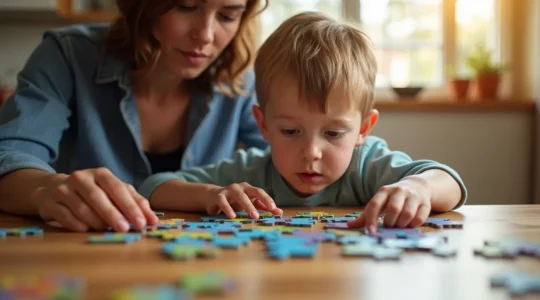
How to Raise a Confident Child Without Creating an Arrogant Ego?
The secret to raising a truly confident child isn’t praise; it’s providing structured opportunities for them to build real-world competence. Authentic confidence is forged by overcoming challenges, not by receiving empty compliments. Focusing on the process (effort, strategy, persistence) builds…
Read more
How to Teach Self-Regulation to an Impulsive Child Without Constant Nagging?
In summary: Effective self-regulation starts with teaching children to recognize internal body signals like hunger and fatigue, not just managing external behavior. Shift your goal from short-term compliance (“Stop that!”) to long-term skill-building (“What is your body telling you right…
Read more
How to Raise an Emotionally Intelligent Child in a Stoic Culture?
Raising an emotionally strong son means upgrading stoicism from emotional suppression to emotional mastery. Dismissing a child’s feelings, even “silly” ones, damages the neural pathways for trust. Teaching boys “not to cry” before age 7 can lead to depression and…
Read more
How to Build a Problem-Solver: The Coach’s Guide for Parents Who Help Too Much
In summary: Effective parenting for problem-solving isn’t about stepping back, but changing your role from a “rescuer” to a “learning environment architect.” Embrace “productive struggle” by allowing your child to face challenges that are difficult but achievable with guidance. Use…
Read more